
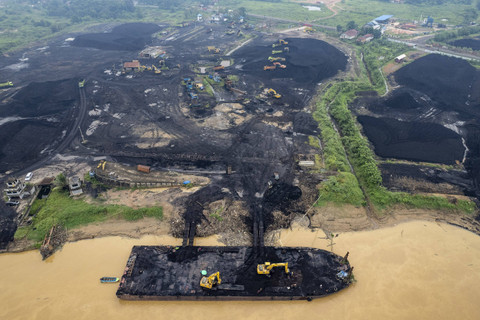

Indonesian coal exports in 2025 recorded a significant decline in both volume and value, signaling a challenging period for the nation’s vital mining sector. Data from the Central Statistics Agency (BPS) reveals that coal export earnings plummeted to just USD 24.48 billion. This represents a substantial 19.70 percent year-on-year (yoy) drop compared to the USD 30.49 billion achieved in the same period the previous year.
According to Ateng Hartono, Deputy for Distribution and Services Statistics at BPS, this notable downturn was primarily driven by the softening of global coal prices throughout 2025. This market dynamic created an unfavorable environment for one of Indonesia’s key commodity exports.
Addressing a press conference at the BPS Building in Jakarta on Monday, February 2, Ateng elaborated on the broad impact of commodity price fluctuations. “Specifically for the prices of coal and also palm oil commodities, there has been a decline, both on a month-to-month and a year-on-year basis,” he stated, highlighting the dual pressure on Indonesia’s export revenue.
Beyond the diminished financial value, the performance of Indonesian coal exports also weakened considerably in terms of volume. Cumulatively, from January to December 2025, coal export volume decreased by 3.66 percent year-on-year, reaching 390.93 million tons. This figure stands notably lower than the 405.76 million tons exported during the corresponding period in the prior year.
This export performance falls significantly short of government projections. The administration had previously set an ambitious target of 650 million tons for coal export volume in 2025, a goal that the year’s actual realization was unable to meet, reflecting the tough market conditions and operational challenges faced by the mining sector.
Production This Year Slashed by up to 70 Percent
Adding to the industry’s woes, the Ministry of Energy and Mineral Resources (ESDM) has drastically cut the 2026 coal production target by up to 70 percent, following an evaluation of the Work Plan and Budget (RKAB) for the year. This drastic decision has sparked considerable apprehension within the Indonesian Coal Mining Association (APBI-ICMA), which now fears potential mass layoffs across the mining sector.
APBI-ICMA argues that such significant production cuts risk pushing companies’ operational scales below economically viable levels. This precarious situation could severely disrupt the sustainability of mining companies’ operations, making it increasingly difficult for businesses to cover fixed operating costs, environmental obligations, crucial safety standards, and essential financial commitments to banks and other lending institutions.
In a press release issued Friday, January 31, APBI-ICMA underscored the severe implications of these production adjustments. “With drastically curtailed production scales, companies face the risk of delays or even the partial or complete cessation of operational activities. The impact could be direct and severe on employment, potentially leading to mass layoffs at mining companies, contractors, and other supporting businesses,” the association warned, painting a grim picture for the industry’s workforce.
Summary
Indonesian coal exports experienced a significant decline in 2025, with earnings dropping by 19.70% to USD 24.48 billion compared to the previous year. The export volume also decreased by 3.66%, reaching 390.93 million tons, which was considerably below the government’s target of 650 million tons. This downturn was primarily attributed to softening global coal prices throughout the year.
Adding to industry concerns, the Ministry of Energy and Mineral Resources drastically cut the 2026 coal production target by up to 70% following an evaluation. The Indonesian Coal Mining Association (APBI-ICMA) fears this significant cut could lead to mass layoffs and push companies’ operational scales below economically viable levels. Such reductions threaten the sustainability of mining operations and their ability to meet essential financial and operational obligations.