
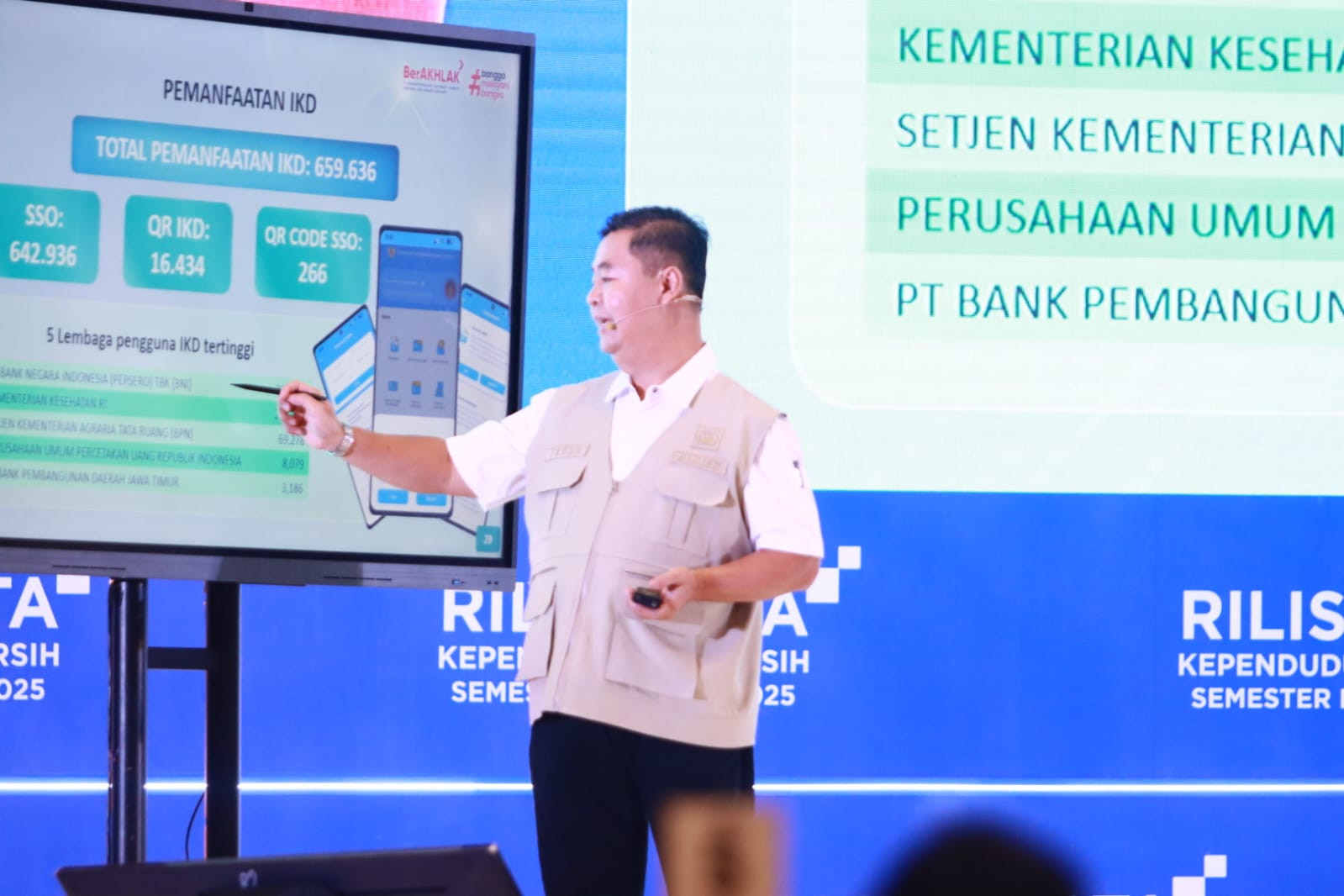
jpnn.com, JAKARTA – The Directorate General of Population and Civil Registration (Dukcapil) at the Ministry of Home Affairs has unveiled the comprehensive population data for Indonesia, reflecting figures for the second half of 2025. Director General Teguh Setyabudi officially released these crucial statistics, providing a detailed snapshot of the nation’s demographics.
According to the newly released data, Indonesia’s total population as of December 31, 2025, reached an impressive 288,315,089 individuals. This significant figure represents a substantial increase of 1,621,396 people compared to the population statistics released for the first half of 2025.
Highlighting this growth, Director General Teguh stated, “Compared to the first semester as of June 30, 2025, Indonesia’s population has expanded by approximately 1.6 million.” He made this announcement during the official release event for the H2 2025 Clean Population Data at Hotel Bidakara on Thursday, March 12.
Further breaking down the national headcount, Teguh detailed the gender distribution: 145,498,082 individuals are male, while 142,816,997 are female. This data provides valuable insights into the country’s demographic balance.
The report also shed light on population distribution across the archipelago, revealing that the majority of Indonesia’s population resides on Java Island, accounting for a dominant 55.81 percent. Sumatra Island secures the second position in terms of population density, with 21.88 percent of the total population.
Regarding religious demographics, Teguh revealed that Islam remains the predominant faith, comprising 87.15 percent of the population. Other religious affiliations include Christianity at 7.37 percent, Catholicism at 3.07 percent, Hinduism at 1.66 percent, Buddhism at 0.69 percent, Confucianism at 0.03 percent, and followers of indigenous beliefs at 0.034 percent.
Additionally, Teguh presented an overview of the population based on marital status for the second half of 2025. The figures indicate that 131 million individuals are unmarried, 137 million are married, 5 million are divorced (living), and 14 million are widowed (divorced by death). Reflecting on these numbers, Teguh noted, “This essentially means that a larger proportion of Indonesia’s population is either currently married or has been married.”
In the same vein, Teguh elaborated on the country’s productive age population, defined as individuals between 15 and 64 years old. This vital segment amounts to 199 million people, constituting 69.03 percent of Indonesia’s total population.
“Observing that 69.03 percent of our population is of productive age, we have much to be grateful for. This signifies what is known as a demographic bonus, which will extend until around 2030,” he explained. “The key now lies in how we optimize this productive age group for national development.”
Teguh underscored that the issuance of these crucial population data releases is mandated by Law Number 24 of 2013, which amends Law Number 23 of 2006 concerning Population Administration. This legislation stipulates that the Ministry of Home Affairs, through the Directorate General of Dukcapil, must release population data twice a year: for the first semester on June 30 and for the second semester on December 31.
Emphasizing the importance of such transparency, Teguh concluded, “Why is it necessary to release this data? Population data serves as the foundational basis for all public needs, whether it be for public services or any other purpose.”
Summary
The Directorate General of Population and Civil Registration (Dukcapil) announced that Indonesia’s population reached 288,315,089 individuals by December 31, 2025. This figure marks an increase of approximately 1.62 million people from the first half of 2025. The data also detailed a gender distribution of 145.5 million males and 142.8 million females, with Java Island housing the majority at 55.81%.
Islam remains the predominant religion, comprising 87.15% of the population. Significantly, 69.03% of the total, or 199 million people, are within the productive age group (15-64 years), indicating a demographic bonus until approximately 2030. This comprehensive population data, mandated by Law Number 24 of 2013, is crucial as a foundational basis for all public services and national development.