
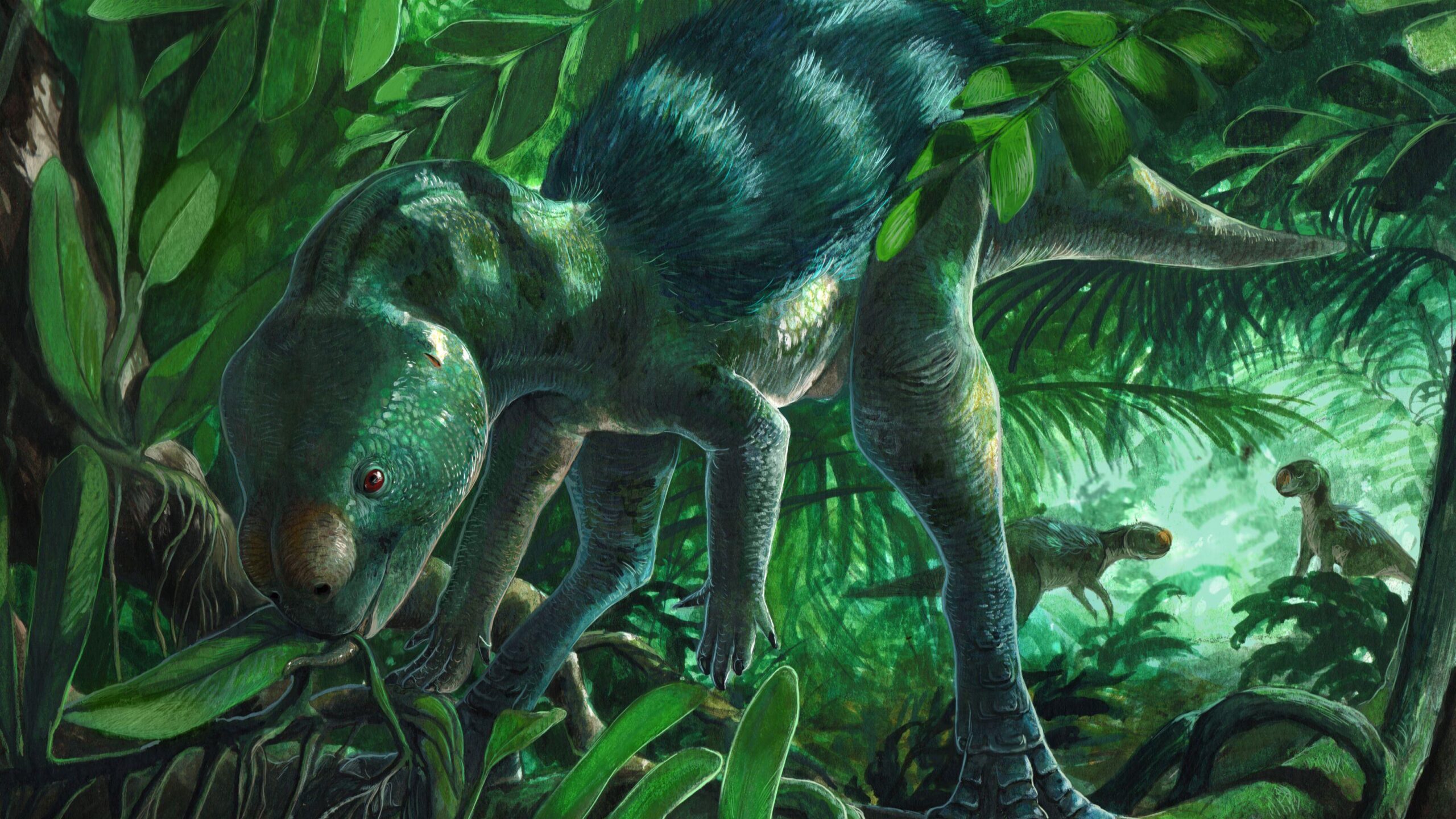

A groundbreaking discovery in Northern Spain has unveiled a chicken-sized dinosaur, identified after years of meticulous research on its fossilized bones.
This newly recognized species has been formally named Foskeia pelendonum, believed to have roamed Earth approximately 125 million years ago. Belonging to the ornithopoda group, a classification of plant-eating dinosaurs, Foskeia challenges previous assumptions with its unexpectedly evolved skull. Paleontologist Penélope Cruzado-Caballero from the Universidad de La Laguna in Spain remarked, “Its anatomy is so strange it’s like rewriting the evolutionary tree.”

The unearthed fossils, which an international team led by paleontologist Paul-Emile Dieudonné from Argentina’s National University of Río Negro has been studying since 2013, represent at least five distinct individuals. Dieudonné shared with the BBC that “the most exciting part of this find is that there is still a lot of fossil material to be found and most of it will come from small-sized dinosaurs.” He emphasized the surprising diversity of small dinosaurs, suggesting that “most of the groups we know likely originated from small-sized dinosaurs that grew larger over time.”
The Elusive Nature of Small Fossils
Despite their evolutionary significance, Dieudonné notes that smaller dinosaur fossils are inherently more fragile and challenging to locate. “Unfortunately, small material is much more easily scattered… small bone sediments are more easily lost,” he added. Paleontologist Koen Stein from Vrije Universiteit Brussel in Belgium, a co-author of the study, confirmed the diminutive stature of this newly identified dinosaur. Standing approximately 25 to 30cm tall, it truly was about the size of a chicken. Stein told the BBC, based on current findings, “I think we can safely say that this [dinosaur] is probably among the smallest, if not the smallest, on the European continent,” even speculating its potential as the smallest dinosaur globally.

Initially, the small size of the fossils might suggest the dinosaurs were juveniles. However, further research revealed otherwise, with Stein clarifying that at least one of the specimens was an adult dinosaur. He also posited that while young, these dinosaurs might have walked on all fours, transitioning to bipedal locomotion as they matured. Foskeia stands as the oldest known rhabdodontomorph—a specific subgroup within the ornithopoda family. Dieudonné explained that rhabdodontomorphs “may have been very small from the beginning,” a trait that would have strategically allowed them to “avoid predators.” He noted, “Small size is not suitable for running long distances, but rather for finding quick hiding places.”
Decades in the Making: The Discovery Journey
The journey to identify Foskeia spans decades, with the majority of the fossils first unearthed in 1998, and additional fragments discovered in subsequent years from the same site. Fidel Torcida Fernández-Baldor, one of the study’s authors from the Museum of Dinosaurs in Salas de los Infantes in Northern Spain, was the initial discoverer of the site and collected most of the fossilized remains. “From the beginning, we knew these bones were extraordinary because of their very small size,” said Torcida Fernández-Baldor.

Researchers underscore the profound importance of Foskeia‘s discovery—whose name, ‘Fos,’ derives from the ancient Greek word for light—for unraveling the evolutionary path of ornithopod dinosaurs. Paleontologist Marcos Becerra from Argentina’s Universidad Nacional de Córdoba wisely stated, “Miniaturization does not mean evolutionary simplicity.” Foskeia also boasts a distinctive dental arrangement, featuring forward-pointing front teeth that Dieudonné described as being “like a giant trident in the middle.” Adding to its unique attributes, Stein highlighted its “rather strange” teeth and “interesting skull morphology,” proclaiming it “another example of the experiments that evolution has performed.”

The Crucial Skull Discovery
Earlier research published in 2016 had tentatively linked these fossils to a Vegagete ornithopod dinosaur. However, a formal identification remained elusive due to insufficient information. The recent breakthrough came with the identification of skull fragments, enabling the formal identification and naming of this Vegagete ornithopod as Foskeia pelendonum. Dieudonné eloquently explained, “In living things, generally, the part of the body that gives us the most information is the skull. It tells us about chewing processes, vision, about body balance.” He elaborated on how the head’s shape readily adapts to an animal’s environmental needs, asserting that “these skull bones, however small and fragmented, give us a lot of information about how the animal lived.” Concluding on the broader scientific imperative, Dieudonné stressed, “It is important to document these things to know how they grew, how they lived, how they died, and how they evolved to understand how life in the past continued to change in a changing environment.”
- Fossils of dinosaurs that died in asteroid attack 66 million years ago found
- The story of a photographer capturing ‘living fossils’ that survived the dinosaur extinction era
- Dinosaur fossil the length of a ‘basketball court’ found in Australia
- World’s oldest cave painting found in Sulawesi: 67,800-year-old ‘claw-like’ handprints
- 140,000-year-old ancient human fossils found in Madura Strait – ‘First’ evidence of life from a sunken continent
- World’s oldest animal painting found in South Sulawesi