
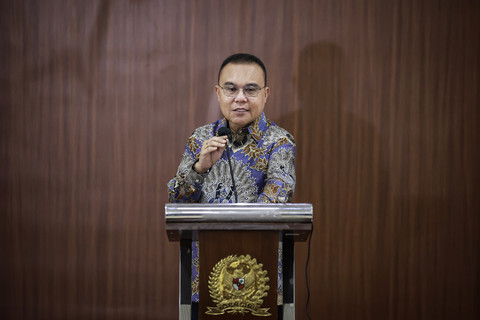

Deputy Speaker of the House of Representatives (DPR) Sufmi Dasco Ahmad has asserted that the proposed increase in the retirement age for Indonesian National Police (Polri) members, as outlined in the draft Polri Law (RUU Polri), aims to achieve equality in service tenure among various law enforcement officials.
Dasco highlighted that the current Polri retirement age significantly trails behind other law enforcement institutions. He pointed out that the Prosecutor’s Office, for instance, operates with a higher retirement age limit. “If we look at the equality among fellow law enforcement officials and with the TNI (Indonesian Military), we see the Prosecutor’s Office retires at 61, or 62 for functional roles. The TNI’s retirement age has also been extended. Naturally, this should also apply to the Police,” Dasco stated on Tuesday (May 26, 2025) at the DPR RI Parliament Complex in Senayan, Jakarta. He further added, “And friends also believe that proposing an increase in the retirement age is justifiable, ensuring there are no such disparities in retirement age.”
Addressing potential misconceptions, Dasco firmly refuted claims that the RUU Polri was deliberately crafted to prolong the term of the current National Police Chief, General Listyo Sigit Prabowo. He emphasized that the revision of the Polri Law has, in fact, been a long-standing plan. “Actually, this revision should have been carried out much earlier. It is only due to various circumstances that it is being implemented now. I firmly believe that specific ulterior motives are not at play,” he asserted, dismissing any suggestions of strategic timing for personal gain.
This push for reform follows earlier actions by DPR Commission III, which has introduced several modifications within the revision of the Polri Law. A key aspect of these changes involves adjusting the retirement age for Polri members to align with the evolving needs of the organization, ensuring operational effectiveness and career progression.
The Chairman of DPR RI Commission III, Habiburokhman, further elaborated on the foundational goals of the RUU Polri. He explained that the draft law is designed to complement the regulatory frameworks of the new Criminal Code (KUHP) and Criminal Procedure Code (KUHAP), while also actively pursuing recommendations for Polri reform. “This RUU concerning Polri encompasses several changes, specifically eight points of change, 11 articles, and their accompanying explanations,” Habiburokhman detailed during a working meeting with Law Minister Supratman Andi Agtas at the DPR on Monday (May 25).
Habiburokhman concluded by providing assurance that the provisions within the RUU Polri will strictly adhere to constitutional principles. He affirmed that the legislation would not deviate from the 1945 Constitution or MPR Decrees Number VI and VII of 2000, underscoring the commitment to a legally sound and constitutionally compliant reform.
Summary
Deputy Speaker Sufmi Dasco Ahmad stated that the proposed increase in the Indonesian National Police’s (Polri) retirement age aims to achieve equality in service tenure with other law enforcement officials. He highlighted that Polri’s current retirement age lags behind institutions like the Prosecutor’s Office (61-62) and the extended retirement age of the TNI. This adjustment seeks to eliminate disparities in service tenure among these bodies.
Dasco firmly denied that the RUU Polri was crafted to prolong the current Police Chief’s term, emphasizing it has been a long-planned revision. Chairman of DPR RI Commission III, Habiburokhman, further explained that the draft law complements new legal frameworks and pursues comprehensive Polri reform. He assured that the RUU Polri, which includes eight points of change, strictly adheres to constitutional principles.
