
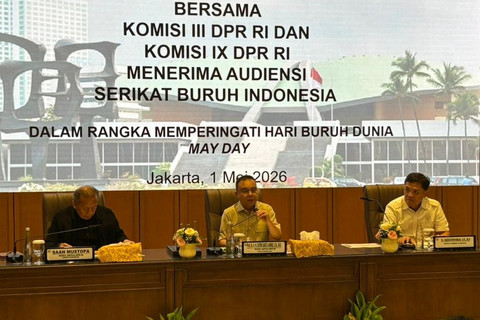

President Prabowo Subianto has officially announced the signing of Presidential Decree (Keppres) Number 10 Year 2026, establishing the Task Force for Mitigating Layoffs (PHK) and Worker Welfare. This significant move aims to directly address pressing labor challenges across Indonesia.
Deputy Speaker of the House of Representatives, Sufmi Dasco Ahmad, expressed optimism that the formation of this dedicated task force will significantly accelerate the resolution of various worker-related issues. These include critical areas such as the wage system and the pervasive practice of outsourcing.
“The government, in collaboration with labor unions, has launched the Task Force for Mitigating Layoffs and Worker Welfare to tackle issues like worker wages, the outsourcing system, and matters concerning potential layoffs. This initiative is designed to provide a direct channel for addressing these concerns, thereby streamlining what was previously a lengthy process,” Dasco elaborated during an audience with labor unions at the Parliament Building in Jakarta on Friday (1/5).
Engaging Workers and Proactive Layoff Mitigation
Dasco further emphasized the task force’s inclusive approach, noting that it integrates worker representatives directly into its operations. This participation is expected to enhance information flow and expedite the handling of on-the-ground cases, ensuring a more responsive and effective intervention mechanism.
He also confirmed that the task force has already begun addressing several potential layoff scenarios reported by various companies. These anticipatory measures are crucial in safeguarding employment stability.
“Information has already been conveyed to the government by worker representatives regarding several companies planning layoffs within the next two to three months. These cases have promptly been channeled to the Task Force for Mitigating Layoffs and Worker Welfare for immediate anticipation and resolution,” Dasco stated, underscoring the task force’s proactive stance.
The government, he added, stands ready to assist companies facing financial difficulties, aiming to prevent these challenges from adversely impacting their workforce. “The President has also conveyed that if companies encounter difficulties, the government will provide assistance, or even take over operations if they become unviable, to ensure that workers retain their employment,” Dasco affirmed, highlighting a strong commitment to job preservation.
 Workers Highlight Wage Disparity
Meanwhile, Sunarno, Chairman of the Confederation of the Indonesian Labor Alliance Congress (KASBI), brought attention to the significant regional disparities in Indonesia’s wage system. This issue remains a core concern for labor advocacy groups.
“We are also focusing on the wage system in Indonesia. We urge the government and the House of Representatives to synergize and synchronize their efforts in addressing the stark disparity in worker wages across different regions of Indonesia. The gap between minimum wages in one area compared to another is quite substantial,” Sunarno explained.
He provided concrete examples: “For instance, the lowest regional minimum wage (UMK) can be around 2.3 million rupiah in parts of Central Java, West Java, and East Java, starkly contrasting with 5.9 million or even 6 million rupiah in other regions. The difference is considerable. Therefore, the government or the state should devise a concept or implement a reform of the national wage system, moving towards a national living wage.”
Addressing Outsourcing and Precarious Employment
Furthermore, Sunarno critically highlighted the rampant practice of outsourcing and the increasing prevalence of labor flexibility. These trends, he argued, significantly erode worker protection and security.
“Another major concern for us, and I am confident it is shared by all labor unions, relates to labor market flexibility, particularly the widespread systems of outsourcing, contract work, apprenticeships, and even daily casual labor. In practice, these arrangements often prove to be far worse than what is stipulated by existing labor laws,” he asserted.
Sunarno noted a disturbing trend: the number of non-permanent workers continues to rise, leading to widespread violations of worker rights. “Out of an estimated 153 million workers in the labor force, roughly 62 million are formal workers. However, research indicates that 40% of these are already non-permanent workers. This signifies an increasingly massive informalization of our employment system,” he stated, illustrating the scale of the challenge.
He concluded that this alarming condition results in many workers being denied fundamental rights, including fair wages and essential social security benefits.
 Vulnerability to Unilateral Dismissal
Sunarno also underscored the heightened vulnerability of non-permanent workers to unilateral dismissals. This risk is particularly acute when they attempt to voice their concerns or form labor unions.
“When workers whose employment status is not permanent try to express their aspirations or even establish a labor union, employers often resort to suppression or even unilateral termination of employment. This remains a significant concern for us, and we are pushing for concrete measures to ensure job security in the future,” he concluded, emphasizing the urgent need for robust protections for all workers.
Summary
President Prabowo Subianto has announced the formation of
