
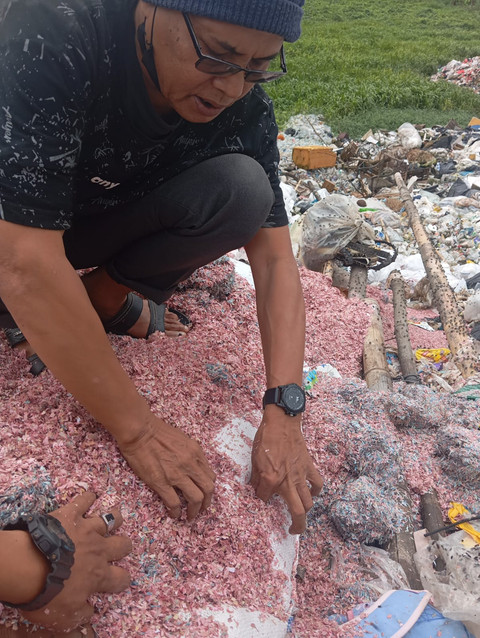

An astonishing discovery has come to light in Bekasi Regency: sacks brimming with shredded Indonesian banknotes, specifically Rp 50,000 and Rp 100,000 denominations, have been unearthed at an illicit landfill in Kampung Serang, Taman Rahayu Village, Setu District. This alarming find, described as ‘waste’ by authorities, has sparked immediate concern regarding proper waste disposal practices and the handling of decommissioned currency.
According to Bagong Suyoto, Chairman of the National Waste Coalition (KPNas), the substantial discovery of this unique waste occurred last week. Confirming the reports, Suyoto stated on Wednesday, February 4, 2026, “Yes, that’s right, there are many sacks, all contained within white bags.” He elaborated that the shredded material consisted of genuine Rp 50,000 and Rp 100,000 banknotes. “The small shredded pieces of paper money were scattered,” he noted, “featuring red Rp 100,000 denominations and blue Rp 50,000 denominations.”

During his on-site review, Suyoto also suspected the presence of other hazardous materials near the piles of shredded currency, including domestic industrial waste, often referred to as sludge, and even medical waste. Emphasizing the gravity of the situation, he urged relevant authorities to conduct thorough laboratory checks to ascertain the exact contents and, crucially, to identify the individuals responsible for this illegal dumping. Suyoto firmly asserted, “The shredded money is genuine. It should have been incinerated after shredding, not carelessly discarded, especially in an illegal landfill. This constitutes a violation of the law.”
 Environmental Agency Intervenes
Meanwhile, Dedi Kurniawan, Spokesperson for the Bekasi Regency Environmental Agency (DLH), officially corroborated the sensational discovery. “Yes, the shredded money (waste) is genuine,” Dedi informed reporters, echoing Suyoto’s assessment.
The Bekasi Regency DLH, in collaboration with the Directorate General of Waste, Hazardous, and Toxic Material Management (Ditjen PSLB3) under the Ministry of Environment (KLH), Gakkum (Law Enforcement), and the local neighborhood head (RT), promptly conducted a joint inspection of the site. Their investigation revealed that the illegal landfill is located on land owned by H. Santo in Taman Rahayu Village, Setu District. Notably, Dedi clarified certain aspects of the findings, stating that while yellow plastic bags typically used for medical waste were discovered, no actual medical waste or sludge was present within them or elsewhere on the site during their inspection. He detailed, “During the inspection, no medical waste or sludge was found. However, red shredded money and yellow plastic bags (commonly used for storing medical waste) were present, but no medical waste was found inside them.”
Currently, the DLH, working closely with the Ministry of Environment (KLH), is actively coordinating efforts to meticulously trace the source of the discarded shredded banknotes. Dedi affirmed that “KLH will coordinate with the landowner and the local RT head to gather further information regarding the waste’s origin, as well as the parties involved in its transport and generation.” This comprehensive investigation aims to uncover the full extent of this unusual waste scandal and ensure accountability for the improper disposal of official currency, reinforcing adherence to proper waste management and environmental regulations.