
News Summary:
- Iran has pledged retaliation for attacks attributed to the United States (US) and Israel.
- Kuwait, Qatar, the United Arab Emirates (UAE), and Jordan, all hosting a US military presence, reported intercepting Iranian missiles.
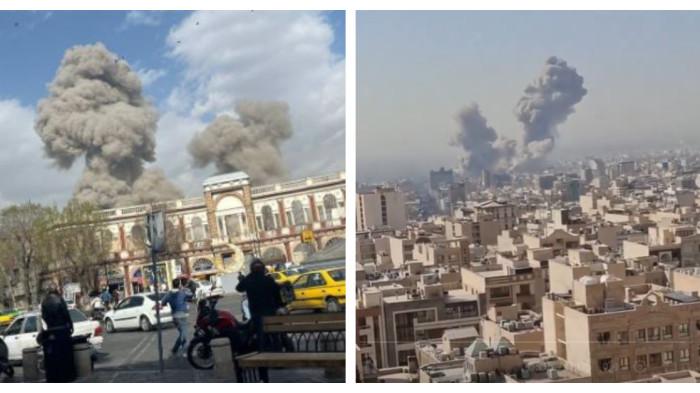
- Videos documenting Iran’s retaliatory strikes across the Middle East have begun to emerge.
Several Arab Gulf states reported on Saturday, February 28, 2026, that they had been targeted by Iranian missiles, signaling a significant escalation in regional hostilities. This development followed Iran’s pledge of retaliation against attacks attributed to the United States (US) and Israel, escalating the conflict into a part of the Arab world that has historically prided itself on relative stability and security.
State media in the United Arab Emirates confirmed one fatality in Abu Dhabi, though further details regarding the incident remained undisclosed. Kuwait, Qatar, the United Arab Emirates (UAE), and Jordan, all nations with a significant US military presence, announced successful interceptions of Iranian missiles.
The Iranian Revolutionary Guard Corps (IRGC) declared on Saturday, as reported by Arab News, that “all occupied territories and malicious US bases in the region have been struck by devastating Iranian missile attacks.” They further asserted, “These operations will continue relentlessly until the enemy is decisively defeated.”
Iran’s Retaliatory Strikes
Footage documenting Iran’s retaliatory missile strikes across the Middle East rapidly began to circulate, confirming the widespread nature of the assaults. Given the numerous US airbases scattered throughout the region, these military installations were widely presumed to be primary targets.
Among the Gulf nations impacted, Bahrain was notably affected, as reported by the BBC. A verified video clip, filmed from a moving vehicle, captured the precise moment a missile struck. The impact was immediately followed by an explosion, sending debris and shrapnel scattering into the air. Occupants within the vehicle could be heard exclaiming “Oh my God” as it sped away along the road.
Bahrain’s National Communication Centre confirmed that the US Navy’s Fifth Fleet service centre had “been targeted by missile attacks.” This critical service centre oversees operations across the Persian Gulf, Red Sea, Arabian Sea, and parts of the Indian Ocean, underscoring the strategic significance of the target. Further verified footage from Bahrain depicted thick plumes of black smoke rising into the sky as sirens wailed throughout the city.
Tasnim news agency, affiliated with the Islamic Revolutionary Guard Corps (IRGC), reiterated the claim that “all US bases and interests in the region have been targeted by Iranian missiles.”
Red Cross Chief’s Response
On Saturday, the head of the International Committee of the Red Cross (ICRC) issued a stark warning that the military escalation in the Middle East was triggering a dangerous chain reaction across the entire region. ICRC President Mirjana Spoljaric implored nations to uphold the rules of war and urged them to find the political will necessary to prevent “further death and destruction.”
In a statement cited by Al Arabiya, Spoljaric warned, “The military escalation in the Middle East is triggering a dangerous chain reaction across the entire region, with potentially devastating consequences for civilians.” She further elaborated, “Upholding the rules of war is an obligation, not a choice. In international armed conflicts, international humanitarian law, particularly the four Geneva Conventions, applies.”
The Geneva-based ICRC serves as the custodian of International Humanitarian Law (IHL), a body of rules designed to limit the impact of armed conflict. The ICRC safeguards individuals who are not, or are no longer, participating in hostilities, and restricts the means and methods of warfare. Spoljaric stressed, “Civilian infrastructure such as hospitals, homes, and schools must be protected from attack. Medical personnel and emergency response teams must be allowed to carry out their duties safely.”
She affirmed that the ICRC maintains teams on the ground in Iran, Israel, and throughout the broader region, ready to address needs within its mandate and in areas where it can operate effectively. However, she cautioned, “Humanitarian aid cannot keep pace with the rate or scale of suffering caused by ongoing conflict; political will is essential to achieve peace and prevent further death and destruction.”
US and Israel Attack Iran

On Saturday morning, February 28, 2026, Israel launched a preliminary strike against Iran, followed by a United States (US) attack that plunged the Middle East into a new military confrontation. This dual assault further diminished hopes for a diplomatic resolution to Tehran’s ongoing nuclear dispute with Western powers.
Explosions were reported in Tehran and across several other cities throughout Iran, confirming the widespread nature of the strikes. Reuters reported, citing a US official, that the American military operation was anticipated to continue for several days. The Israeli military responded by announcing the closure of schools and workplaces, with the exception of essential sectors, and imposed a ban on public airspace usage.
Israel subsequently closed its airspace to civilian flights, and airport authorities advised the public to avoid all airports nationwide. Following the initiation of the attacks, Iran mirrored these precautions by closing its airspace until further notice. Neighboring Iraq and the Gulf state of Kuwait also implemented airspace closures.
Several airlines reported flight cancellations or significant rescheduling of journeys as a direct consequence of the attacks. A spokesperson for Flydubai confirmed that some of their flights were affected by the airspace closures.
Ironically, the United States and Iran had resumed negotiations in February 2026, aiming to resolve their decades-long disputes through diplomacy and avert the very threat of military confrontation that could destabilize the region. However, Israel had consistently insisted that any US agreement with Iran must entail the dismantling of Tehran’s nuclear infrastructure, not merely a halt to enrichment processes. Furthermore, Israel had actively lobbied Washington to include restrictions on Iran’s missile program in the ongoing talks. Conversely, Iran maintained its readiness to discuss limitations on its nuclear program in exchange for sanctions relief but firmly refused to link the issue with its missile development.
(Source: Tribunnews.com/Nuryanti)
Related News: Iran vs. America Tensions Rise
Summary
Iran launched retaliatory missile attacks against Arab Gulf states hosting