

Former U.S. President Donald Trump has reignited discussions about acquiring Greenland, the world’s largest island, from Denmark. This ambition to purchase Greenland aligns with his stated vision for America, as articulated during his hypothetical January 2025 presidential inauguration. Trump declared that under his leadership, the United States would once again be “a nation that grows, a nation that increases its wealth, and a nation that expands its territory,” promising his administration would “wave the U.S. flag to new horizons.”
Trump’s aspirations, particularly regarding the incorporation of Greenland into the U.S., resonate deeply with a long-standing pattern in American history. As Walter McDougall, a historian at the University of Pennsylvania, notes, “Trump’s policy reminds us of the promised land tradition of the Monroe Doctrine.” This pivotal doctrine, established in 1823, has historically served as a foundational justification for U.S. intervention and territorial expansion. Jay Sexton, a historian at the University of Missouri, further explains the rationale: “Like Greenland, the U.S. argued that they needed to seize those territories before they fell into the hands of other powers.”
The territorial expansion that transformed the U.S. into the sprawling nation it is today commenced just years after its founding in 1776. Historically, nation-states seeking to expand their dominions commonly resorted to warfare—conquering and subjugating indigenous populations, displacing settlers, or signing treaties with European powers. However, the United States also developed another distinct strategy: the outright purchase of territory from sovereign nations, a method now echoed in Trump’s proposition for Greenland.
This article delves into several key historical instances where the United States strategically acquired vast territories through purchase. On some occasions, the U.S. agreed to pay foreign powers as a form of compensation for the acquisition of land, a notable example being the 1819 treaty with Spain for Florida.
 The Louisiana Purchase (1803)
The decision by then-U.S. President Thomas Jefferson to purchase the Louisiana Territory from Napoleonic France marked the nascent nation’s first substantial expansion. Napoleon Bonaparte, having abandoned his ambitions for a French empire in the Americas—partially due to the costly Haitian slave rebellion—was receptive to the idea. He recognized the vast, sparsely populated Louisiana territory as an asset he could liquidate to finance his ongoing wars in Europe, aimed at expanding his empire on the continent.
For the young American Republic, this acquisition was deemed vital for its future. President Jefferson sought to secure American control over the strategic Mississippi River Valley and the crucial port of New Orleans, thereby eliminating the persistent threat of French intervention in the region. In November 1803, the Louisiana Purchase was finalized, with the U.S. paying France US$15 million (equivalent to approximately IDR 251 billion at current exchange rates). This monumental acquisition added over two million square kilometers to the United States, dramatically altering its geographical scope.
 The Mexican Cession (1848)
By the 1840s, a pervasive belief in “Manifest Destiny” had captivated a majority of the U.S. populace, fueling an inexorable drive for westward expansion to the Pacific Coast. This ambitious project ultimately unfolded at Mexico’s significant expense.
President James Knox Polk emerged as a staunch proponent of this expansionist agenda. His administration, which began in 1845, inherited a simmering dispute with Mexico over the territory of Texas. Following border clashes between U.S. and Mexican forces the subsequent year, Polk sought a declaration of war from Congress. However, the true origins of the conflict were far more profound than mere border skirmishes.
As historian Jay Sexton reveals, “The U.S. had shown interest in California, which at the time belonged to Mexico and was one of the most economically dynamic regions in the Americas. It had deep-water ports, which were highly desirable at the time to facilitate trade with Asia.” Mexico, however, “never agreed to sell California and claimed to remain in power over that territory.”

The ensuing war concluded with a decisive U.S. victory, culminating in the signing of the Treaty of Guadalupe-Hidalgo in February 1848. Under this treaty, the U.S. gained immense territories, including Texas, California, New Mexico, Arizona, Nevada, Utah, and portions of Colorado, Wyoming, Kansas, and Oklahoma. While the U.S. paid Mexico US$15 million (approximately IDR 251 billion), Sexton emphatically states that “the Mexicans would never have agreed to cede the territory had they not lost the war.” He aptly describes it as “a sale under duress.” The war resulted in Mexico losing more than half its territory, an immense loss that left a lasting national trauma.
The Gadsden Purchase (1853)
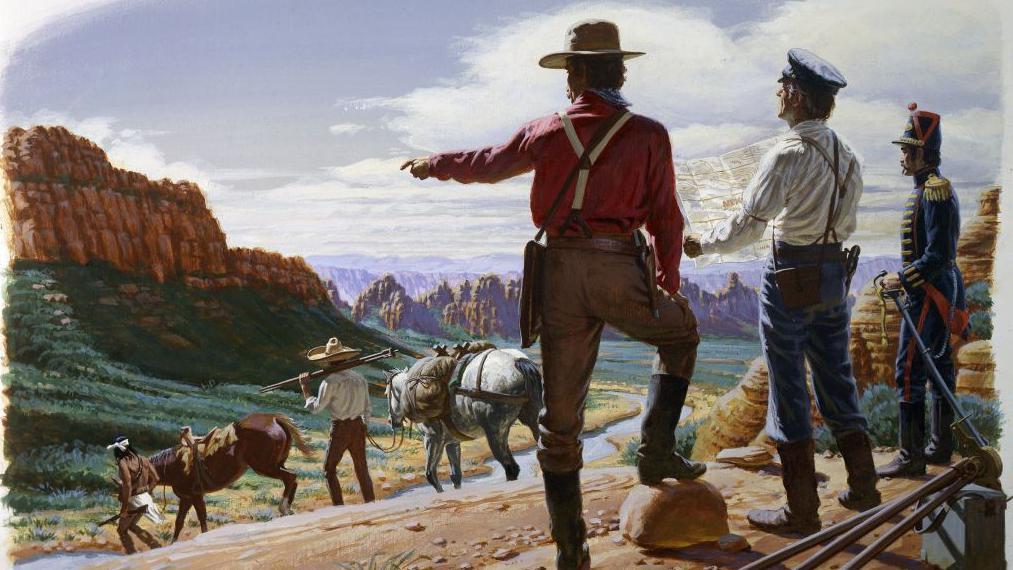
Just a few years later, in 1853, Mexico and the U.S. negotiated the sale of a smaller tract of Mexican territory, now encompassing parts of southern Arizona and New Mexico. This agreement, known as the Venta de la Mesilla in Mexico and the Gadsden Purchase in the U.S., was driven by two primary factors: the U.S. interest in constructing a transcontinental railroad and the Mexican government’s ongoing economic difficulties.
Mexico ultimately accepted US$10 million (approximately IDR 120 billion at current exchange rates) for the land. According to Sexton, slave owners in the Southern U.S. were particularly keen on a Pacific-bound railroad route. They feared that a northern route through the Rocky Mountains would primarily benefit abolitionist states, and thus vigorously advocated for a southern route extending to New Orleans, making the acquisition of this land crucial.
 The Alaska Purchase (1867)
In 1867, many Americans struggled to comprehend the resolute determination of then-U.S. Secretary of State William Seward to purchase Alaska, a vast Arctic territory, from Tsar Alexander II’s Russian government. Seward, however, foresaw immense strategic value in the acquisition. He believed Alaska could serve as a crucial buffer against potential British intervention in North America and grant the U.S. access to lucrative Pacific fisheries. With this vision, he brokered a deal with Russia to buy Alaska for US$7.2 million.
This acquisition sparked considerable controversy at the time, with newspapers deriding it as “Seward’s Folly.” For the Tsarist regime, Alaska was perceived as a “low-value” territory, proving prohibitively expensive to administer and highly vulnerable to attack by Great Britain, their primary rival. Despite the widespread public criticism, the U.S. Congress ultimately ratified the purchase treaty, officially integrating Alaska into the United States.
Decades later, the discovery of substantial gold and oil reserves, alongside its critical military role during the Cold War, unequivocally vindicated Seward’s prescient decision to acquire Alaska.
 The Purchase of the U.S. Virgin Islands from Denmark (1917)
The acquisition of the U.S. Virgin Islands marked the final instance of the U.S. purchasing territory, ironically from Denmark—the same nation currently reluctant to sell Greenland. The islands in question were then known as the Danish West Indies, a Caribbean archipelago that had long captivated the attention of U.S. strategists since the mid-19th century. William Seward himself had attempted to purchase them but failed before leaving his secretarial post. Danish historian Hans Christian Berg notes that following the U.S. Civil War, America began to reassess its strategic position in the Caribbean, though Seward’s primary focus was initially on the annexation of Mexico.

The port of Saint Thomas, in particular, was a significant draw for U.S. strategic planners due to its exceptional natural protection offered by the Virgin Islands’ topography. Denmark had historically exploited these islands through slave-based sugar plantations, but declining sugar prices eventually diminished Denmark’s interest in maintaining the territories. An initial purchase agreement between the two governments in 1867 ultimately failed to materialize, as it was not ratified by the U.S. Congress.

The outbreak of World War I and the ominous threat posed by German U-boats rekindled intense U.S. interest in the Virgin Islands. There was palpable concern that Germany might attack Denmark and seize the crucial port of Saint Thomas. Astrid Andersen of the Danish Institute for International Studies highlights the striking parallel with contemporary discussions about Greenland: “There are echoes of what we are hearing now with Greenland, because essentially what the United States said was, ‘You sell it to us or we will invade it.'”
Ultimately, in the early 20th century, Denmark and the U.S. agreed upon the sale of the islands for US$25 million (approximately IDR 418 billion at current exchange rates). As part of this comprehensive agreement, the U.S. pledged not to oppose Denmark’s “expansion of its political and economic interests throughout Greenland.”