
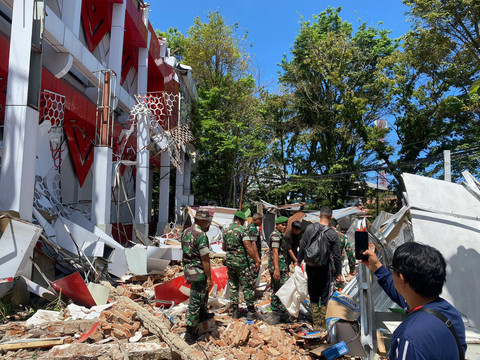

Daryono, a prominent seismologist and tsunami expert, as well as the former Head of the Earthquake and Tsunami Center at BMKG (Indonesia’s Meteorology, Climatology, and Geophysics Agency), has shed light on the characteristics of the magnitude 7.6 earthquake that struck North Sulawesi and North Maluku on Thursday, April 2nd. He explained that the seismic event in the Maluku Sea is intricately linked to the region’s complex tectonic dynamics.
“Earthquakes with a thrust fault mechanism in the Maluku Sea are a direct consequence of the complex tectonic dynamics within this region’s unique double subduction system,” Daryono told reporters on Friday, April 3rd.
He elaborated that the Maluku Sea is situated between two active and opposing subduction systems. This geological configuration generates intense compressional stress within the Earth’s crust, making the area particularly prone to significant seismic activity.
“The Maluku Sea is flanked by two active subduction arcs: the Maluku Sea Plate is subducting westward beneath the Sangihe Arc and eastward beneath the Halmahera Arc. This specific condition leads to an extremely intense accumulation of compressional stress in the Earth’s crust,” he detailed.
According to Daryono, the thrust fault mechanism arises from horizontal compressional forces that compel one block of rock to move upwards relative to another. This phenomenon is a common occurrence in the region, reflecting the ongoing geological pressures.
He further clarified, “Within the framework of rock mechanics and plate tectonics, a thrust fault mechanism results from horizontal compressional forces that push one rock block to move upwards relative to another. In the Maluku Sea, the sources of these thrust earthquakes are typically associated with interplate contact zones, often referred to as megathrusts, or internal deformation within the subducting slab.” This intricate interplay of geological forces underscores the region’s seismic vulnerability.
Daryono emphasized that these geological characteristics imbue earthquakes in the Maluku Sea region with significant hazard potential, including the critical possibility of triggering tsunamis. This makes understanding these events paramount for public safety.
“From a disaster perspective, thrust earthquakes in the Maluku Sea hold high significance because they possess the potential to cause vertical deformation of the seafloor. This can, in turn, trigger tsunamis, especially if they occur at shallow depths and involve substantial displacement along the fault plane,” he warned.
He concluded by stressing that a comprehensive understanding of these earthquake mechanisms is crucial for effective disaster mitigation efforts across Eastern Indonesia, a region highly susceptible to such powerful natural phenomena.
Summary
Daryono, a prominent seismologist, explained that the magnitude 7.6 earthquake in North Sulawesi and North Maluku resulted from complex tectonic dynamics in the Maluku Sea. This region exhibits a unique double subduction system, where the Maluku Sea Plate subducts both westward beneath the Sangihe Arc and eastward beneath the Halmahera Arc. This intricate geological configuration generates intense compressional stress, leading to a thrust fault mechanism.
A thrust fault mechanism involves horizontal compressional forces causing one rock block to move upwards relative to another. Earthquakes with this mechanism in the Maluku Sea hold high significance due to their potential to cause vertical deformation of the seafloor. This can, in turn, trigger tsunamis, especially if they occur at shallow depths, making a comprehensive understanding crucial for effective disaster mitigation in Eastern Indonesia.