

Warning: This article contains details that some readers may find disturbing.
As a new day dawns, hundreds of men already crowd the dusty square in Chaghcharan, the capital of Afghanistan’s Ghor Province.
Lining the roadside, they wait in desperation, hoping for any kind of work to put food on their families’ tables for the day. For most, however, the chance of success is agonizingly slim.
Juma Khan, a 45-year-old father, has only managed to secure three days of work in the last six weeks. His meager earnings, between 150 and 200 Afghanis (approximately US$2-US$3) per day, are barely enough to sustain his household. “For three nights, my children have gone to bed hungry. My wife cries constantly, and so do my children,” he recounts, his voice heavy with despair. “I had to beg my neighbor to lend me money for flour. I live in fear that my children will starve to death.”
Juma Khan’s harrowing ordeal is not an isolated incident in Afghanistan. The country is grappling with an unprecedented humanitarian crisis, where three-quarters of the population cannot meet their basic needs, according to data from the United Nations. The UN’s grim assessment paints a picture of widespread unemployment, a crippled healthcare system, and a humanitarian aid pipeline that has been almost entirely severed.
Afghanistan is currently experiencing its highest levels of hunger ever recorded, with 4.7 million people – more than a tenth of the population – estimated to be just one step away from mass starvation. Ghor province stands out as one of the most severely affected regions.
Hope has all but evaporated for many of the men here. “I received a call telling me my children haven’t eaten for two days,” Rabani explains, his voice faltering. “I felt like killing myself. But then I thought, how would that help my family? So, I’m here, looking for work.” Nearby, Khwaja Ahmad’s tears begin to flow after only a few words. “We are starving. My elder children have already died, so I have to work to feed the rest of my family. But I am old, so no one wants to give me a job,” he laments.

A local bakery near the square opens its doors, and the owner begins distributing dry bread remnants to the waiting crowd. Within seconds, the bread is snatched up by men desperate for a morsel. Suddenly, another commotion erupts: a motorcyclist arrives, seeking a laborer to transport bricks. Dozens of men instantly swarm him, clamoring to offer their services. Over the two hours the BBC team spent observing the scene, only three individuals managed to secure work.

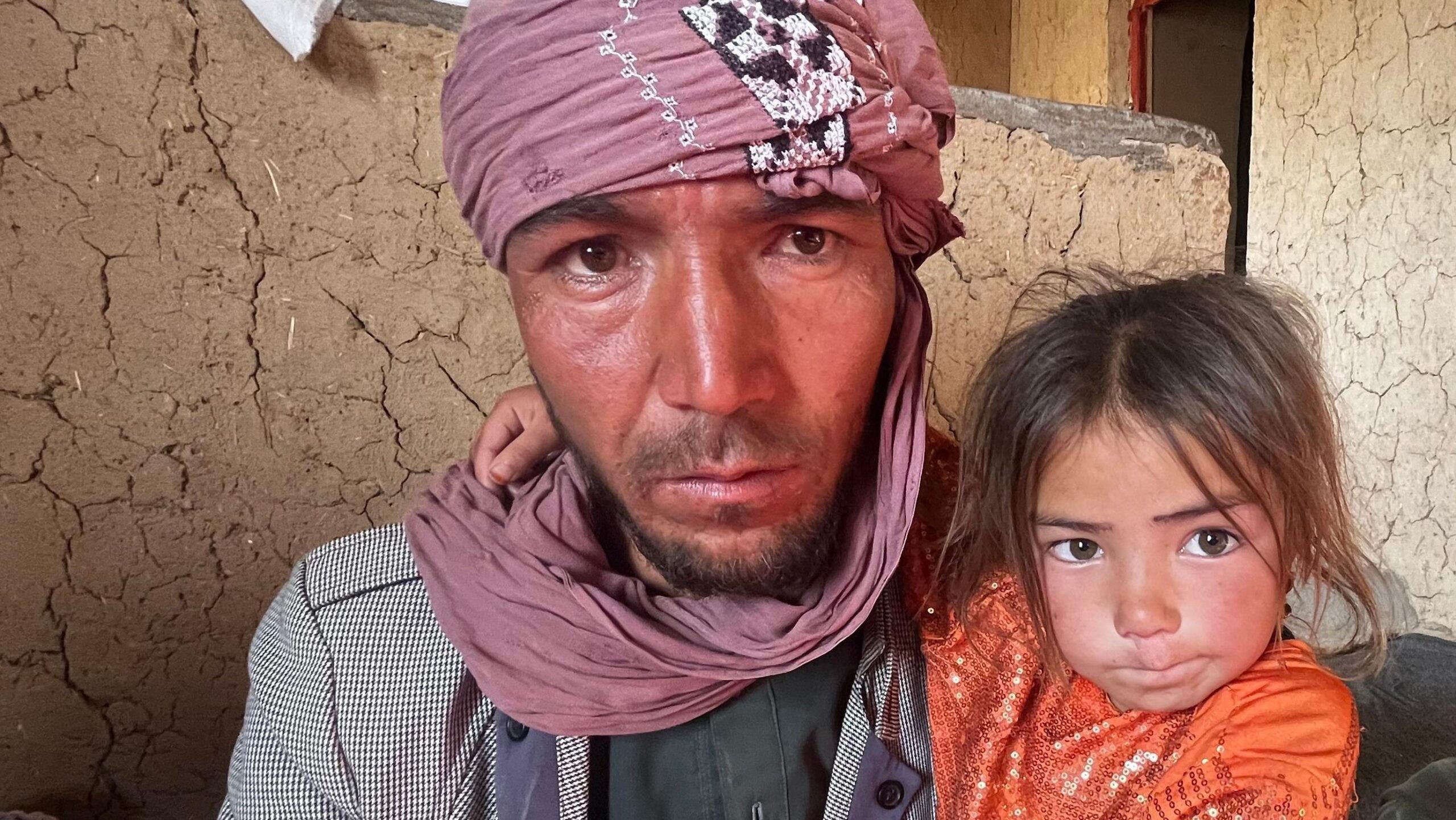
The horrific impact of this rampant unemployment is starkly visible in the surrounding settlements – dilapidated homes scattered across arid, brownish hills, set against the snowy peaks of the Siah Koh mountains. Abdul Rashid Azimi invites us into his home, bringing out his seven-year-old twin daughters, Roqia and Rohila. He cradles them tightly, struggling to maintain composure as he recounts the heartbreaking decision he feels forced to make. “I am willing to sell my daughters,” he says, weeping.
“I am poor, burdened by debt, and helpless. I come home from work with dry lips, hungry, thirsty, stressed, and confused. My children come to me saying, ‘Baba, give us bread.’ But what can I give them? Where is the work?” Abdul confesses he is preparing to give his daughters away for marriage or as household help. “If I sell one child, the money could feed my other children for at least four more years,” he reveals. With tears streaming down his face, he embraces and deeply kisses Rohila. “My heart is broken, but this is the only way out.” His wife, Kayhan, adds, “Our daily food is just bread and hot water; we don’t even have tea.” Their two teenage sons survive by shining shoes in the city center, while another child collects trash that Kayhan uses as fuel for cooking.
Elsewhere, Saeed Ahmad shares another poignant story. He was compelled to sell his five-year-old daughter, Shaiqa, after she was diagnosed with appendicitis and a liver cyst. “I had no money at all for medical treatment. So, I sold my daughter to a relative,” he explains. Shaiqa’s operation was successful, with the medical costs covered by 200,000 Afghanis (approximately US$2,800) from her sale. “If I had taken all the money then, she would have been taken away immediately. So I told the relative, just give me enough money for her treatment now. The remaining payment can be staggered over the next five years, and only after that can she be taken,” Saeed clarifies. Little Shaiqa wraps her small arms around her father’s neck. Their bond is palpable, yet in five years, the child must leave home to live with the relative. “If I had money, I would never have made this decision,” Saeed whispers. “But at the time, I thought, what if she died without the operation? At least this way, she stays alive.”

Just two years ago, Saeed and his family, like millions of other Afghan citizens, regularly received food aid, including flour, cooking oil, pulses, and nutritional supplements for children. However, massive budget cuts to humanitarian aid over the past few years have stripped away this crucial lifeline from the majority of the population. The United States, once Afghanistan‘s largest donor, cut almost all its aid last year. This move was mirrored by many other key donors, including the UK, who also significantly reduced their contributions. Latest UN data indicates that aid received this year has plummeted by a staggering 70% compared to 2025.
This dire situation is further exacerbated by an extreme drought now affecting more than half of the country’s provinces. “We receive no aid from anyone, neither from the government nor from NGOs,” laments Abdul Malik, a local villager.
The Taliban government, which seized power in 2021, blames the previous Afghan administration – which collapsed with the withdrawal of foreign troops – for the country’s economic devastation. “During the 20 years of occupation, the economic wheel that was created was artificial due to the influx of US dollars,” Hamdullah Fitrat, deputy spokesperson for the Taliban government, told the BBC. “After the occupation ended, all we inherited was poverty, misery, unemployment, and various other problems.” Nevertheless, the Taliban‘s own internal policies, particularly strict restrictions on women’s rights, are a primary reason why international donors have reversed course and withdrawn their support.
When questioned, the Taliban government refused to take responsibility for the departure of donors, asserting that “humanitarian aid should not be politicized.” Fitrat then showcased the Taliban‘s plan “to eradicate poverty and create jobs through the implementation of large-scale economic projects,” mentioning several ongoing infrastructure and mining initiatives. Yet, amid long-term projects whose benefits remain distant, millions of lives on the front lines simply cannot survive without immediate emergency assistance.
This tragic reality befell Mohammad Hashem, who lost his 14-month-old daughter just weeks ago. “My child died of hunger and lack of medicine… When a child is sick and starving, death is inevitable,” he says bitterly. A local community leader notes that child mortality rates, largely driven by severe malnutrition, have “surged dramatically” in the last two years. In this region, official death records have never existed. The burial grounds serve as the sole silent witness to the spike in child deaths. Tracing these sorrowful marks, we attempted to count and distinguish small and large grave mounds. The astonishing result: the number of small graves is almost twice that of adult graves – stark evidence that far more children are dying than adults.
Baca juga:
- Ratusan ribu anak perempuan di Afghanistan dilarang bersekolah oleh Taliban
- ‘Suara kami tidak akan bisa dibungkam’ – Dua perempuan kakak beradik di Afghanistan menentang Taliban dengan bernyanyi mengenakan burka

Further heartbreaking evidence is painfully apparent at the main provincial hospital in Chaghcharan. The neonatal unit, or newborn intensive care ward, is the busiest section of the hospital. Every bed is full, with some even forced to accommodate two infants. Most of these babies are born with low birth weight, and the majority struggle intensely just to breathe on their own.
A nurse pushes a small rolling cot holding a pair of newborn twin girls. They were born two months premature; one weighs 2 kilograms, while her twin weighs only 1 kilogram. Their condition is critical, requiring medical staff to immediately attach oxygen support. Meanwhile, their 22-year-old mother, Shakila, is recovering in the maternity ward. “She is very weak because during her pregnancy, she hardly ate anything, only bread and tea,” explains Gulbadan, the twins’ grandmother, detailing the situation. “That’s why my granddaughters are in this state.” Tragically, just hours after we left the hospital that day, the heavier twin passed away – even before she could be named. “The doctors tried hard to save her, but her lifeline dictated otherwise,” the grandmother recounts with a devastated expression the next day. “I wrapped her tiny body and brought her home. When her mother found out, she immediately fainted.” Gulbadan points to the surviving baby. “I just hope, at least this one can survive,” she says.
Nurse Fatima Husseini reveals that there are dark days when three babies die in a single day. “Initially, my heart broke every time I saw children die. But now, that sight has almost become commonplace for us,” she says sadly. Dr. Muhammad Mosa Oldat, who heads the neonatal unit, states that the infant mortality rate there has surged to 10%, a figure he emphasizes as “completely unacceptable.” He adds, “But due to widespread poverty, the number of patients continues to overflow daily. And here, we do not have adequate resources to properly care for these babies.”
A similar scene unfolds in the pediatric intensive care unit (ICU), where a six-week-old baby named Zameer battles meningitis and pneumonia. Both diseases are treatable, but doctors require an MRI scan for proper management – a piece of equipment the hospital completely lacks. Moreover, local medical staff share a shocking fact: this government-run public hospital does not have medicines for most of its patients. Consequently, families are forced to purchase their own medications from pharmacies outside the hospital. “Sometimes, if there are leftover medicines from a baby from a more affluent family, we use them for babies whose families have absolutely no means,” Fatima explains.
The lack of funds ultimately forces many families to make agonizing decisions. Gulbadan’s surviving grandchild had gained some weight and her breathing had stabilized. However, a few days later, the family was forced to take her home. They simply could no longer bear the cost of hospital care. For the same reason, baby Zameer was also eventually taken home by his parents. Now, these tiny, fragile bodies must continue their fight for life and death on their own, outside the hospital, without any medical assistance.
Imogen Anderson, Mahfouz Zubaide, and Sanjay Ganguly contributed to this article.
- ‘My three sons died of starvation, I hope angels take them home’ – Testimony of a mother who lost three children to malnutrition in Afghanistan
- The story of women trapped in Afghanistan’s mental health care system
- The fate of thousands of Afghans expelled from Iran after being accused of being Israeli spies
- The story of Afghan teenage girls who became carpet weavers after being banned from school by the Taliban
- Afghan women ‘banned from midwifery courses’ by the Taliban
- Famine sweeps Afghanistan, 3.2 million babies suffer acute malnutrition – ‘It’s like an apocalypse’
Summary
Afghanistan faces an unprecedented humanitarian crisis, marked by widespread hunger and unemployment, particularly severe in Ghor province. Desperate fathers are forced into unimaginable choices, including selling their daughters for survival or critical medical treatment, as seen in cases like Abdul Rashid Azimi and Saeed Ahmad. This dire situation is exacerbated by massive cuts in international humanitarian aid, which has seen a 70% reduction this year.
The crisis is reflected in a dramatic surge in child mortality rates due to severe malnutrition and lack of medicine, with small graves significantly outnumbering adult ones in burial sites. Hospitals are overwhelmed with critically ill infants, often born prematurely to malnourished mothers, yet lack adequate resources, vital equipment, and even basic medications, forcing families to buy their own or take sick babies home. Although the Taliban government blames past administrations, their restrictive policies on women’s rights are a primary reason for the withdrawal of crucial international donor support, leaving millions without immediate emergency assistance.
