
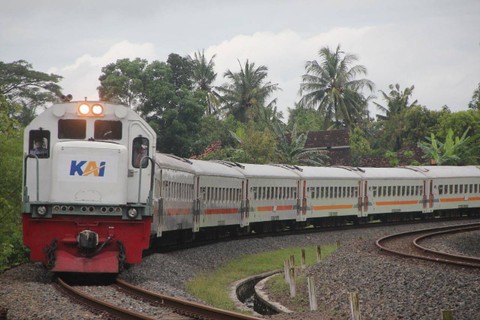

PT Kereta Api Indonesia (KAI) (Persero) has reported a significant surge in urban transportation ridership throughout 2025, signaling a growing demand for public transit across Indonesia.
Across 2025, the KAI Group’s entire urban transportation network collectively served an impressive 442,111,779 passengers. This marks a substantial increase of approximately 36,086,925 passengers from the 406,024,854 recorded in 2024, highlighting robust growth in rail-based commuting.
According to Anne Purba, Vice President of Corporate Communication at KAI, this surge in passenger numbers underscores the escalating demand for increasingly interconnected mobility solutions within urban centers. Anne Purba emphasized in an official statement on Sunday (8/2) that “throughout 2025, the KAI Group’s urban transportation services have seamlessly integrated into the daily routines of communities across numerous regions.”
She further elaborated that rail-based transportation plays a pivotal role in enhancing travel time efficiency, alleviating urban traffic congestion, and critically supporting the economic and social fabric of society. This sustained growth distinctly illustrates the burgeoning mobility demands of urban populations, a trend driven by increasingly dynamic social and economic activities.
This trend is consistent with a 2025 analysis by the Central Statistics Agency (BPS), which identified that Indonesia’s metropolitan regions are predominantly inhabited by a productive-age demographic. This segment exhibits high daily travel intensity, primarily commuting to vital centers of economic activity, education, and public services.
Busiest Routes
Regions such as Jabodetabek, Bandung Raya, Yogyakarta, Surabaya, Medan, and Palembang emerge as key hubs experiencing the highest commuter traffic. These areas critically rely on high-capacity, well-scheduled public transportation to manage their dense daily movements.
The lion’s share of this growth is attributed to services operated by KAI Commuter. In 2025, KAI Commuter alone catered to an impressive 400,737,915 passengers, a significant rise from 374,484,307 passengers recorded in the previous year.
Within the Jabodetabek area, the Commuter Line transported 349,311,251 passengers throughout 2025. Further regional breakdowns show Commuter Line Area II Bandung in West Java serving 18,727,643 passengers, while Commuter Line Area VIII Surabaya in East Java registered 16,020,323 passengers.
In the Special Region of Yogyakarta and its environs, Commuter Line Area VI Yogyakarta recorded 9,015,768 passengers in 2025. Complementing this, the popular KA Prameks service, connecting Yogyakarta and Solo, additionally served 1,113,023 passengers.
Banten province saw 4,463,446 passengers utilize the Commuter Line Rangkasbitung-Merak. Meanwhile, the crucial Commuter Line Soekarno-Hatta Airport service facilitated 2,346,934 passengers, demonstrating its role in airport accessibility.

Beyond conventional commuter lines, the LRT Jabodebek system played a significant role, transporting 28,816,787 passengers in 2025, a notable increase from 21,055,870 in 2024. In terms of airport connectivity, train services to Yogyakarta International Airport (YIA) also saw a rise, catering to 2,865,729 passengers in 2025, up from 2,730,791 the previous year.
The KA BIAS service, which links urban areas with Yogyakarta International Airport, experienced a remarkable surge, serving 769,490 passengers. This represents a substantial leap from just 192,187 passengers in 2024.
Regional services across Indonesia also exhibited strong growth. In North Sumatra, KA Srilelawangsa transported 4,115,680 passengers in 2025, an increase from 3,085,294. Palembang’s South Sumatra LRT saw 4,626,481 passengers, rising from 4,350,217. Finally, Central Java’s KA Batara Kresna service served 179,697 passengers, a significant improvement over 126,188 in 2024.
