
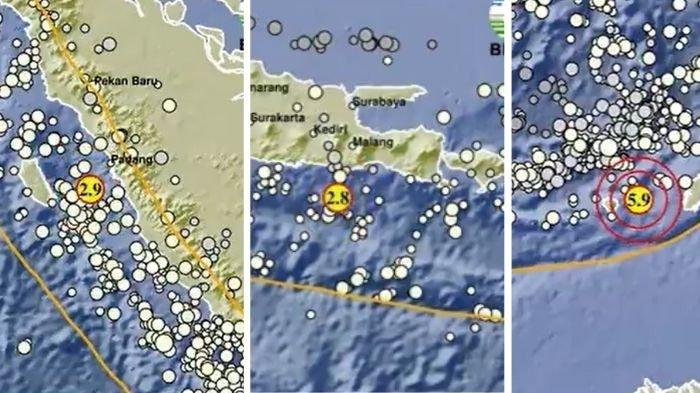
A powerful magnitude 6.2 earthquake struck Pacitan, East Java, in the early hours of Friday, February 6, 2026, triggering widespread concern. Following the main tremor, the Indonesian Agency for Meteorology, Climatology, and Geophysics (BMKG) has meticulously recorded a series of 24 aftershocks.
Despite the observed decrease in the frequency of these subsequent seismic events, the BMKG strongly advises the public to remain vigilant. Daryono, BMKG’s Director of Earthquakes and Tsunamis, confirmed that the aftershocks varied in intensity, with the strongest registering at magnitude 4.0 and the smallest at magnitude 2.2. He offered reassurance, stating, “The frequency of aftershocks has decreased and is now rare; people are asked not to worry too much. The energy has dissipated.”
The initial impactful tremor rattled the region at 01:06 AM Western Indonesian Time (WIB). Its epicenter was pinpointed offshore, situated southeast of Pacitan, at a relatively shallow depth of 58 kilometers. BMKG further categorized this Pacitan earthquake as a shallow megathrust event, highlighting its significant geological origin.
The widespread impact of the magnitude 6.2 earthquake was acutely felt across numerous areas. Shaking reached an intensity of IV MMI (Modified Mercalli Intensity) in Pacitan, Bantul, Yogyakarta, and Sleman. Residents in Kulon Progo, Trenggalek, Wonogiri, Malang, Blitar, Surakarta, and Banjarnegara experienced Intensity III MMI, while Tuban and Jepara reported a milder Intensity II MMI.

According to reports from the National Disaster Management Agency (BNPB) as of Friday afternoon, the earthquake in Pacitan affected 224 individuals across East Java, Yogyakarta, and Central Java. Tragically, 40 people in Bantul Regency were reported to have sustained injuries. The tremor was felt strongly for 2-3 seconds in Pacitan and Trenggalek, and its effects resonated across several regions in DI Yogyakarta and Central Java.
The earthquake’s impact extended to infrastructure across various regencies. In East Java, the affected areas included Pacitan and Trenggalek. DI Yogyakarta saw disruptions in Bantul, while Sukoharjo, Karanganyar, and Wonogiri were impacted in Central Java. Preliminary damage assessments indicated that in East Java, 29 homes, one educational facility, and one village hall were affected. Central Java reported damage to 18 homes, five educational facilities, and one each of a place of worship, health facility, and general public facility. In DI Yogyakarta, eight homes, alongside government, educational, health, and religious facilities, were also reported as affected.
BMKG is committed to continuously monitoring seismic activity in the region. The agency reiterates its crucial advice for the public: maintain vigilance, diligently follow official information from trusted sources, and strictly avoid buildings that have sustained damage due to the earthquake, prioritizing safety above all else.
Understanding Earthquake Intensity: The MMI Scale
To provide context for earthquake impacts, BMKG references the Modified Mercalli Intensity (MMI) scale, which describes the perceived shaking and observed damage at a specific location:
- I MMI
Earthquake vibrations are generally not felt, except under unusual circumstances by a very few individuals. - II MMI
The tremor is felt by a few people; lightweight hanging objects like lamps may gently sway. - III MMI
Vibrations are distinctly felt indoors, often described as similar to a passing truck. - IV MMI
During the day, felt by many people indoors and some outdoors. Pottery may break, windows and doors may rattle or creak, and walls can make noise. - V MMI
The earthquake is felt by almost everyone, causing people to run outside. Pottery breaks, objects are thrown around, large objects and poles visibly sway, and pendulum clocks may stop. - VI MMI
Felt by all, leading most people to be alarmed and run outdoors. Plaster may fall from walls, factory chimneys can be damaged, and minor structural damage may occur. - VII MMI
Everyone inside buildings evacuates. Minor damage to well-constructed buildings. However, poorly constructed buildings may suffer cracks or even collapse, and chimneys can break. - VIII MMI
Slight damage to strongly built structures. Significant cracking in poorly constructed buildings, walls detach from frames, factory chimneys and monuments collapse, and water in wells or springs may become murky. - IX MMI
Considerable damage to strong structures; building frames become misaligned, and extensive cracking occurs. Houses appear to shift from their foundations, and internal pipes may rupture. - X MMI
Strong wooden structures are damaged, and their frames detach from foundations. The ground splits, railway tracks become bent, and landslides occur along riverbanks and on steep slopes. - XI MMI
Very few buildings remain standing. Bridges are severely damaged, deep fissures form in the ground. Underground pipelines are rendered completely unusable, the ground widely splits, and railway tracks are severely warped. - XII MMI
Represents total destruction. Visible waves appear on the ground’s surface, the landscape is drastically altered, and objects are thrown violently into the air.
Summary
A magnitude 6.2 earthquake struck Pacitan, East Java, on Friday, February 6, 2026, at 01:06 AM WIB, originating offshore as a shallow megathrust event. Following this powerful tremor, BMKG recorded 24 aftershocks, with the largest measuring magnitude 4.0. While the frequency of these subsequent seismic events has decreased, BMKG advises the public to remain vigilant and follow official information.
The earthquake’s widespread impact was felt across multiple regions, reaching IV MMI intensity in Pacitan and Yogyakarta. It affected 224 individuals and caused injuries to 40 people in Bantul. Preliminary damage assessments indicate significant infrastructure damage in East Java, Central Java, and DI Yogyakarta, affecting numerous homes and various public facilities.
