
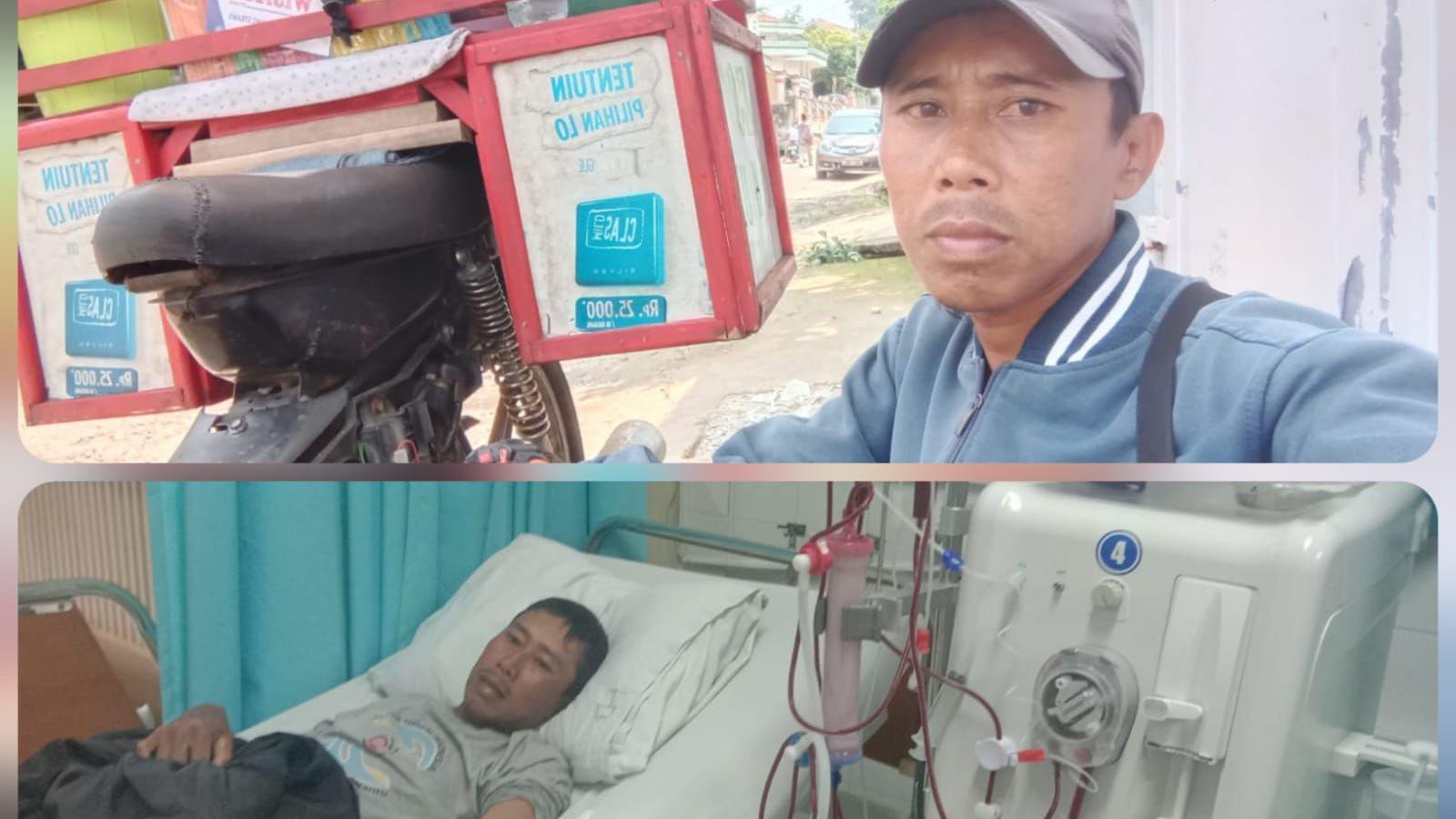

Ajat, a 37-year-old resident of Rangkasbitung, Banten, was already lying on the hospital bed, with the needles for his routine dialysis procedure inserted into his arm. Yet, on Monday morning (February 2nd), the life-sustaining treatment he had relied on for years was abruptly cancelled. His health insurance, provided through the BPJS PBI (Recipient of Contribution Assistance) scheme, was suddenly declared inactive by the hospital.
Ajat is just one of millions of Indonesians impacted by what critics are calling the Ministry of Social Affairs’ “reckless BPJS data update.”
Just a week prior, Ajat, who earns his living as a street ice vendor, had undergone his dialysis sessions without any issues. “I’ve been using BPJS for 11 years; this is the first time there’s been a problem,” Ajat recounted, expressing his shock.
The same fate befell Subur (65) and Mujiati (40), a married couple from Siwalan, Semarang City. They only discovered their BPJS PBI was no longer active when Mujiati tried to visit a community health center (Puskesmas) on Wednesday (February 4th) for a painful tooth. “Last week, I was still able to use it for a check-up at the Puskesmas,” Mujiati stated, bewildered.
Timboel Siregar, Advocacy Coordinator for BPJS Watch, highlighted this as a recurring “classic problem” stemming from the BPJS data reconciliation process, which he describes as arbitrary and lacking transparency. He points out that the transition of the database from DTKS (Integrated Social Welfare Data) to DTSEN (National Single Socio-Economic Data) was conducted without adequate field verification, a critical oversight, especially given similar issues reported last year. Despite the past failures, the Ministry of Social Affairs, according to Timboel, has not improved its operational methods.
Furthermore, Timboel argues that the fixed PBI quota of 96.8 million beneficiaries does not align with the real needs on the ground. According to the Social Health Insurance Program Management Report up to December 31st, 2025, the number of PBI beneficiaries recorded was 113.5 million, accounting for 40.2% of all BPJS users. Additionally, regional PBI beneficiaries reached 63.5 million, or 22.5%. Timboel suggests that this exceeding number is natural given the current economic climate and is actually consistent with the roadmap. The government’s adherence to the 96.8 million quota, he notes, is primarily due to budget constraints. “Especially in the regions, reduced central government transfers have forced local governments to cut the number of covered participants,” he added.
As of February 2026, a staggering 11 million PBI members have had their memberships suddenly deactivated. This follows a similar incident in July 2025, when 7.6 million PBI participants faced deactivation, with only 25,000 successfully reactivating their status. In both instances, individuals only learned of their inactive membership when attempting to use their BPJS for medical services.
Separately, Rizzky Anugerah, Head of Public Relations for BPJS Kesehatan, explained that the deactivations were based on Ministerial Decree No. 3/HUK/2026, effective February 1st, 2026. “Under this decree, adjustments have been made where a number of deactivated PBI JK participants are replaced with new participants. Thus, the total number of PBI JK participants remains the same as in the previous month. The updating of PBI JK data is carried out periodically by the Ministry of Social Affairs to ensure that PBI JK participant data is accurately targeted,” Rizzky stated. However, this data update process has been fraught with inconsistencies.
On social media, BBC News Indonesia found numerous self-paying BPJS participants who were surprised to discover their status had been switched to PBI. These individuals, who claim they are able to pay for their insurance, are now seeking to revert to their independent status. In stark contrast, Ajat, who clearly requires assistance, was removed from the PBI list and is now forced to switch to an independent plan to continue his vital dialysis treatments.
‘Hopefully, I’m strong enough today’
Monday and Thursday are Ajat’s routine dialysis days, a necessity since he was diagnosed with kidney failure approximately 11 years ago. He travels to Adjidarmo General Hospital by public transport. Upon arrival, the hospital staff usually initiate the procedure immediately, as in previous weeks. “The needle was already inserted into my arm, but then I was called and informed that my BPJS wasn’t active. I asked how that could be and what I should do. Finally, I was asked to contact my family to sort out the BPJS first,” Ajat recounted, the memory still fresh.
Ajat immediately called his wife, hoping she could reactivate the suddenly unusable BPJS. His wife promptly went to the local sub-district office (kelurahan) to obtain a certificate of indigence and other necessary documents. From there, she proceeded to the district office (kecamatan) and then to the local Social Affairs Office (Dinas Sosial). This arduous journey, however, brought even more surprising news for Ajat and his wife.
Despite completing all required paperwork, their BPJS could not be reactivated as PBI because their “desil” category had been placed in desil 6. PBI participants are only allocated to those in desil 1 to desil 4. According to the explanation of desil categories, desil 6 represents the middle-to-upper income group, considered relatively prosperous. Characteristics of desil 6 include having a stable income and being generally safe from the risk of poverty. This classification deeply contradicts Ajat’s reality: he daily sells ice, earning an unpredictable income. “If I sell all my goods, I get Rp250,000 a day, cut by about Rp150,000 to Rp160,000 for capital. If I don’t sell everything, I only cover my capital, or at most bring home Rp20,000 to Rp30,000,” he explained. “Especially during this rainy season, sales are never good. Sometimes I don’t even sell if it rains from morning till night. Not to mention, twice a week I have dialysis, so I definitely don’t sell on those days.”
His wife is a homemaker, making the family’s finances entirely dependent on Ajat’s fluctuating earnings. Their 12-year-old daughter receives assistance for school and healthcare. “Our lives are barely getting by, and our income is uncertain; how can we be called capable?” Ajat lamented.
Given the desil classification, Ajat was informed his BPJS could be immediately activated if he switched to an independent plan. With assistance from Tony Samosir of the Indonesian Dialysis Patient Community (KPCDI), Ajat transitioned to an independent status, incurring a monthly premium of Rp70,000 for himself and his wife. He admitted this amount is a heavy burden for his family, whose income is inconsistent. “Pak Tony from KPCDI helped activate the independent plan. Because I was already late for dialysis. It should have been Monday and today (Thursday). But because it just became active, I can only have dialysis tomorrow,” Ajat said, highlighting the dangerous delay. “If it’s delayed, my body starts feeling unwell. I’m already a bit nauseous. My body is weak, and I’m swollen. My breathing is also difficult. Hopefully, I’m still strong enough today,” he added, his voice tinged with concern.
Tony Samosir, Chairman of KPCDI, stated he became aware of this situation on Monday (February 2nd) and has since tried to find solutions by contacting various parties responsible for the BPJS system and the rights of these vulnerable citizens. “Why is it so difficult for me to discuss with them? Usually, this gets resolved, but this time it doesn’t. Their answer is, ‘we follow the regulations from the Ministry of Social Affairs as stipulated in their regulations.’ Ultimately, this was the breaking point yesterday; we couldn’t take it anymore, we had to make it public. What are the patients’ actual desires and hopes?” Tony expressed, frustrated.
Compounding the urgency, kidney failure requiring routine dialysis is categorized as a chronic illness, one whose treatment cannot be postponed and is rigidly scheduled. Typically, dialysis requires two to three sessions per week. Each session costs between Rp700,000 and over Rp1 million.
Tony, who also undergoes routine dialysis, emphasized that delays in treatment usually lead to severe shortness of breath and extreme fatigue. The consequences of obstructed dialysis can cascade into problems with other organs, such as increased blood pressure, heart failure, pulmonary edema, and even the risk of death. “Dialysis is not a choice; it’s a mandatory standard that patients must undergo. The sessions are determined, for example, five hours per session. The days and frequency are also predetermined,” Tony asserted, underscoring the critical nature of the treatment.
He questioned the data update process that disproportionately affects low-to-middle income citizens with established records of routine medical treatment. Information about deactivation, he noted, is often received abruptly when patients are already prepared for their procedures. Patients often incur significant travel costs to and from the hospital and sacrifice substantial time, leading to lost daily income. These indirect, non-medical costs are already borne by the patients themselves, saved from their meager earnings. “Imagine, an elderly person or someone undergoing routine dialysis comes to the hospital. Suddenly, they are told their BPJS is inactive. If they want treatment, they must either sort out their BPJS or pay Rp1 million for medical costs like a general patient,” Tony elaborated, painting a grim picture.
If the government’s data were truly integrated, such incidents should be preventable. PBI participants, by definition, struggle to meet daily needs, let alone cover routine medical expenses, which is why they receive assistance. Their BPJS PBI is consistently utilized, and its usage should ideally be recorded in the database. If any issues arise, Tony suggests that notifications should be provided at least 30 days in advance, allowing patients to verify their status promptly rather than facing sudden cancellations. “This is simply arbitrary. And then they casually say it can be reactivated, which turns out to take a long time and is not guaranteed to pass verification. Dialysis is a life-saving therapy, not a service that can be delayed. There is no time to wait for chronic disease patients, including dialysis patients,” Tony declared passionately. “This is a human rights violation regarding health. They lack empathy and humanity. We strongly condemn the government’s actions. Now, our organization is taking over the state’s duty for those whose dialysis is hampered. The poor and neglected children were supposedly cared for by the state. This time, KPCDI is providing that care. How tragic it is to live in our country.”
Currently, KPCDI has documented over 100 dialysis patients facing obstacles due to the deactivation of their PBI status. Overall, the number of dialysis patients covered by BPJS Kesehatan reached 134,000 in 2024. This figure is projected to increase, as kidney failure cases are expected to double by 2025, with a concerning rise in younger patients.

On Thursday (February 5th), the BPJS office on Jalan Sultan Agung, Candisari District, Semarang City, was bustling with people. Among them were Subur (65) and Mujiati (40), a couple from Siwalan, Gayamsari District, Semarang City. They appeared perplexed, as their BPJS Recipient of Contribution Assistance (PBI) had suddenly become inactive and unusable.
Mujiati explained that she came to the Semarang Branch of BPJS Kesehatan to reactivate her and her husband’s PBI. However, her hopes were dashed; she left empty-handed, informed that she would have to process the reactivation through the local community health center and sub-district office. “Yes, my husband’s and my BPJS are inactive. The Puskesmas said it’s inactive and needs to be reactivated before it can be used for check-ups,” Mujiati told Kamal, a journalist reporting for BBC News Indonesia.
Mujiati had initially visited the Puskesmas on Wednesday (February 4th) for a dental check-up. It was there that the Puskesmas staff informed her that her BPJS PBI was no longer active. “Yesterday, I went for dental treatment; many of my teeth have cavities. When I was there, they asked me to activate it first,” she recalled. Hearing the news, Mujiati was deeply confused, as her BPJS PBI had supported her for over 10 years. Her thoughts immediately turned to her husband, Subur, who suffers from multiple complications and requires routine monthly check-ups.
Upon checking, the BPJS PBI under Subur’s name was also inactive, prompting Mujiati to quickly visit the nearest BPJS office. “I came here to activate it, but upon arriving, I was told to go to the Puskesmas first,” she complained. At the Semarang Branch BPJS Office, she was informed that the process required going through the Puskesmas first, then to the sub-district office. “So, at the Puskesmas, I’m given a stamped form to fill out for BPJS PBI reactivation, then it’s processed at the sub-district office. I thought I could come directly here,” she clarified, expressing her frustration with the bureaucratic hurdles.
Worry began to set in. She feared having to pay for her husband’s future medical controls. “I am a small person; my husband only works as a parking attendant, earning very little,” Mujiati stated. “If we have to pay in the future, we’ll be lost; we are poor people, we don’t even own our own home. My husband also needs routine check-ups for his complications. He has to control his heart, lungs, and diabetes every month.” She added, “It has always been free. I don’t know how much money we would have to pay without BPJS. He also just had an accident, and his leg still has a pin.” Compounding their difficulties, beyond the deactivation of millions of PBI participants, hospital polyclinic visits are now restricted to one polyclinic per referral. This poses another significant problem for Subur, who requires visits to multiple specialties.
Limited Quotas, Mis-targeting, and Budgetary Politics
- Mis-targeting
BPJS Watch Advocacy Coordinator Timboel Siregar reiterates that the data update conducted by the Ministry of Social Affairs has once again been executed “haphazardly.” Last year’s incidents, he notes, seemingly failed to serve as a lesson for the Ministry of Social Affairs to refine its methods and ensure accurate data targeting. “This is just a superficial effort. Clearly poor people are affected by the cleansing. People with catastrophic illnesses, like those needing dialysis, cancer patients, heart patients, are also affected by the cleansing. They shouldn’t be affected,” Timboel asserted.
This recurring situation, Timboel argues, demonstrates the government’s non-compliance with regulations, specifically Government Regulation No. 76 of 2015 concerning Recipients of Health Insurance Contribution Assistance. This regulation outlines criteria for removal, replacement, and addition of beneficiaries. However, removal is only permissible if a participant has passed away, is registered multiple times, or no longer falls into the category of the poor and indigent. “With this classic problem repeating, poor people are still subjected to this cleansing, meaning the data cleansing process is not carried out based on whether the person is poor and incapable or if they are already capable,” Timboel explained.
This point was also raised by Tony Samosir, Chairman of KPCDI. If data updates were conducted accurately and included proper field verification, the incident involving Ajat would not have occurred. Furthermore, he highlighted the absurdity of individuals like Harvey Moeis, a defendant in a major tin corruption case with trillions of rupiah in assets, allegedly being registered as a PBI beneficiary and not subject to data removal. “Someone like Harvey Moeis can be included and not get removed from the data. This is strange. What kind of accurate targeting is this? This is clearly mis-targeting,” Tony remarked critically. Both experts emphasized the need for the government to transparently announce the participants whose PBI status has been revoked, allowing for immediate follow-up. “This is never communicated openly. It could be done through neighborhood associations (RT/RW), posted on public notice boards. Or digitally, participants could be notified via their contact information. It’s always sudden and non-transparent,” Timboel stressed.
- Limited Quota
Timboel also took issue with the limited PBI participant quota, capped at 96.8 million individuals. BPJS Kesehatan itself acknowledged that the current removals are intended to replace other participants, thereby maintaining the total number of PBI participants. However, given the prevailing economic conditions, Timboel believes there should be flexibility in this quota. The original spirit of BPJS was to help citizens cover health costs, recognizing that medical expenses often deplete family finances, especially for those without a strong social safety net. This rigid quota, however, is seen as deviating from the initial spirit of BPJS. Even returning to Government Regulation No. 76/2015, the government, Timboel states, is not upholding it. This regulation stipulates that workers who have been laid off and remain unemployed for six months can be categorized as PBI participants. With a rigid quota, accommodating such cases becomes difficult. “The number should be flexible. The regulation exists, but they still stick to 96.8 million. The situation involves many layoffs and a decline in the middle class. This means the government must increase the quota and not simply burden the regions,” Timboel argued.
According to Presidential Regulation No. 36 of 2023 concerning the Social Security Roadmap 2023-2024, the target for PBI participants was 111 million individuals in 2023 and 113 million in 2024.
- Budgetary Politics
However, the difficulty in increasing the quota cannot be divorced from budgetary politics. Referring to the 2026 State Budget (APBN), central government funds allocated to cover health services amount to Rp69 trillion, drawn from the Ministry of Social Affairs’ overall health service budget ceiling of Rp508.2 trillion. Of this health service fund, Rp15.5 trillion is designated to finance 96.8 million PBI participants, and Rp2.5 trillion is allocated for contribution subsidies for 49.6 million non-wage earners (PBPU) and non-workers (BP) in Class III. Additionally, Rp24.7 trillion from these funds is allocated for the Free Nutritious Meals (MBG) program for toddlers, pregnant women, and the elderly.
Timboel further pointed out the decrease in transfers to regional governments, which has forced local administrations to reduce the number of BPJS aid recipients. “Regional fiscal capacity has decreased. To finance local PBI communities and regional PBPU. Because fiscal capacity is down, the number of people guaranteed is also down.”
What Triggered the PBI Data Update?
Rizzky Anugerah, Head of Public Relations for BPJS Kesehatan, reiterated that the deactivation of PBI participants refers to Ministerial Decree No. 3/HUK/2026, effective February 1st, 2026. The number of PBI participants needed to be adjusted, he explained, because some were found to be mis-targeted or had never utilized their benefits. “The updating of PBI JK data is carried out periodically by the Ministry of Social Affairs to ensure that PBI JK participant data is accurately targeted. Deactivated JKN participants can reactivate their JKN membership status if they meet several criteria,” Rizzky stated.
The criteria for reactivating PBI JK participants include:
- The participant was included in the list of PBI JK participants deactivated in January 2026.
- Based on field verification, the participant falls into the category of poor and vulnerable-poor communities.
- The participant suffers from a chronic illness or is in a medical emergency that threatens their life.
“Deactivated PBI JK participants can report to the local Social Affairs Office with a Letter of Need for Health Services. Subsequently, the Social Affairs Office will propose these participants to the Ministry of Social Affairs, and a verification process will be conducted for the proposed participants,” Rizzky explained. “If the participant passes verification, BPJS Kesehatan will reactivate their JKN status, allowing them to once again access health services,” he affirmed.
Minister of Social Affairs, Saifullah Yusuf, echoed similar explanations. “If they are indeed from families in desil 1 to desil 4 or families designated by the local government as eligible for assistance, then we will help them and process their application,” he said. Saifullah also urged BPJS Kesehatan to impose sanctions on hospitals that continue to refuse patients. He believes that hospitals that reject patients should face severe penalties, including closure. “BPJS should sanction them. This means the hospital is problematic, Sir. The hospital should be shut down,” Saifullah declared.
Similar to last year, the Ministry of Social Affairs maintains an avenue for affected beneficiaries to undergo reactivation if they are genuinely in need. “For others, we certainly hope that beneficiary families will follow developments. So, they should not be passive but also active. If there are updates that ultimately prevent them from getting the opportunity, please study them well and reactivate immediately,” Saifullah urged.
- Polemic of BPJS Kesehatan services – ‘We were surprised, why were we told to go home?’
- BPJS Kesehatan faces a potential deficit of Rp20 trillion and claims payment failure, premium increase becomes a ‘necessity’
- Healthcare workers’ ‘differentiated treatment of BPJS patients’ condemned by public, ‘highly inappropriate’ – Activists: ‘It’s a form of fraud and most common in hospitals’
- ‘I’m disappointed, why couldn’t I be helped?’ – Dengue fever patient rejected by hospital for ‘not being critical’ and not covered by BPJS Kesehatan
- Mother and unborn child die after being rejected by four hospitals – ‘This is the rotten state of healthcare services in Papua’
- Healthcare workers’ ‘differentiated treatment of BPJS patients’ condemned by public, ‘highly inappropriate’ – Activists: ‘It’s a form of fraud and most common in hospitals’
- ‘If trained but facilities are lacking, it’s useless’ – Is the government’s plan to train general practitioners for C-sections appropriate?
- No anesthesiologist in Sikka, East Nusa Tenggara, mother and fetus die in hospital
- From pant size to ‘unscientific stethoscopes’ – What are Health Minister Budi Gunadi’s controversial statements and policies?
- Polemic of BPJS Kesehatan services – ‘We were surprised, why were we told to go home?’
- ‘Dilemma’ of chronic kidney failure patients behind illegal organ trafficking practices
- BPJS Kesehatan faces a potential deficit of Rp20 trillion and claims payment failure, premium increase becomes a ‘necessity’
Summary
Millions of BPJS PBI (Recipient of Contribution Assistance) users have been suddenly deactivated, disrupting access to essential medical services. This abrupt change, often discovered at the hospital, has forced vulnerable patients, such as Ajat who requires dialysis, to pay out-of-pocket or face dangerous treatment delays. Many affected individuals, including those with chronic illnesses, report being misclassified into higher economic categories despite their genuine need for assistance.
Critics, including BPJS Watch, attribute these deactivations to the Ministry of Social Affairs’ “reckless” data updates, which lack transparent verification and rigidly adhere to a 96.8 million beneficiary quota despite higher actual needs. While BPJS Kesehatan cites a ministerial decree for these adjustments to ensure accurate targeting, the process is criticized for its mis-targeting of the poor and chronically ill, and for violating their health rights. Experts urge the government to improve data integrity, provide timely notifications, and align beneficiary quotas with real socio-economic conditions.
