
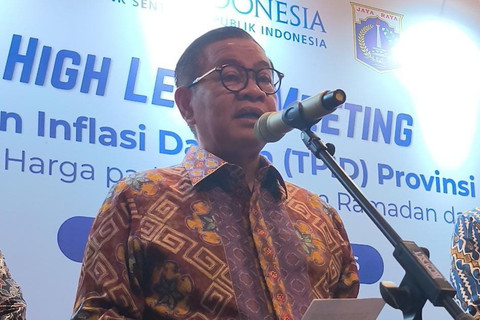
The DKI Jakarta Provincial Government announced a significant milestone, successfully emerging from a period of economic stagnation below 5 percent in the third quarter of 2025. This positive turn culminated in an impressive surge during Q4 2025, where Jakarta’s economic growth soared to 5.71%, comfortably surpassing the national average. This remarkable acceleration was primarily fueled by strategic government incentive policies targeting key service sectors, including accommodation, food and beverage, and transportation.
“The most encouraging news is our ability to achieve 5.71 percent growth in the fourth quarter,” stated Pramono following a High-Level Meeting (HLM) of the DKI Jakarta Province held in preparation for Ramadan and Eid al-Fitr 1447 H at the Aryaduta Hotel, Central Jakarta, on Friday (6/2). He elaborated that this substantial leap in economic recovery was directly linked to various economic activities actively promoted by the provincial government in anticipation of the Christmas and New Year holidays, which significantly boosted public consumption.
Pramono further emphasized, “The initiatives undertaken to celebrate Christmas and New Year profoundly influenced consumer spending patterns.” He revealed that the tangible impact of these policies was evident in the astounding transaction value of Rp 15.25 trillion recorded during a single collaborative event involving businesses. “It was reported that transactions totaled Rp 15.25 trillion, significantly contributing to Jakarta’s growth, pushing it well above the nearly 5 percent recorded in the third quarter,” he added, highlighting the pronounced acceleration.
This robust performance also translated into a strengthened overall contribution of Jakarta’s economy to the national Gross Domestic Product (GDP) throughout 2025. “In 2025, Jakarta’s GDP contribution once again reached 16.61 percent of the national GDP,” Pramono affirmed, underscoring the capital’s pivotal role in the country’s economic landscape.
Pramono elaborated that the most vibrant sectors experiencing positive growth throughout 2025 were those that directly benefited from local government incentives. “Areas like accommodation and food and beverage provision, which repeatedly received government incentives, exemptions, and other forms of support, saw particularly strong growth in Jakarta during 2025,” he stated. He observed that these targeted incentive policies were instrumental in accelerating the growth trajectory of these critical sectors, noting, “When these incentives were provided, the growth actually became even better.”
Complementing these successes, the transportation and warehousing sector, alongside other service industries, also played a crucial role in supporting Jakarta’s economic recovery. Iwan Setiawan, Head of Bank Indonesia’s DKI Jakarta Representative Office, hailed this surge in economic growth as a pivotal moment for the capital’s economy. “DKI Jakarta has grown significantly better, exceeding 5.71 percent compared to Q3, marking a very positive momentum,” Iwan emphasized.
He noted that Jakarta successfully broke free from the pressure of sluggish growth experienced in the preceding quarter. “It’s fair to say that Q3 saw growth below 5 percent, and now it has leaped to 5.71 percent,” he elaborated. Iwan underscored that this achievement not only demonstrates the resilience of Jakarta’s economy but also the robust collaboration within the Regional Inflation Control Team (TPID). “This clearly indicates that our economy, particularly in DKI Jakarta, is resilient and capable of achieving sustainable growth,” he asserted.
Looking ahead, the DKI Jakarta Provincial Government, in conjunction with the TPID, aims for continued sustainable growth while maintaining strict control over inflation. “For 2026, the DKI Jakarta government targets an inflation rate lower than the central government’s benchmark of 2.5 percent plus-minus 1 percent,” Pramono concluded, outlining ambitious yet achievable economic goals.
Summary
Jakarta’s economy successfully emerged from stagnation, achieving a significant 5.71% growth in Q4 2025, comfortably surpassing the national average. This remarkable acceleration was primarily driven by strategic government incentive policies targeting key service sectors such as accommodation, food and beverage, and transportation. Initiatives undertaken for the Christmas and New Year holidays also notably boosted public consumption, with one collaborative event generating Rp 15.25 trillion in transactions.
This robust performance strengthened Jakarta’s overall contribution to the national Gross Domestic Product (GDP) to 16.61% in 2025. Officials, including Pramono and Bank Indonesia’s Iwan Setiawan, lauded this achievement as a pivotal moment, demonstrating the resilience of Jakarta’s economy and effective collaboration. Looking ahead, the DKI Jakarta Provincial Government aims for continued sustainable growth while targeting an inflation rate lower than the central government’s benchmark for 2026.
