
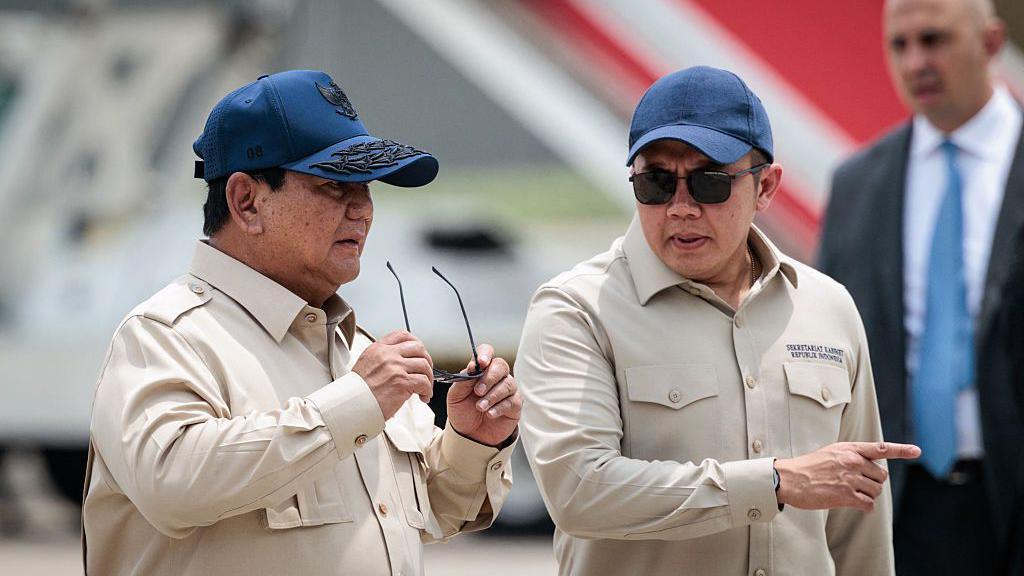

The role of Cabinet Secretary Teddy Indra Wijaya, who frequently receives reports from government ministers, is being questioned for its administrative propriety and lack of institutional alignment, according to University of Indonesia bureaucracy and state administration expert, Dian Puji Simatupang.
This scrutiny stems from Presidential Regulation Number 148 of 2024 concerning the Ministry of State Secretariat. Under this mandate, the Cabinet Secretary—now integrated into the organizational structure of the Ministry of State Secretariat—holds a rank equivalent to an Echelon II official, a position that, in theory, should not carry the authority to influence presidential and cabinet management.
Public concern peaked following a 37-second video shared by the Ministry of Social Affairs titled “Cabinet Secretary Receives Progress Report on People’s Schools.” In the footage, Teddy and Social Affairs Minister Saifullah Yusuf discuss the launch of the “People’s School” program slated for July 2026, which aims to provide education to 1,000 underprivileged and street children in Jakarta across ten locations. BBC News Indonesia reached out to Minister Saifullah Yusuf and the Head of the Presidential Communications Office, Muhammad Qodari, for comment, but neither has provided a response as of the time of publication.
A Trend of Ministerial Reporting to Teddy
The viral Instagram video showing the meeting between Minister Saifullah Yusuf and Teddy Indra Wijaya sparked significant debate among netizens regarding why cabinet ministers are increasingly treating the Secretary as a primary point of contact. In the clip, the Minister apologizes for his visit, to which Teddy responds by citing his recent return from France.
While the video focused on educational initiatives, it highlighted a broader pattern noted by social media users. Observers have pointed out several instances where high-ranking officials reported directly to Teddy: Immigration and Correctional Affairs Minister Agus Andrianto discussed core ministry programs on July 26, 2025; Transportation Minister Dudy Purwagandhi coordinated 2025 holiday travel logistics with him; Communication and Digital Minister Meutya Hafid reported on child protection regulations on March 28, 2026; and Cooperatives Minister Ferry Juliantono briefed Teddy on national recruitment figures on April 21, 2026.
Who is Teddy Indra Wijaya?
Teddy Indra Wijaya is an active-duty Indonesian Army officer who has served as Cabinet Secretary under the Prabowo Subianto administration since 2024. His background includes serving as an aide to then-President Joko Widodo and later as a personal aide to Prabowo during his tenure as Minister of Defense (2020-2024). During the presidential campaign, Teddy was a constant presence by Prabowo’s side.
His appointment as Cabinet Secretary triggered controversy regarding his active military status, as the position is typically reserved for civilian roles under the TNI (Indonesian National Armed Forces) Law. However, following the issuance of Presidential Regulation Number 148 of 2024, the role was restructured under the Ministry of State Secretariat. As an Echelon II-level official under the Military Secretary to the President, his role technically allows him to remain an active soldier.
The Scope of the Cabinet Secretary’s Duties
Under Article 50 of the new regulation, the Cabinet Support Secretariat is tasked with providing administrative and management support to the President and Vice President. Key functions include policy research, resolving implementation bottlenecks, organizing cabinet meetings, handling presidential documentation, and assisting the Final Assessment Team in high-level government appointments.
Why Experts Call it Overreach
Dian Puji Simatupang argues that since Teddy is technically an Echelon II official rather than a cabinet-level minister, his involvement in managing the government’s daily operations is inappropriate. “It is strange for a non-cabinet member to significantly influence the President’s management,” Dian stated. She suggests that if ministers have reports to deliver, these should be directed to the President, not to an Echelon II staffer.
Critics also identify three major concerns regarding his conduct. First, he is perceived as a “gatekeeper” who hinders direct access to the President, potentially complicating communication channels that were traditionally more open under previous administrations. Second, his tendency to publicly dismiss or criticize observers—labeling them as sources of “inflationary opinions”—is viewed as diplomatically unwise for a state official who should be managing public feedback as strategic information.
Third, he frequently appears to function as a personal aide or private secretary rather than a professional administrator. He is often seen accompanying the President on both domestic and international trips, such as the 2026 state visit to Paris, which observers argue falls outside the purview of a Cabinet Secretary’s administrative duties.
Long-term Institutional Risks
Teuku Harza Mauludi, a researcher at the UI Center for Political Studies (Puskapol), attributes this dynamic to the informal power structure often found in military environments, where aides often act as primary liaisons for their superiors. While this may be comfortable for the President, Harza warns of significant risks. In the short term, it creates confusion over decision-making authority—making it difficult for the public to hold specific officials accountable when policies fail.
In the long run, this reliance on informal networking rather than institutional protocol poses a threat to democratic governance. “If the government operates through informal brokers rather than clear institutional channels, it creates uncertainty,” Harza concluded, warning that such precedents could undermine the standard, transparent processes expected in a modern democracy.

Summary
The role of Cabinet Secretary Teddy Indra Wijaya has sparked controversy due to his active engagement with cabinet ministers, which experts view as an administrative overreach. According to Presidential Regulation Number 148 of 2024, Teddy serves as an Echelon II official under the Ministry of State Secretariat, a position that lacks the formal authority to oversee or receive progress reports from ministerial-level officials. Critics, including bureaucracy expert Dian Puji Simatupang, argue that this practice disrupts standard institutional protocols and suggests that Teddy is functioning more as a personal aide than a professional administrator.
Analysts warn that this shift toward informal power structures creates significant risks for democratic governance and policy accountability. By acting as a potential gatekeeper for the President, the current arrangement complicates established communication channels and makes it difficult for the public to hold specific officials responsible for policy outcomes. Experts emphasize that relying on personal influence rather than clear, transparent institutional processes undermines the integrity of the government’s administrative functions.
