

A new comprehensive export policy for critical commodities including coal, Crude Palm Oil (CPO), and ferro alloy, managed through PT Danantara Sumberdaya Indonesia (DSI), is set to commence its transitional phase on Monday, June 1, 2026. This crucial implementation marks a significant step before the policy’s full enforcement on January 1, 2027, promising enhanced oversight for Indonesia’s vital export sector.
PT DSI, a newly established state-owned enterprise (SOE), has been specifically mandated to act as the single-door export manager for these strategic natural resource commodities. This centralized approach is designed to streamline processes and bolster national economic resilience.
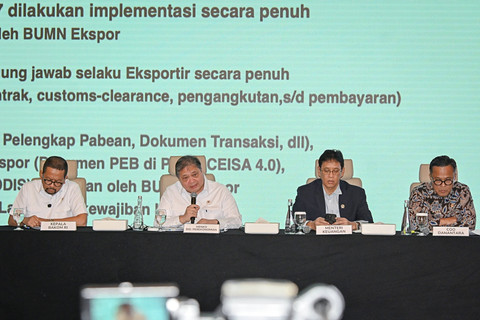
“The implementation will begin tomorrow, June 1, 2026, marking a transitional period. During this time, export activities will proceed as usual for the respective companies. However, it will become mandatory for all exporting firms to report their export activities through PT DSI, which serves as the designated state-owned export entity,” announced Coordinating Minister for Economic Affairs, Airlangga Hartarto, during a press conference at Wisma Danantara on Sunday, May 31.
Minister Hartarto underscored that this decisive measure is being undertaken to significantly improve the governance of strategic commodity exports, which have long formed the backbone of Indonesia’s international trade. The government aims to create a more transparent and accountable export environment.
According to Hartarto, the policy is meticulously designed to strengthen export oversight and management, while simultaneously combating detrimental practices such as under-invoicing, transfer pricing, and the illicit flight of export proceeds abroad. These measures are crucial for protecting national assets and ensuring fair trade.
“This regulation will reinforce export oversight and governance. Let me reiterate, this is about strengthening export oversight and governance,” Hartarto emphasized, highlighting the policy’s primary objective.
Government data further illustrates the immense importance of these three commodities, which collectively reached an export value of USD 66.13 billion in 2025, accounting for a substantial 23.4 percent of total national exports. Specifically, coal exports contributed USD 24.48 billion, palm oil USD 24.42 billion, and ferro alloy USD 16.49 billion, underscoring their critical role in the Indonesian economy.
Hartarto elaborated that the initial phase, beginning June 1, 2026, serves as a transition. During this period, while companies will continue to conduct their export operations, they will be required to meticulously report all activities to PT DSI using the advanced CEISA 4.0 system, managed by the Directorate General of Customs and Excise. This digital integration aims to create a comprehensive and traceable record of all transactions.
The government plans to conduct a thorough evaluation within the first three months of the transitional phase before proceeding to subsequent stages. The full, comprehensive implementation of the single-door export policy is strategically targeted for January 1, 2027, allowing ample time for all stakeholders to adapt.
“This timeline provides businesses, operators, exporters, and all related parties with sufficient time to make the necessary adjustments,” Hartarto affirmed, signaling the government’s commitment to a smooth and well-managed transition.

In a parallel move to enhance export governance, the government is also implementing Government Regulation (PP) Number 21 of 2026, which mandates the onshore placement of Export Proceeds (DHE) from Natural Resources (SDA), effective June 1, 2026. This regulation is designed to fortify domestic foreign exchange reserves and bolster economic stability.
Finance Minister Purbaya Yudhi Sadewa announced that all natural resource exporters are now obligated to repatriate their export proceeds to Indonesia, demanding a robust 100 percent compliance rate. This stringent requirement reflects the government’s determination to keep valuable foreign currency within the national economy.
“Natural resource exporters are compelled to repatriate DHE to domestic accounts with a 100 percent compliance level,” Minister Purbaya explicitly stated, emphasizing the non-negotiable nature of the new policy.
Under this regulation, non-oil and gas sector exporters are required to deposit 100 percent of their natural resource DHE into special domestic accounts for a minimum duration of 12 months. In contrast, oil and gas exporters must place at least 30 percent of their DHE from natural resources for a period of no less than three months, establishing differentiated but equally critical obligations.
The placement of these funds must be channeled through designated special accounts within state-owned banks (BUMN). Furthermore, the government has imposed a cap, limiting the conversion of natural resource DHE from foreign currency to rupiah to a maximum of 50 percent, managing the impact on local currency and foreign exchange dynamics.
According to Minister Purbaya, this strategic policy is meticulously crafted to prevent export proceeds from directly flowing out of the country. Instead, these repatriated funds are intended to significantly strengthen domestic foreign exchange liquidity, thereby playing a pivotal role in maintaining overall national economic stability.
Despite the tightened obligations for DHE placement, the government has proactively prepared a series of incentives for exporters who diligently comply with these new regulations. Among these incentives is a more favorable Income Tax (PPh) rate applied to earnings derived from DHE placement instruments, offering a significant advantage over regular investment instruments.
“The government is providing tax facilities for compliant exporters who place their natural resource DHE domestically. The Income Tax rate on earnings from DHE placement instruments can even reach as low as 0 percent, depending on the duration of the fund placement,” Minister Purbaya concluded, highlighting the attractive benefits for adherence.
Summary
Indonesia is implementing a new comprehensive export policy for critical commodities like coal, Crude Palm Oil (CPO), and ferro alloy, managed through the state-owned enterprise PT Danantara Sumberdaya Indonesia (DSI). This policy begins its transitional phase on June 1, 2026, with full enforcement slated for January 1, 2027. The initiative aims to significantly improve governance, enhance oversight, and combat detrimental practices such as under-invoicing and illicit flight of export proceeds. During the transition, companies must report all export activities to PT DSI, strengthening accountability for these vital national exports.
Concurrently, effective June 1, 2026, Government Regulation Number 21 of 2026 mandates the onshore placement of 100 percent of Export Proceeds (DHE) from natural resources. This regulation compels all natural resource exporters to repatriate their foreign exchange to designated domestic accounts for specific durations. The policy seeks to fortify domestic foreign exchange reserves and bolster national economic stability by preventing funds from flowing directly out of the country. Exporters complying with these stringent requirements are offered incentives, including significantly favorable Income Tax rates on earnings from DHE placement instruments.
