
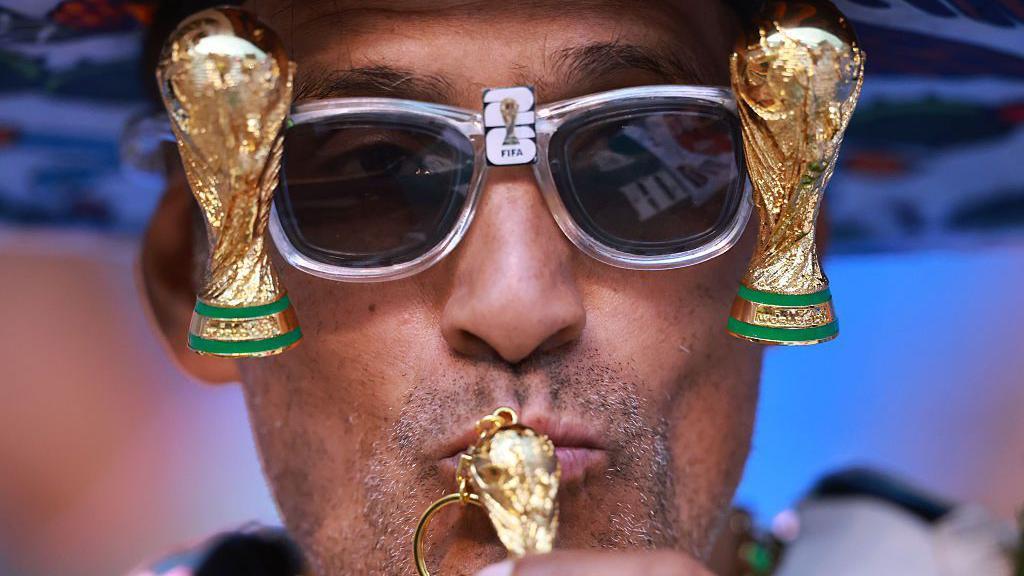
While Paul the Octopus captured global adoration for his uncanny knack of correctly predicting all of Germany’s 2010 World Cup matches, his predictive prowess pales in comparison to that of German economist Joachim Klement. Klement has developed a remarkable statistical model that boasts a 100% accuracy rate in forecasting World Cup champions since 2014, making him a true oracle in the realm of football predictions.
Utilizing his sophisticated prediction model, Joachim Klement has already charted the course for the highly anticipated World Cup 2026, which will uniquely unfold across three host nations—the United States, Mexico, and Canada—from June 11 to July 19.
Klement’s meticulously crafted model delves deep into the potential outcomes of the expanded 48-team tournament. His forecasts include astonishing upsets, such as Japan triumphing over football giant Brazil in the knockout stages, and Scotland’s journey ending at the hands of South Korea in the same round. More notably, the model projects England’s national team, currently under the guidance of Thomas Tuchel, to reach the semifinals. However, their path to the final will be blocked by Portugal, mirroring a classic encounter from the 2006 World Cup. While the model doesn’t predict if history will repeat itself with a penalty shootout, it unequivocally names its ultimate champion for this edition. According to Joachim Klement’s statistics, the Netherlands national team is poised to claim their first-ever World Cup title, marking a historic achievement in the annals of the sport.
For more insights into the upcoming tournament, you might also be interested in:
- World Cup 2026: Check schedules and results for your favourite team
- World Cup 2026 in the US, Canada, and Mexico – What’s your favourite national team kit?
- The 1938 World Cup and the Dutch East Indies national team: My grandfather ‘scored a goal’ in the 1938 World Cup
For Joachim Klement, who candidly describes himself as a “pessimist,” his elaborate model was never intended to generate substantial betting wins. Instead, it was conceived as a tongue-in-cheek exercise to highlight the inherent absurdity of attempting to predict outcomes in such a volatile domain. “It started as an exercise to show the world the arrogance of economists who think they can predict something they don’t really understand,” Klement explains. “However, if you’re lucky enough often enough, people will think of you as a prophet.”
‘People Think This Model is Unbeatable’
Following his astute prediction of his home country, Germany, clinching the 2014 World Cup title, Klement initially envisioned that his calculations for the 2018 World Cup would merely expose his previous success as a fluke. Yet, he once again proved uncannily accurate, correctly foreseeing France’s victory in 2018, followed by Argentina’s triumphant campaign in 2022. “Because I was right three times in a row, people now think that [my] model is unbeatable and that I will be right again next time,” he notes, reflecting on the escalating public expectation surrounding his football predictions.
While it’s true that a nation’s success in the World Cup is partially shaped by “systemic” factors—such as population size, economic wealth, climate, and FIFA rankings—Joachim Klement adamantly urges the public to approach his predictions with a critical and cautious eye. He emphasizes that these factors can only account for a fraction of a country’s ultimate success. “The other half is luck,” he asserts. “Every match—especially when high-quality teams with very similar abilities and qualities face each other—is very dependent on the performance on the day, referee decisions, or a bit of luck like the ball hitting the post or going into the net. Things like that are completely unpredictable.”
‘A Distraction from All the Bad Things’
For Klement, the recurring cycle of a World Cup tournament provides a welcome and enjoyable diversion from his demanding daily routine. “Especially in 2026, when there are so many crises, wars, and various things happening, this is something that makes me feel happy and hopefully also makes readers happy and gives them a bit of a distraction from all the bad things happening in the world,” he shares, highlighting the model’s role as a lighthearted escape.
However, with Klement having accurately predicted the champions of three consecutive World Cups, the weight of expectation has undeniably grown on him. By day, he serves as a strategist at the investment bank Panmure Liberum, where he faces probing questions from fellow economists – for instance, whether an ACL injury to Tottenham’s Dutch midfielder, Xavi Simons, would influence his intricate model. Thus, despite his persistent disclaimers about the absolute reliability of his forecasts, Klement is bracing himself for the tournament’s June kick-off. “I have some colleagues who have placed bets on the Netherlands in response to the notes I published,” he reveals. “And if the Netherlands get knocked out of the World Cup, I think the next day I’ll have to work from home,” he quips, underscoring the high-stakes nature of his now-famous football predictions.
Summary
German economist Joachim Klement has developed a statistical model that has
