
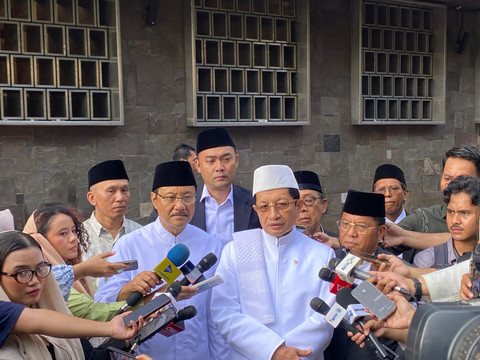
The use of the state budget (APBN) to fund President Prabowo Subianto’s sacrificial cattle for Eid al-Adha has sparked considerable public discussion. Responding to the debate, Minister of Religious Affairs Nasaruddin Umar clarified the true essence of the kurban (sacrifice), emphasizing that its benefits are intended for all, not exclusively for one group.
During his address at the Istiqlal Mosque in Central Jakarta on Thursday, June 28, Nasaruddin asserted, “The sacrifice is not solely for Muslims; it is for anyone who is hungry, anyone in need. This is rooted in the Prophet’s hadith.” He further elaborated on teachings from Prophet Muhammad SAW, which strictly forbid allowing anyone to suffer from hunger, regardless of their faith or background.
Nasaruddin cited a profound example from Islamic tradition: “There was a hungry Jewish woman on that day. Rasulullah (Prophet Muhammad) stated that no one should go hungry. Whatever their religion, take from his possessions and the mosque to distribute to them.” This historical account underscores the deeply inclusive nature of charity and the imperative to address food insecurity across all communities.
The Minister of Religious Affairs further stressed that the distribution of meat from these sacrifices affirms every individual’s fundamental right to consume meat. He drew a parallel between this concept and zakat fitrah during Eid al-Fitr, highlighting both as integral to ensuring communal well-being during religious holidays.
“Our objective for the sacrifice is identical to that of Eid al-Fitr,” Nasaruddin explained, quoting Rasulullah SAW who stated that no one should go hungry or without food on an Eid day. “Therefore, zakat fitrah aims for everyone to be well-fed on Eid al-Fitr by consuming carbohydrates. For Eid al-Adha, its counterpart is animal protein.” He expressed a hopeful sentiment that during this month of sacrifice, no one would be deprived of meat consumption.
Providing context to the public discussion, it was revealed that President Prabowo Subianto distributed a significant number of sacrificial cattle—a total of 1,098 cows. Of these, 598 cows were allocated to various regions across the country, while the remaining 500 were directed to educational institutions and influential community figures, broadening the reach of this annual charitable act.
The financial outlay for these sacrificial animals amounted to an estimated Rp 100 billion. This substantial sum was drawn from the state budget (APBN), channeled through the long-established Presidential Community Assistance (Banpres) program. This program is designed to provide government aid directly to the community, especially during significant national or religious events.
Deputy Minister of State Secretary Juri Ardiantoro elaborated on the government’s official stance regarding the initiative on Wednesday, May 27. He stated, “The intention behind the President’s sacrificial cattle is to provide government assistance to the public. The primary goal is to ensure that needy citizens can celebrate Eid al-Adha by participating in the collective slaughter of sacrificial animals.” Moreover, Juri underscored that the distributed beef from these sacrifices would ultimately reach those who are most in need, reinforcing the humanitarian aspect of the program.
Summary
The use of the state budget (APBN) to fund President Prabowo Subianto’s sacrificial cattle for Eid al-Adha sparked public discussion. Minister of Religious Affairs Nasaruddin Umar clarified that the sacrifice’s benefits are intended for all, not exclusively one group, rooted in Prophet Muhammad’s teachings that no one should suffer hunger regardless of background. He emphasized that the distribution of meat affirms every individual’s fundamental right to consume animal protein during Eid al-Adha, akin to zakat fitrah for Eid al-Fitr.
President Prabowo distributed 1,098 sacrificial cows, with 598 going to various regions and 500 to educational institutions and community figures. This initiative was funded by an estimated Rp 100 billion from the state budget (APBN) through the Presidential Community Assistance (Banpres) program. Deputy Minister of State Secretary Juri Ardiantoro stated the primary goal is to provide government assistance, ensuring needy citizens can celebrate Eid al-Adha and receive distributed beef.
