
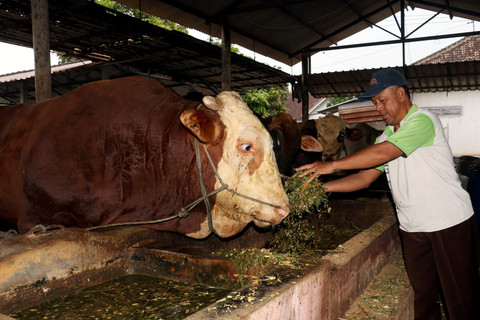

The recent purchase of 1,098 sacrificial cows by President Prabowo Subianto has ignited public discussion, primarily due to the fact that these animals were procured using state funds, specifically the State Budget (APBN).
In response to the growing discourse, Deputy Minister of State Secretary Juri Ardiantoro clarified that the distribution of these sacrificial cows from the President constitutes a vital form of government assistance to the community.
This initiative, he elaborated, falls under the longstanding Presidential Community Assistance program, or Banpres. Ardiantoro affirmed that such actions are considered customary and a regular practice for the government.
Elaborating on the program’s intent, Juri stated in a press release on Wednesday, May 27, that “The purpose of these sacrificial cows from the President is to provide government assistance to the public. It aims to ensure that citizens in need can celebrate Eid al-Adha by partaking in the communal sacrifice of animals.”
He further underscored that the meat from these sacrificial cows would be meticulously distributed to those most in need, reinforcing the program’s charitable objectives.
Additionally, Ardiantoro pointed out that President Prabowo also participates in the tradition of sacrifice personally, funding his own sacrificial animals. The meat from these private contributions is likewise shared with the community, demonstrating a dual commitment to the practice.
MUI Confirms Sharia Compliance
As the discussion around the funding source intensified, Asrorun Niam Sholeh, Chairman of the Indonesian Ulema Council’s (MUI) Fatwa Division, stepped forward to provide a religious perspective. He asserted that the procurement of sacrificial animals using the State Budget poses no issue under Islamic law, highlighting that this model of provision possesses a robust jurisprudential foundation rooted deeply in Islamic history.
Niam specifically referenced a Hadith narrated by Imam Bukhari, which indicates that a leader or Imam is indeed recommended (sunnah) to purchase sacrificial animals through the Baitul Mal, the traditional Islamic public treasury.
He further clarified, “In the contemporary context of state governance, the APBN functions as a modern Baitul Mal. Therefore, these state-funded sacrifices are purely intended for the extensive benefit and welfare of the wider community. From a Sharia perspective, there is no issue whatsoever.”

Beyond religious legitimacy, Niam also emphasized the bureaucratic logic behind this mechanism, explaining its similarity to the distribution of other forms of social assistance.
The key distinction, he noted, lies in the form of assistance: this time, it is delivered as sacrificial animals, meticulously distributed to various regions across the country.
Niam elucidated, “It’s akin to how Banpres funds are materialized into staple food packages and then distributed to the public. The logic remains consistent: these sacrificial animals are not for the President’s personal consumption but are directly channeled to different regions for communal benefit.”
President’s Sacrificial Cows Purchased Using State Budget
The specifics regarding the President’s sacrificial cow procurement using the State Budget were initially disclosed by Deputy Minister of State Secretary Juri Ardiantoro.
He confirmed that a total of 1,098 sacrificial cows were purchased under the Presidential Community Assistance budget, with an approximate value of Rp 100 billion.
Speaking from the Presidential Palace in Jakarta on Tuesday, May 26, Juri elaborated, “The source of funding is indeed the APBN, channeled through the Presidential Assistance budget, specifically the Presidential Community Assistance program. The price of each cow naturally varies due to differences in weight and location, so we adjust the pricing according to each region. The total budget expended is approximately Rp 100 billion.”
Summary
President Prabowo Subianto procured 1,098 sacrificial cows using the State Budget (APBN), totaling approximately Rp 100 billion, under the Presidential Community Assistance program. Deputy Minister of State Secretary Juri Ardiantoro clarified this initiative is a vital form of government aid, ensuring citizens in need can celebrate Eid al-Adha, and is a longstanding, regular practice for the government.
The Indonesian Ulema Council (MUI) confirmed the procurement using the APBN is sharia compliant. MUI’s Fatwa Division Chairman Asrorun Niam Sholeh explained that the APBN functions as a modern Baitul Mal, making state-funded sacrifices for the community’s welfare permissible under Islamic law, similar to other forms of social assistance distributed to the public.
