
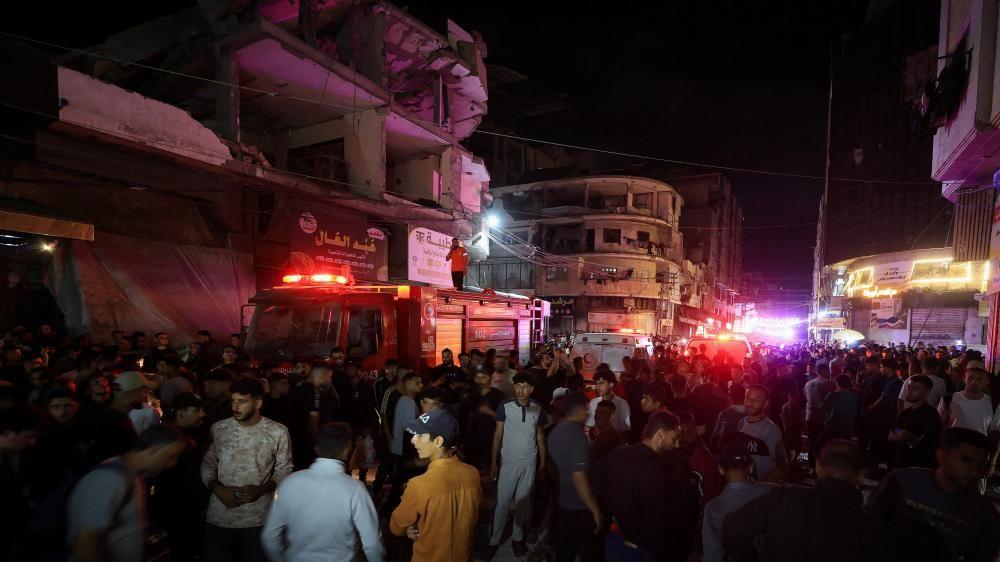

Hamas military wing commander Mohammed Odeh was killed in an Israeli airstrike in the Gaza Strip on Tuesday, May 26—marking the second high-profile assassination of a commander in the group’s leadership within weeks.
Local medical officials and witnesses reported that at least three Palestinians were killed and dozens more injured in the strike, which decimated a residential building in one of Gaza City’s most congested market districts. The area was particularly crowded at the time as residents prepared for the upcoming Eid al-Adha holiday.
The Israeli military and the Shin Bet security agency confirmed the operation, stating that the building housing Odeh’s hideout was targeted after his movements had been closely monitored for several months. While Hamas has yet to issue a formal press release, internal sources and relatives confirmed that Odeh and his wife died in the blast, while their adult son passed away from his injuries early Wednesday morning.
Despite a ceasefire agreement reached between Israel and Hamas last October, the region continues to be plagued by near-daily violence. The latest strike hit the top three floors of the al-Kayali Building in central Gaza City. Emergency teams rushed to the scene but faced significant difficulties reaching the upper levels due to catastrophic structural damage and the heavy traffic characteristic of the busy commercial area.
Eyewitnesses described a coordinated assault, with at least five missiles striking the building almost simultaneously from various directions. One resident noted the sound of helicopters hovering above the neighborhood moments before the explosions. Video footage from the site showed civil defense teams and ambulances navigating through the wreckage as crowds gathered to assist in the search for survivors.

In a statement released on Tuesday, the office of Israeli Prime Minister Benjamin Netanyahu labeled Odeh as “one of the masterminds behind the October 7 massacre.” The statement further asserted that Odeh was responsible for the “murder, kidnapping, and wounding of many Israeli citizens and IDF soldiers.”
Odeh’s death follows that of his predecessor, Izz ad-Din al-Haddad, who was killed in a similar Israeli airstrike in early May. That operation also targeted a residential structure and resulted in at least three fatalities, according to local sources.
A joint statement from the Israel Defense Forces (IDF) and Shin Bet explained: “As part of a joint IDF and Shin Bet operation to eliminate the terrorist Mohammed Odeh, several buildings in the heart of Gaza City where he was hiding were attacked, following months of intelligence surveillance to track his movements and the movements of his associates within the organization.”
The military added that they also targeted a nearby apartment belonging to a Hamas operative who participated in the October 7 attacks and was part of Odeh’s inner circle. The October 7 reference denotes the 2023 Hamas-led assault on southern Israel.
Hamas sources confirmed to the BBC on Tuesday that Odeh and his wife had been killed. Relatives added that funeral services would be held following the Dhuhr (midday) prayer at a mosque in Gaza City.
Israel Continues Gaza Offensive
Israel has maintained a pattern of regular strikes across Gaza since the ceasefire officially began on October 10. Hamas has repeatedly accused Israel of violating the terms of the truce and targeting civilian populations. The Hamas-run Palestinian Ministry of Health reports that over 900 people have been killed by Israeli strikes during the ceasefire period alone.
Conversely, the Israeli government claims it maintains the authority to target Hamas members and has accused the group of breaching the ceasefire by failing to undergo demilitarization. Progress on a U.S.-led peace plan for Gaza has largely stalled since the conflict expanded to include Iran in February.
The U.S. had announced the start of the second phase of the plan in January, which envisioned a technocratic interim government taking control of Gaza, accompanied by reconstruction and demilitarization. However, negotiations regarding disarmament remain deadlocked, and Hamas has since reactivated its police force to reassert authority in several areas.
Israeli Defense Minister Israel Katz stated on Wednesday that Israel remains committed to preventing Hamas from governing Gaza “either civilly or militarily.” He also alluded to a “voluntary emigration plan for Gaza” to be implemented “at the appropriate time and in the appropriate manner.”
Prime Minister Netanyahu reiterated Israel’s resolve to “continue hunting down anyone involved in the October 7 massacre,” adding that “sooner or later, Israel will reach them all.”
The October 7 attacks resulted in approximately 1,200 deaths and the taking of 251 hostages. Israel’s subsequent military campaign has devastated large portions of the Palestinian territory and displaced the majority of its 2.1 million residents. According to the Gaza Health Ministry—whose data is deemed reliable by the United Nations—Israeli forces have killed more than 72,800 people in Gaza since the start of the conflict.
The recent strike in Gaza coincides with an escalation in Lebanon, where 31 people were killed in Israeli strikes following Netanyahu’s vow to ramp up military action against the armed group Hezbollah. The Israeli military maintains those strikes target Hezbollah fighters and infrastructure.
- Nine Indonesian volunteers from the Global Sumud Flotilla arrive back in Indonesia
- ‘Raped, shot, and dragged by the hair’ – Testimonies from flotilla volunteers detained by the Israeli military
- Who are the key leaders of Hamas?
- President Prabowo attends Peace Council meeting; Indonesia to serve as deputy commander of the ISF in Gaza
- Positioned in a Hamas combat infrastructure center: What are the risks of TNI involvement in the Board of Peace program in Gaza?
- The story of a Palestinian teenager shot by Israeli soldiers and left to bleed to death – ‘Medics were blocked from helping’
- What is Indonesia’s role in the Trump-initiated Board of Peace?
- Hamas demands ‘peacekeeping forces’ in Gaza remain neutral and avoid interfering in Palestinian internal affairs – What does this mean for Indonesia?
- Indonesia joins condemnation of Israel’s plan to take over Gaza City – What is known so far?
Summary
Israeli forces killed Hamas military wing commander Mohammed Odeh in an airstrike in Gaza City on Tuesday, May 26. The strike, targeting a residential building in a crowded market district, resulted in at least three Palestinian fatalities, including Odeh, his wife, and their adult son, with dozens more injured. Both the Israeli military and Shin Bet confirmed the operation, stating Odeh, whom they labeled a “mastermind behind the October 7 massacre,” was targeted after months of surveillance. This marks the second high-profile assassination of a Hamas commander in weeks, following the death of Izz ad-Din al-Haddad in early May.
The incident occurred amidst persistent violence in Gaza despite a ceasefire agreement from last October, with Israel maintaining regular strikes and Hamas accusing them of truce violations. Prime Minister Netanyahu reiterated Israel’s commitment to relentlessly pursue all individuals involved in the October 7 attacks, which caused approximately 1,200 deaths and 251 hostages. According to the Gaza Health Ministry, over 72,800 people have been killed in Gaza since the conflict began, and Israel has vowed to prevent Hamas from governing the territory. This strike also coincided with increased Israeli military actions in Lebanon targeting Hezbollah fighters and infrastructure.
