
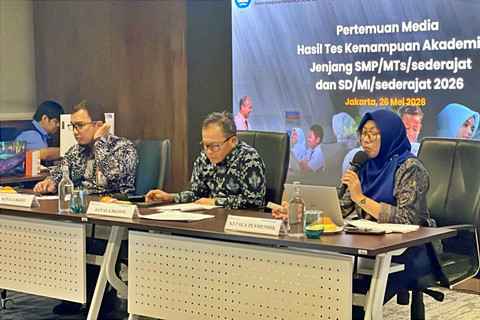
The Ministry of Primary and Secondary Education (Kemendikdasmen) officially released the results of the 2026 Academic Ability Test (TKA) for primary (SD/MI equivalent) and junior secondary (SMP/MTs equivalent) levels on Tuesday, May 26, at 13:00 Western Indonesian Time (WIB). This significant announcement marks a pivotal step in the ongoing efforts to enhance the nation’s educational landscape.
Toni Toharudin, Head of the Kemendikdasmen’s Agency for Primary and Secondary Education Policy (BKPDM), emphasized that the TKA is not designed to categorize or rank regions or schools. Instead, he clarified during a media briefing at the Kemendikdasmen office that “The TKA serves as an instrument to capture academic achievements more comprehensively, providing valuable material for collective reflection to strengthen the quality of learning across our homeland.” This statement underscores the Ministry’s commitment to using the assessment as a tool for improvement, not judgment.
The data gathered through the TKA is poised to become a cornerstone for more targeted and evidence-based educational policies. Toharudin further elaborated that “The mapped academic achievement data, extending down to provincial, city, educational unit levels, and even student competency categories, will form a crucial foundation for developing more precise and evidence-based education policies.” This granular insight is expected to directly inform future initiatives, including a significant shift in teacher training methodologies, reflecting a proactive approach to educational reform.
Adding to the clarity on result dissemination, Rahmawati, Head of the Kemendikdasmen’s Center for Education Assessment (Pusmendik), stated that the results are not published based on individual subject scores or ranked. “We deliberately did not order them by scores but by the provincial codes available in the TKA registration system,” Rahmawati explained. This strategic decision aims to prevent any misinterpretation or unauthorized ranking by media outlets, ensuring the data is utilized as intended rather than for comparative labeling.
A critical point highlighted by Rahmawati is that this year’s TKA results have not yet undergone a process of equating between regional and central test questions. Consequently, direct and accurate comparisons of scores between different regions cannot be reliably made. She cautioned, “If we wish to make comparisons, extreme care is needed, as there are still regional questions whose difficulty levels have not been standardized with those at the national level.” This nuance is vital for understanding the current limitations and the appropriate use of the results.
Despite the complexities of inter-regional comparison, the provincial achievement data is being released to maintain transparency. Rahmawati stressed that the paramount importance lies in how this data is leveraged to devise diverse learning strategies tailored to the unique conditions of each region. She cited a stark example: “There’s one province where less than 5 percent of students achieved inadequate Indonesian language results, with the rest being adequate or good. Conversely, another province has less than 5 percent performing well, with the majority being inadequate or adequate. Such contrasting scenarios mean a uniform learning strategy would certainly miss its mark.”
The TKA results are designed to empower educational units, particularly high schools, to conduct an initial assessment of incoming students. Rahmawati illustrated, “When a high school admits junior high students, each student will have their TKA results. Schools can then map what percentage are lacking, adequate, or proficient. This serves as an initial assessment.” This allows schools to customize their curriculum effectively; for instance, if the majority of students are proficient, they can proceed directly with the Grade 10 curriculum without revisiting junior high material.
Educational institutions can access the Tes Kemampuan Akademik (TKA) results for primary and junior secondary levels from 13:00 WIB today via the official TKA website: https://tka.kemendikdasmen.go.id/hasiltka/.
Summary
The Ministry of Primary and Secondary Education (Kemendikdasmen) officially released the 2026 Academic Ability Test (TKA) results for primary and junior secondary levels on May 26. The TKA aims to comprehensively assess academic achievements and strengthen learning quality across the nation, rather than ranking regions or schools. This data will form a crucial basis for developing precise, evidence-based educational policies and is presented by provincial codes to prevent misinterpretation.
Direct comparisons of TKA scores between different regions are currently not reliable, as the tests have not undergone equating for difficulty levels. However, the provincial data is made transparent to assist regions in devising tailored learning strategies based on specific student competency profiles. Educational units can utilize these results for initial assessments of incoming students to customize curriculum and teaching effectively.
