
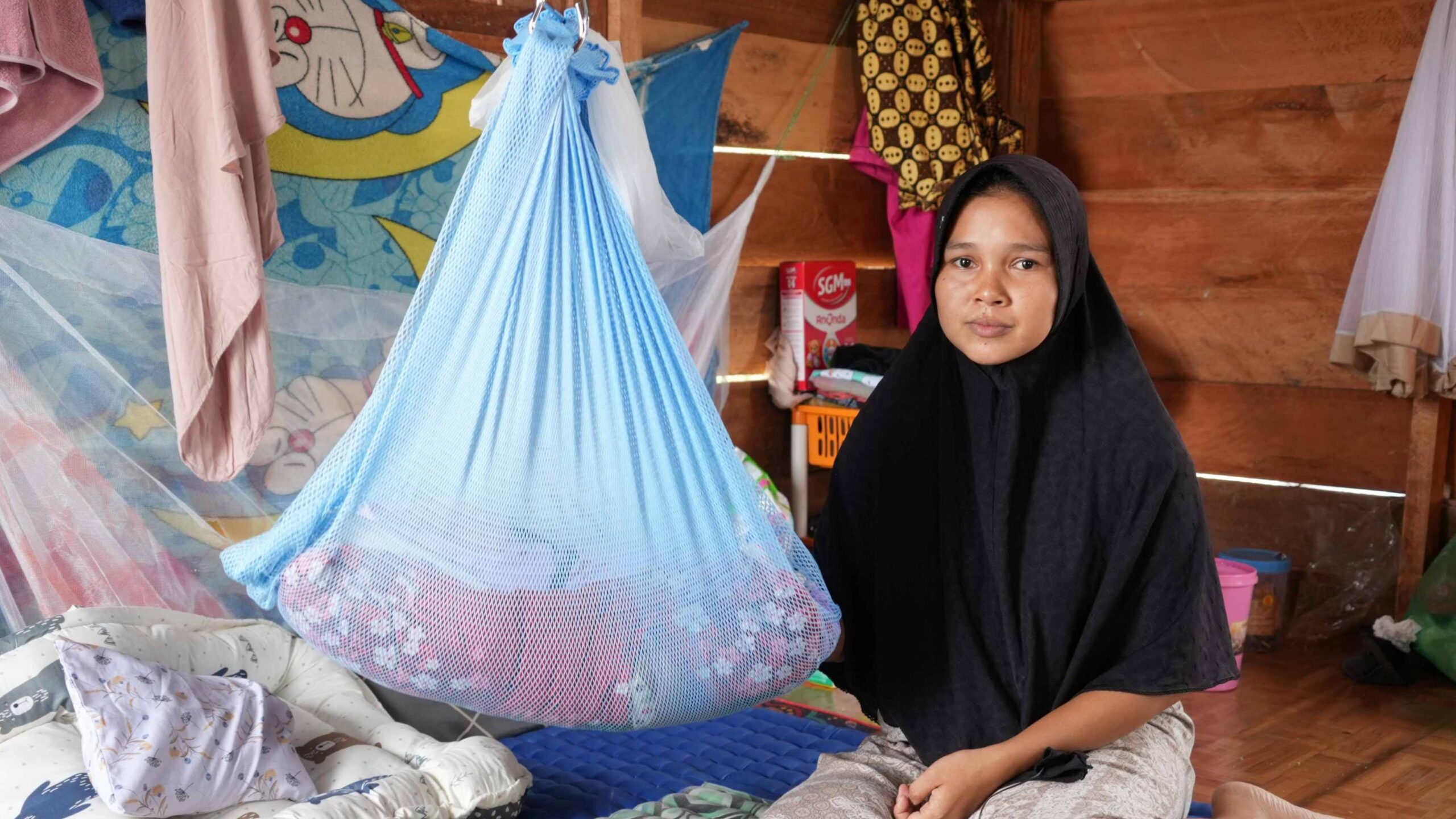

Tears streamed down the face of an Aceh disaster survivor as she recounted the immense struggle of raising her infant child amidst profound limitations and isolation, six months after Sumatra was ravaged by a catastrophic flood.
This article is the first in a special report series by BBC News Indonesia, chronicling the resilience and hardships faced by vulnerable communities in the six months following the disaster.
Nurul Akla, a 23-year-old resident of Geudumbak Village in Langkahan District, North Aceh Regency, shared with BBC News Indonesia the daily challenges of providing essential nutrition for her baby.
“It’s so heartbreaking. I’ve tried various medications, but my breast milk isn’t coming. My child needs formula, but we simply cannot afford to buy it,” she said, weeping on Thursday (May 7).
“We have no income; my husband has no work. All our plantations were destroyed,” she added, her voice choked with emotion.
On November 26 last year, a devastating flood, accompanied by massive log debris, tore through her community, leaving widespread destruction in its wake.
The calamity impacted approximately 1,659 lives and swept away 337 homes. Furthermore, about 80% of residents’ plantations, including palm oil, cocoa, areca nut, orange, and rice crops, suffered severe damage.

Nearly six months since the disaster, Nurul, her husband Basriadi (30), and their children now reside in a temporary shelter (huntara). This shelter was ingeniously constructed by volunteers using salvaged logs, positioned right next to their former home, which was damaged and dragged dozens of meters by the floodwaters.
From the front of Nurul’s dwelling, a vast expanse of logs remains scattered in what was once a riverbed, now dry. This ‘sea’ of timber stands as a stark testament to the sheer force and devastating impact of the disaster on their village.


During BBC News Indonesia’s visit to their 6×6 meter, two-room home on Thursday (May 7), Nurul was carefully feeding her baby daughter, nestled in a hanging cradle, with formula from a bottle. This formula, a gift from relatives, would only last for two more days. After that, Nurul would again face the daunting task of finding a way to nourish her child.

A fan whirred steadily, providing a slight reprieve from the intense midday sun baking the temporary shelter’s living room.
Nurul was frequently lost in thought as she gazed at her second child, who had arrived into the world on April 29.
“We can’t afford milk, diapers, or vitamins for her because we have no income,” she lamented.
“Perhaps in the future, we will have better fortune, and I will continue to try to produce breast milk.”

Read also:
- The struggle of pregnant women and autoimmune sufferers amidst the Aceh floods
- Flood survivors in Central Aceh and Pidie Jaya celebrate Eid al-Fitr in hardship – ‘Please protect nature, don’t just clear-cut’
- The stories of children orphaned by the Sumatra tragedy, what is the state’s responsibility?
Seated beside Nurul, her husband Basriadi explained how the plantations, once their primary source of livelihood, lay utterly devastated.
“Our source of income is gone. Our lime garden is completely destroyed. From one hectare, only six trees remain,” he expressed with a sigh.
“Everything is difficult now; we don’t even have the capital to farm.”


Before the floods struck, Basriadi owned two hectares of land: one hectare of productive lime trees and another hectare planted with young palm oil trees, just months old. He recounted that it took immense effort and years of dedication to establish these plantations.
“Just when we started to reap the benefits from the garden, Allah suddenly took back those blessings. May Allah open the doors of sustenance to provide for us and allow us to buy milk for our children,” Basriadi prayed.

Basriadi admitted that even the thought of restarting their farming, which demands significant capital, felt insurmountable. Simply meeting the family’s daily needs was an overwhelming burden. Observing their current circumstances, he conceded that a return to normalcy, pre-flood, would be a long and arduous journey.
“It could take five to seven years for us to fully recover and live normally again,” he stated.

Currently, Basriadi relies solely on infrequent invitations from others to work as a palm oil harvester, typically twice a month. His earnings, ranging from IDR 100,000 to IDR 200,000 per day, are barely enough to survive.
“The income isn’t even sufficient to buy food for the household,” Basriadi revealed. Nurul interjected, explaining that as a result, her family had been forced to borrow money from relatives to cover essential needs from the initial disaster until her recent childbirth.
“We owe around IDR 3 million for clinic visits (check-ups and delivery), for food, and when our child was sick,” she elaborated. Nurul added that this debt would likely continue to mount if her family did not quickly find a stable source of income.
‘Running from the flood, meeting the flood’
“Our lives are incredibly difficult,” Nurul and Basriadi both affirmed, describing their daily existence as one of “limitation and isolation” since the disaster claimed all their possessions. The tragedy that befell their family, along with hundreds of thousands of other Sumatra residents, occurred on November 26 of the previous year.
Triggered by Tropical Cyclone Senyar, floods and landslides ravaged Aceh, North Sumatra, and West Sumatra, leaving a trail of destruction.


Prior to the disaster, Geudumbak had endured five consecutive days of heavy rain. However, on November 26, Basriadi recounted, the situation was markedly different. Water levels in the dry riverbed in front of their home rose with alarming speed. Basriadi quickly decided to evacuate with Nurul, who was four months pregnant at the time, and their first son, using a motorcycle.

They initially sought refuge at a primary school, but the floodwaters rapidly submerged it. They were forced to move again to higher ground, only for that temporary haven to also be inundated. “We ran from the flood, only to meet the flood again. It happened three times,” Basriadi recounted, shaking his head.
During these multiple displacements, Nurul explained, her family survived on instant noodles, often just once a day. After about two weeks, Nurul and her family decided to return and establish a makeshift tent camp alongside other villagers. Eventually, aid in the form of instant noodles, rice, and drinking water began to arrive. This assistance coincided with government efforts to clear debris and reopen access roads to Geudumbak Village from the ‘sea’ of logs by the end of last year.

Beyond the torrential rainfall, the floods that devastated Geudumbak Village are largely attributed to extensive forest degradation in the river’s catchment area. This destruction stems from palm oil plantation expansion, illegal logging, and illicit mining activities.
Now, six months on, the sprawling expanse of logs, resembling a vast wooden ocean, remains a stark presence. This ongoing situation, Basriadi warns, is akin to a ticking time bomb.
“If it gets hot, these logs will catch fire. If it rains again, there could be another flood. Our homes will all be destroyed again if these logs aren’t removed immediately.”
“This could very well become a time bomb; if it’s not water, it will be fire,” he asserted with grave concern.

Nurul shared her distressing experience of receiving no vitamins or medication during her pregnancy while in displacement, meaning she couldn’t monitor her health or the baby’s development. All she could do was pray that her unborn child would be safe and healthy.
“It was incredibly sad; my child slept in a tent, there wasn’t enough food, and I was pregnant,” she recalled, the trauma still palpable. After a month of living in the tent camp, Nurul finally moved into a temporary shelter constructed by volunteers in January.
In addition to volunteer efforts, the government, through the TNI (Indonesian National Armed Forces), BNPB (National Disaster Management Agency), and the Ministry of Forestry, also contributed to building approximately 30 temporary shelters from logs in Nurul’s vicinity. While having a roof over their heads was a relief, living in these temporary shelters presented its own set of formidable challenges, Basriadi explained.
For several months, their area lacked access to clean water and electricity. Basriadi resorted to fetching clean water from a neighboring village using jerry cans to meet his family’s daily needs. A water tower and electricity lines were only installed in April. However, the water they received was yellow and emitted an unpleasant odor, according to Basriadi.
“The water can only be used for bathing and cleaning; it’s not safe for consumption,” he stated. To this day, Basriadi added, there are no adequate bathroom facilities in their area. He and other residents constructed temporary wooden outhouses for bathing, while for other necessities, they must venture into the nearby plantation.
During their approximately three months of living in the temporary shelter, Nurul also gave birth to her baby girl. She recounted that the birthing process itself was far from easy. Her pregnancy had extended to almost ten months, yet she experienced no contractions.

Eventually, Nurul’s amniotic fluid began to leak, prompting her to be rushed to a clinic for labor induction. “The medical staff said my stress from all the worries was preventing contractions. My mind was consumed with thoughts of how we would manage after birth, with no economy, my husband having no income, and our other child still so young,” Nurul revealed.
‘Able or not, we must face it’
Nurul and Basriadi hold immense hope for the government, earnestly pleading for the swift disbursement of the promised living allowance (jadup) of IDR 15,000 per person and vital business capital.
“The government once promised to provide aid, but nothing has materialized so far. That aid represents our sole hope for rebuilding our lives,” Nurul stated. She elaborated that her family intends to use any government assistance as capital to restart farming activities.
“We will replant whatever we can, focusing on agriculture to provide for our children,” she affirmed.

Previously, Minister of Home Affairs Muhammad Tito Karnavian visited Geudumbak Village on Wednesday (December 31, 2025). During his visit, Tito distributed essential food items, fast food, clothing, school supplies, and personal hygiene kits for women.
Furthermore, Tito announced that the Ministry of Social Affairs would channel financial aid including a daily food allowance of IDR 15,000 per person, IDR 3 million for household contents, and IDR 5 million per family for economic empowerment initiatives.

However, Basriadi stated that these government promises have remained “just promises.” To date, he claims to have received no aid from the government. “Most of the help comes from volunteers. Even the temporary shelter I live in was built with volunteer assistance,” he emphasized.
With a newborn child, a destroyed plantation, and severely limited employment opportunities, Basriadi finds it incredibly difficult to envision a stable future for his family. “My greatest hope is for government assistance, to serve as capital and strength, enabling us to rebuild our lives,” he expressed.

North Aceh Regent Ismail A Jalil reportedly met with Social Affairs Minister Saifullah Yusuf. Ismail requested that aid for damaged houses, living allowances, economic stimulus, and household contents for his constituents be disbursed before Eid al-Adha 1447 Hijriah, aiming to alleviate the burden on flood survivors in North Aceh.
“The assistance allocated by the central government for flash flood and landslide survivors will undoubtedly greatly help residents celebrating Eid al-Adha 1447 Hijriah,” said North Aceh Regency Government Spokesperson Muntasir Ramli on Saturday (May 16).
Ismail mentioned that the North Aceh Regency Government has proposed 98,530 households for inclusion in the Post-Disaster Rehabilitation and Reconstruction Plan for North Aceh. The North Aceh Regency Government has also urged flood survivors to be patient, as the government is still finalizing data collection to ensure that all those affected receive government assistance.

North Aceh Regency was among the regions most severely impacted by last year’s Sumatra disaster. BNPB data indicates that 248 people died in the area, marking the highest fatality count among the 10 affected regencies/cities. Furthermore, BNPB recorded 373,063 people suffering, 54,186 damaged homes, 838 damaged public facilities, and over 40,000 hectares of affected land. Meanwhile, in North Aceh, over 4,600 temporary shelters and 104 permanent homes have been constructed.

At the close of the conversation, Basriadi affirmed his unwavering resolve to fight for his family’s life, even if government assistance remains elusive. “Our living conditions are nothing like before. If we wanted to blame someone, who could we blame?” he mused. “Because this is God’s will. Able or not, we must face it,” Basriadi concluded with a profound sense of acceptance.

Meanwhile, Nurul admitted that she still carries the trauma of imagining how her family navigated each day over the past six grueling months. Yet, amidst the myriad of problems they face, Nurul believes she is still fortunate compared to other survivors. “Even though there’s no food, everything is difficult, my life is incredibly hard, and the trauma hasn’t faded, I am grateful because I am with my husband and child.”
“Other people have been separated from their children, husbands, and have lost their family members,” she observed. Nurul added that she would continue to push forward, struggle, and refuse to surrender for the sake of her young children. “We will continue to fight together, no matter what challenges come our way, for the sake of our children and their future,” Nurul concluded with determined hope.
- White flags in Aceh, ‘Aceh’s condition is so bad, we are not okay’ – What is the central government’s response?
- The story of a nurse who stayed in Aceh Tamiang Regional General Hospital for a baby
- Didong Gayo Art, ‘a comforter’ for flood-landslide survivors in Central Aceh
- Floods and landslides open old wounds for earthquake survivors in Central Aceh
- The story of a family trapped in the North Sumatra forest for days during floods and landslides – ‘Leave me, save your sibling’
Summary
Nurul Akla, a 23-year-old flood survivor in North Aceh, faces immense hardship raising her infant child six months after a devastating flood in Sumatra. Her family resides in a temporary shelter after their home and plantations were destroyed, leaving them without income. Nurul struggles to provide formula milk for her baby due to her inability to breastfeed and their severe financial limitations. They have also incurred significant debt for medical and daily expenses.
The November 26 flood, attributed to forest degradation, destroyed livelihoods and homes for thousands, with North Aceh being particularly hard-hit. Despite government promises of living allowances and economic aid, Nurul and her husband, Basriadi, report receiving no such assistance, relying instead on volunteers. They also face ongoing challenges like a lack of clean water and the threat of further disasters from accumulated log debris, highlighting the slow recovery and unfulfilled commitments to survivors.
