
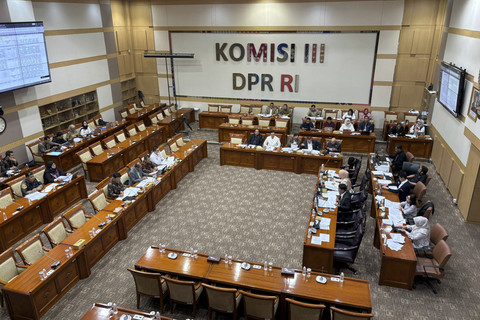

Indonesia’s House Commission III has unveiled significant proposed amendments within the Draft Law (RUU) on the Indonesian National Police, widely known as the Polri Bill. A key provision in this legislative overhaul addresses the adjustment of the police force’s retirement age, which will be modified to align with the evolving operational and organizational needs of the institution.
According to Habiburokhman, the Chairman of House Commission III, the Polri Bill is meticulously crafted to complement the regulatory frameworks established by the new Criminal Code (KUHP) and Criminal Procedure Code (KUHAP). More broadly, it serves as a direct response to and implementation of various recommendations for comprehensive police reform.
“The Draft Law concerning the Indonesian National Police incorporates several crucial modifications, encompassing eight core points of change, 11 amended articles, and their corresponding explanations,” Habiburokhman affirmed during a working meeting with Minister of Law Supratman Andi Agtas at the House of Representatives on Monday.
He underscored that the regulations proposed in the Polri Bill are designed to remain fully consistent with the 1945 Constitution (UUD 1945) and the decrees of the People’s Consultative Assembly (Tap MPR) Number VI and VII of the year 2000. This commitment ensures the bill operates firmly within the existing constitutional framework.
Reiterating this crucial adherence, Habiburokhman further emphasized that the provisions within the Polri Bill will not deviate from the 1945 Constitution or Tap MPR Number VI and VII of 2000. This includes safeguarding the president’s prerogative in the selection process for the National Police Chief (Kapolri), a fundamental aspect of executive authority.
Habiburokhman elaborated that these reforms entail the amendment of 11 articles within the draft law. The Polri Bill introduces a series of new primary regulatory provisions aimed at modernizing and strengthening the institution. These include:
-
Clarity on Polri’s Transformation Goals: Affirming the objective and direction for a transparent, professional, integrity-driven, and high-quality transformation of the police force in public service.
-
Enhanced Oversight and Transparency: Strengthening the oversight function and implementing principles of openness through the utilization of modern information and communication technology.
-
Ensuring Police Neutrality and Professionalism: Guaranteeing the neutrality and professionalism of Polri within its governance system and human resource career development pathways.
-
Strict External Assignments Regulations: Implementing stringent and clear regulations concerning Polri members assigned to duties outside the police institution.
-
Adjusted Retirement Age: Precisely regulating the police retirement age to be more clearly defined and measurable, adapting it to the organization’s specific needs.
-
Human-Centric Education Curriculum: Adopting an educational curriculum that integrates humanist, democratic principles, and robust protection of human rights.
-
Strengthening Kompolnas: Reinforcing the duties and functions, and redefining the strategic position, of the National Police Commission (Kompolnas).
Habiburokhman noted that the drafting of the bill followed extensive consultation, with House Commission III receiving diverse inputs from the Working Committee for Police Reform (Panja Reformasi Polri), the Public Prosecution Office, the Courts, and recommendations from the Commission for the Acceleration of Police Reform (KPRP).
“Therefore, to concretely and responsively act upon the recommendations from Panja and KPRP, House Commission III has meticulously drafted the Draft Law on the Indonesian National Police,” he stated.

In addition to these comprehensive reforms, the Polri Bill will also incorporate eight crucial points derived from the work of the Panja Reformasi Polri within House Commission III. These significant aspects are:
-
Polri’s Presidential Mandate: Reaffirming the Indonesian National Police’s position under the President, with appointments and dismissals made by the President, subject to House approval, in line with Tap MPR Number VI and VII of 2000.
-
Kompolnas Optimization: Maximizing the effectiveness of the duties and functions of Kompolnas.
-
Regulating External Police Assignments: Emphasizing the critical need to regulate the assignment of Polri members outside the police institution, referencing Constitutional Court decisions.
-
Strengthened Internal Oversight: Fortifying the internal oversight mechanisms within the Indonesian National Police.
-
Fiscal and Resource Governance: Ensuring the sound governance of Polri’s resources and budget in accordance with prevailing regulations.
-
Cultural Police Reform: Highlighting the imperative for cultural reform within Polri, with a pronounced emphasis on respecting human rights and democratic principles.
-
Modernization and Technology Integration: Advancing the modernization of Polri and leveraging technology to enhance police duties and functions.
-
Urgency of Legislative Reform: Stressing the critical necessity for comprehensive rule reform through the enactment of the Polri Bill.
Summary
Indonesia’s House Commission III has proposed significant amendments within the Draft Law on the Indonesian National Police (Polri Bill). A key provision is the adjustment of the police force’s retirement age, which will be modified to align with the institution’s evolving operational and organizational needs. This bill aims to complement the new Criminal Code and Criminal Procedure Code, implementing various police reform recommendations through eight core points of change and 11 amended articles.
According to Habiburokhman, the bill is meticulously crafted to be consistent with the 1945 Constitution and relevant People’s Consultative Assembly decrees, upholding the president’s prerogative in selecting the National Police Chief. Beyond the retirement age, reforms include enhanced oversight, ensuring police neutrality, stringent regulations for external assignments, a human-centric education curriculum, and strengthening the National Police Commission (Kompolnas). The drafting process involved extensive consultations to achieve comprehensive police reform.
