
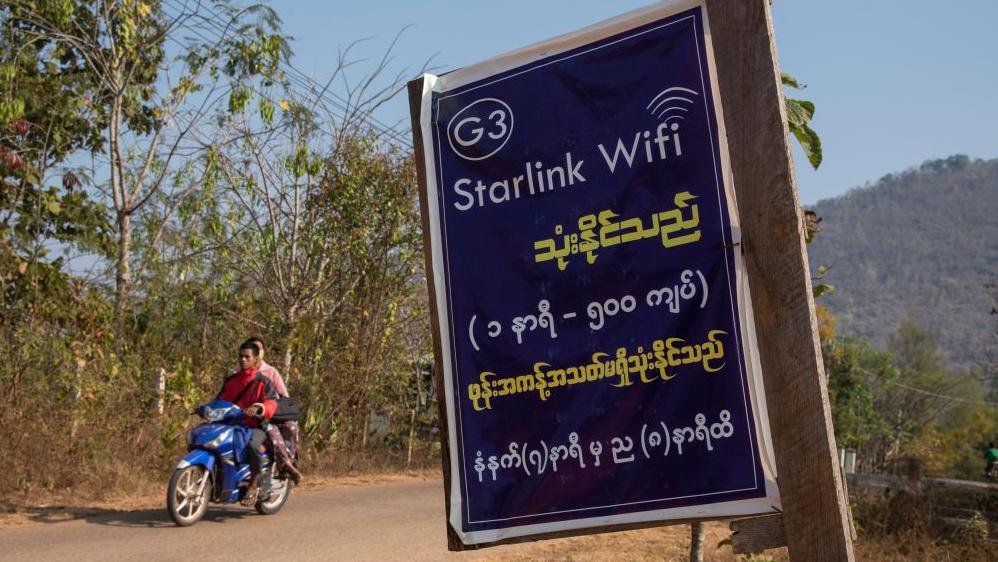

In a small bamboo kiosk in Myanmar, Min is preparing to open his shop.
Messy, dangling wires connect an off-grid solar power system to the sockets. Rows of plastic chairs await the arrival of customers, while a handwritten menu displays a selection of meat snacks and salads.
Min—not his real name, for safety reasons—knows well that his customers will spend a significant amount of time here. They come for one reason only: the internet.
He recounts that around 30 people visit his cafe every day. When it first opened over two years ago, such cafes were still a rarity, and about 300 to 400 customers would come daily.
“The demand was truly extraordinary,” he recalls.
Min’s region is one of many areas affected by local internet blackouts. This policy was imposed by Myanmar’s military junta, which has been in power since seizing control through a military coup in 2021.
During the five years of civil war that ensued, some regions across the country experienced internet outages lasting for days, and in some cases, even months.
In 2022, UN experts stated that these network disconnections deliberately targeted areas where the junta faced fierce resistance from opposition groups.

To circumvent the internet blackouts, Min employs a clever trick: he utilizes Starlink. Elon Musk’s SpaceX satellite internet service connects directly to space, making it entirely independent of the crippled domestic internet infrastructure.
The lifeline of connectivity in his shop relies on a flat, rectangular signal-receiving antenna. He acquired the device through the black market in Thailand, smuggled it across the border, and it is now firmly installed on the tin roof of his kiosk.
Hidden Location
Min states that his business actually operates at a loss. He deliberately sets a low rate of 1,000 kyat (approximately Rp 8,374 or $0.60 USD) per hour to keep it affordable for refugees and local residents he aims to assist.
However, operating this internet cafe is a life-threatening endeavor. The military junta strictly prohibits such businesses. Even a slight misstep could lead to Min being thrown in jail or having all his valuable equipment confiscated.
These restrictions mean his cafe can only operate for three hours a day.
Also read:
- Businesses and online taxi drivers suffer losses due to internet disruption in Merauke
- A child accesses the internet every half second – How to keep them safe online?
Beyond the limited electricity supply, the shadow of fear constantly looms.
Although the area is under the control of resistance groups, Min remains anxious that his solar panels or Starlink dish might be visible from the air when government fighter jets pass overhead.
To evade military radar, he has even moved his cafe’s location twice to more secluded spots.

According to records from the Myanmar Internet Project (MIP)—a digital rights organization—since February 2021, internet shutdowns in various regions of Myanmar have occurred more than 450 times, impacting the lives of over 20 million people.
MIP has also observed a clear pattern linking these blockages to attacks launched by the junta.
“Our research shows that almost 90% of these internet disconnections are closely related to bombing campaigns… They intentionally cut off citizens’ communication so they can destroy areas undetected,” reveals Nyan, a digital rights analyst at MIP who also uses a pseudonym for safety.
Furthermore, cyber surveillance in the country is extremely strict. Myanmar citizens are strictly forbidden from providing or using VPNs without official permission from the military government. Yet, this technology, which utilizes remote servers to hide IP addresses and user locations, has long been relied upon worldwide to bypass internet censorship.
Ironically, internet access challenges don’t solely originate from the military. Armed resistance groups also occasionally disrupt networks. For their own security, they sometimes impose temporary bans on Starlink usage in areas they control, or even boldly attack existing communication infrastructure.
Outages on the Rise
While Min’s operation is small-scale, he is part of a growing global movement. In various parts of the world, more and more individuals and groups are operating across legal boundaries to breach the walls of internet censorship erected by some of the most repressive regimes on earth.
This phenomenon aligns with findings from Access Now, an international digital rights organization. In its report, Access Now noted that global internet shutdowns have steadily climbed since 2020, reaching an all-time high in 2025 with a total of 313 outages in 52 countries.
Of these figures, Myanmar holds the grim record for the most shutdowns, totaling 95 instances.
Beyond total network disconnections, the blocking of specific digital platforms has also surged dramatically.
In 2025, Access Now identified 94 cases of social media and instant messaging app blockages worldwide—including Facebook, WhatsApp, Telegram, and X. This number of access closures has tripled compared to 2016, when the organization first began tracking this data.

Thousands of kilometers from Myanmar, Andrés Azpurúa works from Madrid. Andrés leads a team of volunteers dedicated to building an application specifically designed to penetrate censorship blockades in his home country, Venezuela.
The media landscape in Venezuela is tightly controlled by the government. Many local independent news outlets are blocked, while periodic restrictions continue to target international platforms like X and Facebook, as well as news sites such as The Wall Street Journal.
To combat this silencing, Azpurúa’s team launched Noticias Sin Filtro (News Without Filter). This free application gathers various independent news sources—both local Venezuelan and international—with a VPN technology built directly into it.
According to Azpurúa, the app was intentionally designed to make it easier for Venezuelans to use a VPN.
“You don’t need to log in, you don’t need to create an account, you don’t need to pay anything… You just read the news,” he explains.
The application, released just before the contentious presidential election in July 2024, has been downloaded 140,000 times. However, this struggle has come at a high price.
As a vocal digital rights activist opposing censorship, Azpurúa was forced to flee Venezuela later that year due to the looming threat of imprisonment.
“All signs indicated they were tracking my whereabouts and trying to arrest me,” he recalls.
When former president Nicolás Maduro was detained by the United States earlier this year, many Venezuelans rejoiced, believing political change was imminent.
However, under the leadership of his successor, Delcy Rodríguez, Azpurúa believes the situation has not improved; media and internet censorship remains largely unchanged.
To this day, the news application continues to be developed thanks to the hard work of volunteers and funding primarily sourced from donations. For Azpurúa, this project is more than just technology.
“This is our way of supporting the enforcement of human rights, including the right to access information and freedom of expression,” he states.
China’s ‘Great Firewall’
Meanwhile, on another side of the globe, an expatriate using the pseudonym Echo is part of a growing line of developers challenging another colossal internet censorship system: The Great Firewall of China.
In China, access to various international news websites, social media platforms, search engines, and streaming platforms is completely blocked. Instead, citizens are directed to use state-controlled and closely monitored applications like WeChat and Weibo.
Echo—a former IT worker who left China three years ago—established a third-party software-based service.
Through this system, he helps people in China bypass the digital blockade to access forbidden sites such as Google, YouTube, and Facebook.
In operating his service, Echo collaborates with a business partner inside China, proceeding with extreme caution to avoid detection by authorities.
“In China, if you are caught helping others access the internet freely… you will definitely be arrested,” he asserts.
Echo’s venture provides free subscription packages for users in China, while operational costs are covered by the sales of premium paid packages with more comprehensive features.
Echo himself admits he currently survives on his savings. He views his efforts as a dynamic battlefield against China’s stringent censorship.
“There are times when developers like us have the upper hand, but there are also times when we are cornered,” he says.
Beyond assisting citizens in his homeland, Echo is now extending these free subscription packages to users in Iran. That country has been grappling with mass internet blackouts following a wave of protests last January, compounded by the ongoing conflict against the United States and Israel.
Regarding this situation, the UK-based human rights organization, Article 19, presented a detailed report on how Iran is imitating various cyber technologies and tactics from China to tighten its grip on their digital space.

When contacted by the BBC for confirmation regarding these internet restrictions, the governments of Myanmar, Venezuela, and China chose to remain silent and did not respond to the questions posed.
Nevertheless, on various previous occasions, these regimes have often sought refuge behind reasons of national security and stability.
For example, the Myanmar junta in 2021 stated that blocking Facebook was done to curb the spread of “fake news and disinformation.”
Meanwhile, while still in power, Maduro accused several social media platforms of being used as tools to spread “hatred.”
On the other hand, Chinese President Xi Jinping has also asserted that “chaos” in cyberspace would only “harm the public interest.”
But for people at the grassroots, like the customers who visit Min’s internet kiosk in Myanmar, the impact of these digital blackouts is profoundly distressing.
“Almost all aspects of our lives are paralyzed—from daily activities, the local economy, education, to communication among family members,” laments Khin (not her real name), a 27-year-old woman living in central Myanmar.
Khin recounts that when the internet blackout first occurred, she completely lost a way to contact her family living in remote areas, where even phone networks were unreliable.
“Our communication was completely cut off,” she remembers.
To even get a glimmer of an internet signal, she sometimes had to walk for an hour.
Similar suffering is experienced by Nay (25), a university student whose name has also been disguised. To access the internet at the Starlink cafe, she regularly travels more than 2 kilometers.
“We, the youth… bear the responsibility to build our region. But now, with these internet blackouts, we can do nothing,” Nay softly states.
For her, the future of the younger generation seems to be deliberately “pushed into darkness.”
- Pros and cons of Starlink in Indonesia – ‘Local players are also capable, the government shouldn’t favor foreign players’
- Jakarta Administrative Court rules internet blocking in Papua and West Papua ‘unlawful’
- Komdigi blocks Magdalene content – ‘Similar to New Order era censorship’, says AJI
- Internet blocking in Papua deemed baseless, digital rights activists to sue government
Summary
Internet censorship and network shutdowns are increasingly common tactics used by repressive regimes
