
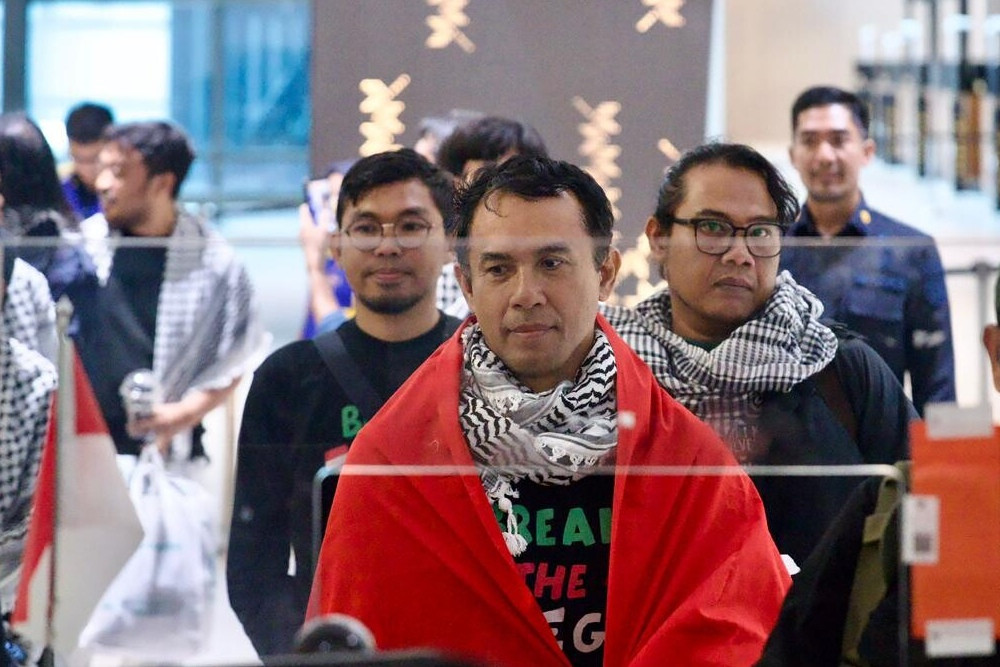
JAKARTA – The detention of nine Indonesian citizens by the Israeli military following the interception of the Global Sumud Flotilla (GSF) 2.0 humanitarian aid ship posed a significant test for Indonesian diplomacy amidst the escalating Gaza conflict. This incident transcended mere citizen protection abroad; it challenged the Indonesian government to uphold its consistent support for Palestine while swiftly securing the release of the volunteers, all without formal diplomatic ties with Israel.
The vessel, laden with crucial humanitarian aid destined for Gaza, was intercepted by Israeli forces in the waters surrounding Cyprus and the Eastern Mediterranean. Aboard the convoy were nine Indonesian nationals, members of the Global Peace Convoy Indonesia (GPCI).
Upon receiving news of the detention, the Indonesian government reacted immediately. General (Ret.) Dudung Abdurachman, Head of the Presidential Staff (KSP), confirmed the swift response. “Indeed, I immediately went to the Ministry of Foreign Affairs to coordinate on this matter,” Dudung stated during a press conference at the Bina Graha Building, Presidential Staff Office, recently.
Initial reports received by the government indicated that five Indonesian citizens were already detained by the Israeli military, while the remaining four were still aboard different ships in the vicinity of the Eastern Mediterranean. In response, Indonesia mobilized its diplomatic resources, with the Ministry of Foreign Affairs coordinating intensively through its representatives abroad, including the Indonesian Embassies in Ankara, Cairo, Rome, Amman, and the Consulate General in Istanbul.
Proactive measures were also prepared, such as the issuance of Travel Letters in Lieu of Passports (SPLP) should the volunteers’ documents be confiscated. Medical support was also made ready for any immediate needs. General Dudung emphasized that the government’s focus extended beyond merely securing the release of its citizens; it also vehemently condemned the Israeli military’s actions against the humanitarian fleet. Indonesia urged Israel to release all volunteers and ensure that humanitarian assistance to the Palestinian people continued unimpeded, in accordance with international humanitarian law.
Diplomacy Without Formal Ties
However, the situation was significantly complicated by Indonesia’s lack of formal diplomatic relations with Israel. This absence prevented the government from utilizing direct communication channels typically available for citizen protection cases. Foreign Minister Sugiono acknowledged these limitations, explaining that the government instead relied on countries with established communication access to Israel, primarily Turkey and Jordan. “So we have been communicating with our colleagues at the Foreign Ministries in Jordan and Turkey to ascertain the condition of our intercepted and detained compatriots by Israel,” Sugiono stated at the DPR building on Wednesday, May 20, 2026.
Turkey emerged as a pivotal player in this process. Beyond maintaining diplomatic relations with Israel, Ankara is renowned for its vocal criticism of Israeli military operations in Gaza. In addition to Turkey, Indonesia leveraged diplomatic networks in Egypt, Italy, Jordan, and other nations to monitor the volunteers’ welfare. As the situation evolved, the detention of the GSF 2.0 volunteers garnered international attention, drawing concern from multiple countries whose citizens were also involved.
International Pressure and Multilateral Role
International relations expert Teuku Rezasyah observed that Indonesia did not act in isolation during the effort to free the volunteers. “I believe the Indonesian government also coordinated with other countries whose citizens were detained by Israel,” Teuku Rezasyah told Bisnis on Sunday, May 24, 2026. According to Rezasyah, multilateral coordination was crucial, as Israel was perceived to potentially exploit the detention of foreign volunteers for political and diplomatic leverage. Teuku further noted that the Indonesian government utilized channels within the United Nations (UN), the UN Human Rights Office, and the UN Special Rapporteur to amplify international pressure on Israel.
Concurrently, several European nations began escalating their diplomatic pressure on Israel. “European Union countries have already summoned the Israeli Ambassadors there,” Teuku revealed. He identified the combination of international pressure, global public outcry, and inter-governmental coordination as key factors that expedited the volunteers’ release. “All are key factors. Indonesian diplomacy played a role. Then the UN also played a role. And global public opinion also played a role,” he affirmed.
Amidst sensitive geopolitical pressures, the Indonesian government opted for a strategy of quiet diplomacy, revealing minimal details of the negotiations to the public. Updates provided by the government were limited to the condition of the Indonesian citizens and the ongoing diplomatic efforts. According to Teuku Rezasyah, this approach was essential in a delicate situation like the Israel-Palestine conflict. “Diplomacy works in silence, not seeking popularity,” he remarked.
This discreet approach ultimately bore fruit when, on Thursday, May 21, 2026, Foreign Minister Sugiono announced that all nine Indonesian citizens had been released. The government attributed their release to intensive diplomatic coordination involving numerous parties.
Human Rights and Journalist Protection Spotlight
The incident also brought to the forefront issues of human rights and journalist protection, as several volunteers participating in the humanitarian mission were known to be media professionals. The Alliance of Independent Journalists (AJI) asserted that journalists involved in humanitarian missions should not be treated as criminals. “Journalists covering humanitarian missions should not be treated as criminals or targets of military intimidation,” stated Nani Afrida, Chair of AJI.
AJI urged the Indonesian government to intensify international pressure through various global forums and collaborate with international journalist networks. “When Indonesian journalists face threats at an international level, the state must have a real presence,” Nani emphasized. Following their release, the nine Indonesian citizens were transported to Istanbul, Turkey, before their eventual repatriation to Indonesia.
Indonesian Ambassador to Turkey, Achmad Rizal Purnama, clarified that the volunteers underwent several procedures, including health examinations and psychological recovery, in Turkey. “There will be a process of testimonies, medical examinations, and health tests by the Turkish authorities, and we will repatriate them to Indonesia as soon as the process in Turkey is complete,” Achmad Rizal informed reporters via text message on Friday, May 22, 2026. Turkey, once again, played a critical role in the process, serving as both a transit country and a diplomatic facilitator throughout the release efforts.
The successful liberation of the nine Indonesian volunteers garnered political appreciation for Foreign Minister Sugiono. Bahtra Banong, Deputy Chairman of DPR RI Commission II, commended Sugiono for demonstrating effective diplomacy without seeking excessive publicity. “Mr. Sugiono displayed a quality of leadership that is becoming rare today, which is not talking much, not busy creating sensationalism, but focusing on work and delivering tangible results,” Bahtra stated on Saturday, May 23, 2026. He further elaborated that Indonesian diplomacy under Sugiono’s leadership exhibited a calm yet powerfully impactful approach. “Diplomacy was not conducted with fanfare, but through measured and calculated quiet work,” he concluded.
Summary
Nine Indonesian volunteers from the Global Peace Convoy Indonesia were detained by the Israeli military after their humanitarian aid ship, the Global Sumud Flotilla 2.0, was intercepted en route to Gaza. Despite lacking formal diplomatic ties with Israel, the Indonesian government swiftly initiated a “quiet diplomacy” effort. This involved intensive coordination through its embassies in countries like Turkey, Jordan, Egypt, and Italy, which have established communication channels with Israel. Indonesia also strongly condemned the interception and urged Israel to release all detained volunteers and allow humanitarian aid to proceed.
Leveraging multilateral coordination with other affected nations and utilizing UN channels, Indonesia amplified international pressure on Israel. The strategy of quiet diplomacy, avoiding public sensationalism, was crucial given the sensitive geopolitical context. This concerted effort, combined with international pressure and global public opinion, ultimately led to the successful release of all nine Indonesian citizens on May 21, 2026. Following their release, the volunteers were transported to Istanbul, Turkey, for health procedures before their eventual repatriation, with Turkey playing a significant facilitating role.
