
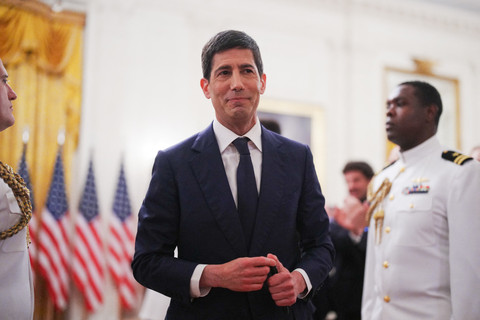
Kevin Warsh has officially taken the helm of the Federal Reserve (The Fed), ushering in a significant reform agenda amidst intense scrutiny over potential political pressure from U.S. President Donald Trump, who appointed him as the head of the nation’s central bank. This inaugural period is marked by high expectations for change and concerns about the institution’s revered independence.
Warsh’s appointment to a four-year term as the central bank‘s leader was officially confirmed by the U.S. Senate last week, culminating in his swearing-in ceremony at the White House on Friday, May 22.
“I believe, Mr. President, these years can usher in extraordinary prosperity that will elevate the living standards of Americans from all walks of life, and The Fed has a role in that,” Warsh stated, following lavish praise from Trump, as quoted by AFP on Saturday, May 23.
The 56-year-old native of northern New York previously concluded his first term on the Federal Reserve‘s Board of Governors prematurely in 2011, citing disagreements over monetary policy direction. His return signals a fresh perspective and a willingness to challenge established norms.
Now, Warsh returns to lead The Fed with a clear mandate to manage inflation and ensure maximum employment. He arrives with ambitious goals to transform how the central bank makes decisions, communicates its strategies, and implements policy changes, aiming for greater transparency and effectiveness.
His tenure commences amid unprecedented political pressure on the Federal Reserve‘s independence. President Trump has persistently urged the central bank to cut interest rates, advocating for such measures to stimulate U.S. economic growth and activity.
Trump has a history of criticizing and attacking Warsh’s predecessor, Jerome Powell, for what he perceived as a reluctance to swiftly reduce interest rates. The Trump administration even reportedly targeted Powell in a criminal investigation and continues its efforts to remove another Fed governor, Lisa Cook. This backdrop underscores the highly charged political environment Warsh now navigates.
During his confirmation hearing before the U.S. Senate Banking Committee, Warsh explicitly pledged to uphold the Federal Reserve‘s independence, emphatically stating he would “absolutely not” become a puppet of Trump.
Intriguingly, his inaugural address shifted focus, making no direct mention of the institution’s independence. Instead, Warsh vowed to challenge “static frameworks and models” and to uphold “clear standards of integrity and performance,” signaling a potential reorientation of priorities for the US central bank.
Profile of Kevin Warsh, Trump’s Chosen Fed Chair
Born and raised in Albany, New York, Warsh pursued higher education at Stanford University and Harvard Law School. He is married to Jane Lauder, granddaughter of the Estée Lauder cosmetics company founder. Notably, Jane’s father, Ronald Lauder, is a billionaire and a long-standing ally of President Trump, a connection that has drawn additional attention to Warsh’s appointment.
Warsh began his career in investment banking at Morgan Stanley, specializing in mergers and acquisitions. His professional trajectory then led him to serve as an economic policy advisor in the White House under President George W. Bush from 2002 to 2006, prior to his initial appointment as a member of the Federal Reserve‘s Board of Governors.
His first tenure at The Fed coincided with the tumultuous global financial crisis, from which he ultimately departed in 2011 due to differing views on how the central bank should manage the unfolding crisis. Following his departure, Warsh returned to Wall Street, where he held board positions at several prominent companies, including UPS.
“I saw The Fed and the people within it at their best, but I also witnessed an institution tempted to play a larger role in the economy and society,” Warsh remarked, reflecting on his earlier experience.
This statement resonates strongly with President Trump’s perspective, who believes the Federal Reserve should strictly adhere to its primary duties and avoid venturing into broader societal issues.
Kevin Warsh’s Track Record and Policy Stance at The Fed
During his initial term at The Fed, Warsh was known for favoring tightening monetary policy, advocating for interest rate hikes to curb inflation. However, in recent years, his stance appears to have shifted, aligning with Trump’s calls for lower interest rates, even as U.S. inflation has remained elevated since the COVID-19 pandemic. This apparent evolution in his policy views adds a layer of complexity to his current leadership.
Warsh has attributed the persistent high inflation experienced in 2021 and 2022 to what he termed “policy errors” by the Federal Reserve itself.
Furthermore, he champions a fundamental shift in the central bank‘s policymaking regime. This includes overhauling the data sets The Fed utilizes for its decisions, streamlining policy communications by eliminating overly strategic messaging, and fostering more open and robust internal debates within the institution.
Additionally, Warsh has expressed a desire to reduce The Fed‘s balance sheet and prioritize interest rates as the central bank‘s primary policy instrument, advocating for a more streamlined approach to monetary management.
David Wessel, a Senior Fellow at the Brookings Institution, acknowledges that Warsh indeed arrives with a comprehensive agenda. However, Wessel emphasizes that the public will need to observe his concrete actions, rather than merely his pronouncements, to gauge the true impact of his leadership.
According to Wessel, Warsh will not be able to unilaterally impose his will upon The Fed. He will necessarily need to collaborate and build consensus with other policymakers to advance his objectives effectively.
“He is very subtle in his approach and quite good at relating to people. That will help him as long as he doesn’t move too quickly or too radically,” Wessel told AFP, suggesting that Warsh’s interpersonal skills could be key to his success, provided he exercises caution in implementing change.
Meanwhile, Columbia University law professor Kathryn Judge believes that the existing internal divisions within The Fed will pose a significant challenge for Warsh as he attempts to steer the institution.
“I think we have to wait and see. It’s been a long time since we’ve had a Fed chair who has come in with the goal of charting a new course, rather than simply building on the successes of their predecessors,” Judge commented, highlighting the unique nature of Warsh’s appointment and the high stakes involved in his ambitious reform efforts.
Summary
Kevin Warsh has been officially sworn in as Chairman
