

The military court proceedings regarding the acid attack on KontraS activist Andrie Yunus faced a delay on Wednesday (May 20), as the trial focused on conflicting medical testimonies. During the session at the Jakarta Military Court II-08, expert witnesses—an ophthalmologist and a plastic surgeon—provided critical insights into the severity of Yunus’s injuries, which were sharply contrasted against the minor injuries sustained by the four defendants.
The hearing commenced with the military prosecutor calling upon two experts from Cipto Mangunkusumo Hospital: plastic surgeon and lead treating physician Parintosa Atmodiwirjo, and ophthalmologist Faraby Martha. Both doctors have been overseeing Yunus’s recovery since he was first admitted in the early hours of March 13, 2026.
Addressing the court, Faraby Martha revealed the devastating impact on the victim’s sight. “His right eye can only perceive light,” the ophthalmologist testified. When asked to clarify, the expert added that Yunus could not even read the largest letters on an eye chart, merely distinguishing between light and darkness. Faraby further emphasized that the damage reached a grade three severity level, the second-highest on the four-point scale.

Responding to inquiries from the panel of judges regarding the possibility of recovery, Faraby delivered a grim prognosis, stating it is highly unlikely Yunus’s vision will ever return to normal. When explicitly asked if the condition constitutes permanent disability, the doctor confirmed, “It can be described as such.”
The physical trauma extends well beyond his vision. Dr. Parintosa Atmodiwirjo reported that Yunus suffered 20% total body surface area burns, noting, “The injuries reached below the skin layers, past the fatty tissue, meaning there is no viable skin left to regenerate.” Consequently, Yunus requires extended periods of complete bed rest following skin grafting procedures.
Comparing injuries: The victim versus the perpetrators
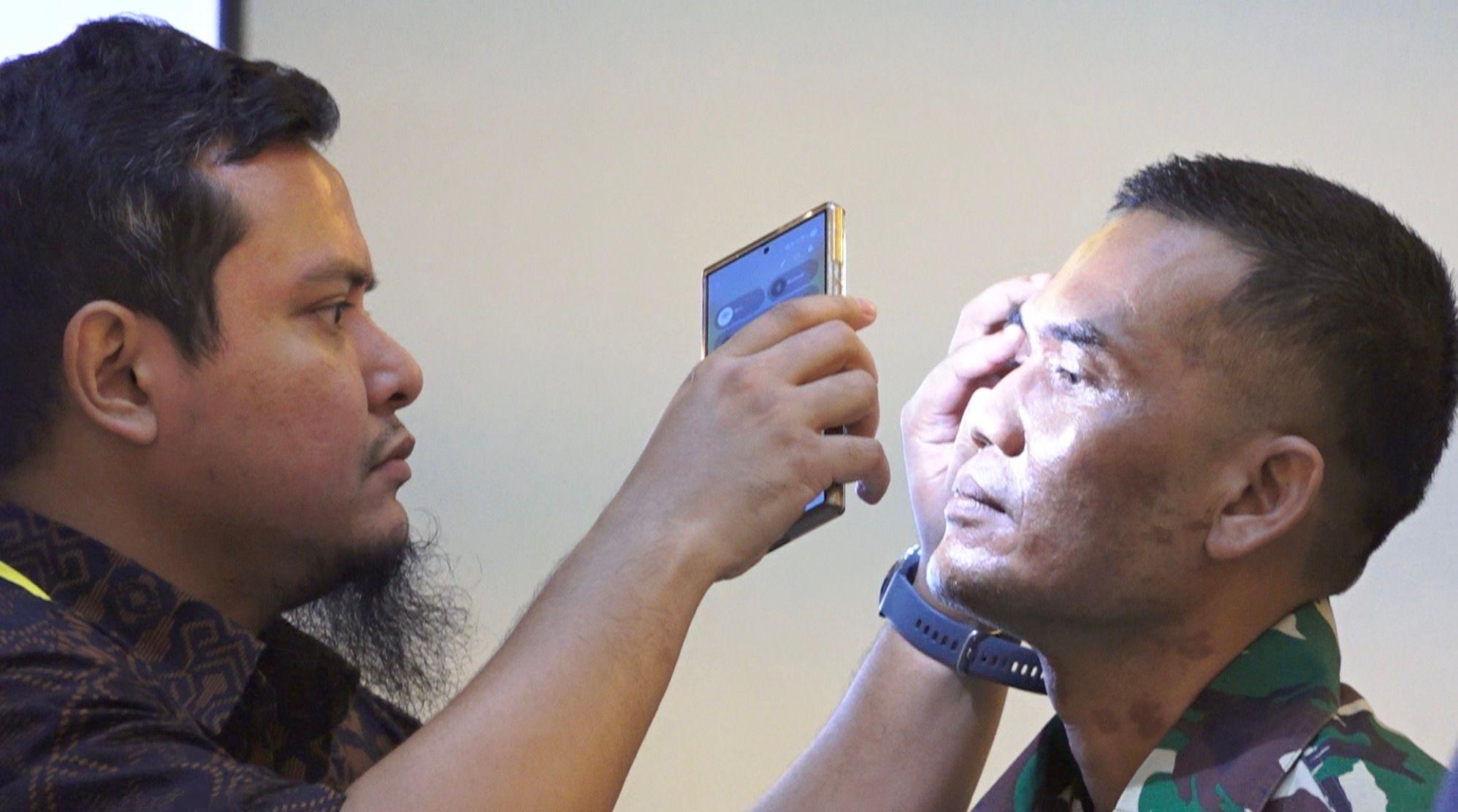
A point of contention arose when the defendants’ legal team requested the experts to compare Yunus’s severe condition with the injuries suffered by the first and second defendants, who allegedly sustained chemical splashes during the attack. After examining the defendants’ eyes using a smartphone light, Faraby stated, “I cannot draw a definitive conclusion, but the injuries appear similar.”
However, Dr. Parintosa offered a starkly different medical perspective after a closer inspection. He characterized the defendants’ injuries as superficial, noting, “These are shallow wounds that will heal easily because they are not deep.”
Challenges in court attendance
While presiding judge Colonel Chk Fredy Ferdian previously ordered Yunus to appear in court to witness the severity of the victim’s condition, legal obstacles remain. The Witness and Victim Protection Agency (LPSK) had formally notified the court that Yunus was unfit to provide testimony in person. Dr. Parintosa reinforced this, explaining that Yunus is currently under strict medical supervision and requires medication, leaving his eyes highly vulnerable to infections in crowded environments like a courtroom. Although the judge inquired about the possibility of a virtual testimony via Zoom, the expert confirmed that this would be medically feasible.
Following the testimonies, the military prosecutor must now revise their sentencing demands. Consequently, the sentencing hearing, initially scheduled for May 20, has been postponed until June 3.
Allegations of ethical misconduct
The trial has been further complicated by legal friction. On May 18, the Advocacy Team for Democracy (TAUD), representing Yunus, filed a report with the Supreme Court’s Oversight Chamber alleging ethical violations by the three military judges. Daniel Winarta, a representative for TAUD, cited inappropriate language used during proceedings and accused the judges of improperly demonstrating how to handle acid during the trial. Furthermore, the defense raised concerns regarding procedural failures, such as judges handling evidence without protective gloves.

Mayor Chk Endah Wulandari, spokesperson for the Jakarta Military Court II-08, stated that the court respects the TAUD’s right to file a correction request. However, TAUD remains critical of the military court system, arguing that it lacks the independence required to impartially try its own members. The organization has previously expressed its rejection of the military tribunal process, labeling it a failure to provide safety or recovery for the victim.
Looking ahead, TAUD intends to file a pretrial motion with the South Jakarta District Court to challenge the perceived delay and lack of transparency in the investigation. The team alleges that despite claims from the Jakarta Metro Police regarding CCTV footage and identified suspects, the investigation has stalled without accountability. TAUD’s independent investigation suggests that more than 16 individuals may have been involved in the plot against Yunus, fueling concerns that the current legal process is failing to address the broader scope of the attack.
Related Reading:
- TAUD rejects military court transfer, fearing protection of intellectual actors
- Why acid was used to target Andrie Yunus and two other activists
- UN Human Rights Council monitors the horrific attack on KontraS activist Andrie Yunus
Summary
The military court trial regarding the acid attack on KontraS activist Andrie Yunus faced a delay due to conflicting medical testimonies. Expert witnesses confirmed Yunus sustained devastating and permanent damage to his right eye, which can only perceive light and is highly unlikely to recover, qualifying as a permanent disability. He also suffered deep burns covering 20% of his total body surface area, requiring extensive medical care and skin grafting.
While an ophthalmologist initially noted similarities between Yunus’s and the defendants’ eye injuries, a plastic surgeon later characterized the defendants’ wounds as superficial and easily curable. Yunus remains medically unfit to appear in court due to infection risks, though virtual testimony is deemed feasible. The trial is further complicated by allegations of ethical misconduct against the judges by Yunus’s legal team, who also plan to challenge the investigation’s delays and lack of transparency.
