
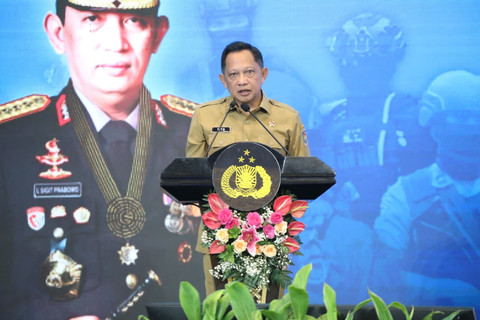

Indonesia’s Minister of Home Affairs, Muhammad Tito Karnavian, is strongly advocating for the enhanced implementation of a soft approach strategy to combat the spread of violent extremism and terrorism. The Minister emphasized that prevention efforts must be collaborative, adaptable, and meticulously target the root causes of these phenomena, including their manifestations and dissemination within the crucial digital space.
These significant remarks were delivered by the Home Affairs Minister during his attendance at the 2026 Technical Working Meeting (Rakernis) of the National Police’s Special Detachment 88 Anti-Terror (Densus 88 AT Polri). The meeting, themed “A Precise Collaborative Strategy of Densus 88 AT Polri to Counter Violent Extremism and Terrorism in Maintaining Public Order and Security Stability,” took place at the Bidakara Hotel in Jakarta on Monday, May 18, 2026. This gathering provided a vital platform for discussing proactive measures against such threats.
During the event, Minister Karnavian meticulously detailed how the proliferation of violent extremist ideologies occurs through specific communication patterns. These patterns inherently involve a sender, a receiver, various channels of transmission, and particular social contexts. Consequently, he asserted that effective prevention critically hinges on the ability to disrupt and break these propagation chains at any vulnerable point.
“If we can break just one of these five components, then the process of transferring radical messages or terrorist ideologies from the sender to the receiver will never occur,” the Minister stated, underscoring the strategic importance of intervention across all elements of communication.
To effectively tackle these complex challenges, the Home Affairs Minister unveiled five comprehensive strategies designed to operate in parallel. These include deradicalization, counter-radicalization, strengthening counter-ideology initiatives, disrupting channels for the spread of radical ideologies, and proactively addressing societal social and economic issues.
He further elaborated that deradicalization is crucial for individuals already exposed to radical ideologies, aiming to guide them back towards moderate understanding and unwavering support for national values. Concurrently, counter-radicalization is essential for fostering robust community resilience from an early stage, thereby inoculating society against the insidious spread of violent extremist ideologies.
Beyond these, the Minister highlighted the necessity of reinforcing counter-ideology efforts. This particular strategy calls for the active engagement of influential figures within specific community groups, recognizing their unique ability to ensure that messages of moderation are more readily accepted and internalized by those within their spheres of influence.
“This approach is exceptionally effective because these groups possess a distinct culture and norm of ‘insider trust’; they tend not to trust outsiders but place their faith in those from within their own ranks,” he explained, emphasizing the nuanced understanding required for successful community engagement.

Minister Karnavian also underscored the critical importance of intensifying cyber patrols and developing compelling counter-narratives within the digital space. This is seen as a vital step to decisively sever the channels through which radical ideologies are propagated. He noted that rapid advancements in information technology have dramatically accelerated and expanded the reach of extremist ideologies across diverse digital platforms.
Furthermore, the Minister stressed that resolving pervasive social and economic issues within communities constitutes another indispensable component of a long-term prevention strategy. This is particularly pertinent in regions identified as vulnerable to the enticement and spread of violent extremist ideologies, where socio-economic factors can often serve as fertile ground for radicalization.
He acknowledged that, historically, Densus 88 AT Polri has primarily employed a robust law enforcement approach, often characterized as a kinetic or hard approach, against active threats. However, looking ahead, he stressed the increasing imperative to strengthen the soft approach as a proactive measure for early prevention, shifting focus beyond immediate active threats.
“I understand that Densus has historically leaned more towards a kinetic, a hard approach. Why? Because the adversaries were active. But once they are suppressed, we must begin to bombard them with soft approach activities,” he articulated, signaling a strategic evolution in the unit’s methodology.
Concluding his address, the Minister took the opportunity to extend his profound appreciation to the dedicated ranks of Densus 88 AT Polri. He commended their tireless efforts in upholding national security stability, which has demonstrably contributed to a more conducive national security environment across Indonesia.
“I deeply appreciate the work of Densus over the years, the results of which have been felt by the Indonesian people, who now experience greater tranquility compared to several years ago,” he affirmed, highlighting the tangible positive impact of their operations on public peace and safety.
