
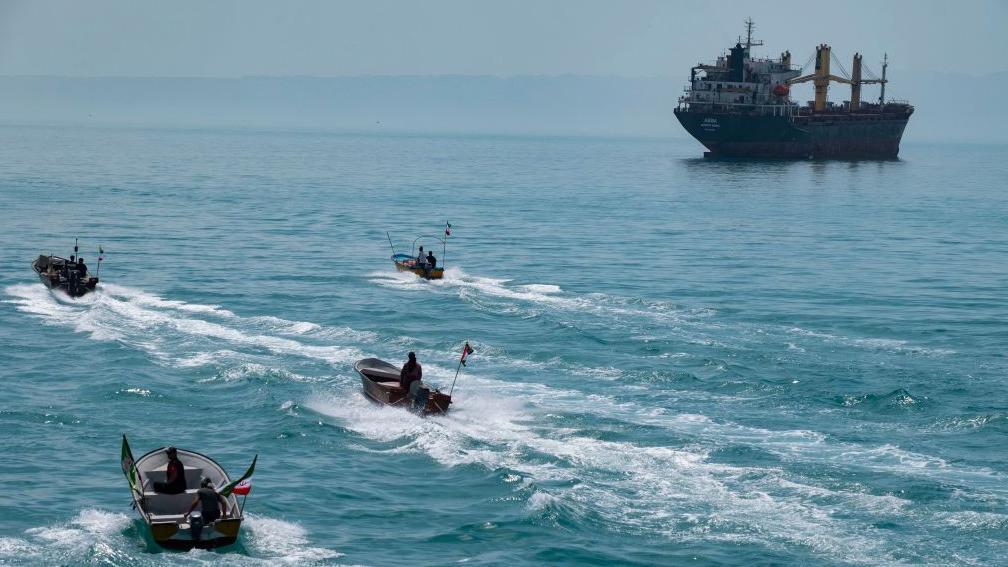

United States President Donald Trump recently claimed to have “completely destroyed” the Iranian Navy, leaving behind nothing more than “small boats with machine guns.” However, Western analysts describe these vessels as a “mosquito fleet,” and they pack a far more lethal punch than their modest size suggests.
For months, these small craft have been instrumental in the Iranian military’s efforts to disrupt the Strait of Hormuz, one of the world’s most vital shipping lanes. According to experts, this strategy is designed to inflict damage on the global economy and exert pressure on Washington to avoid further conflict with Tehran.
Disrupt, Swarm, Confuse, and Destabilize
The “mosquito fleet”—a collection of agile, high-speed attack boats—was first developed by Iran during the 1980s amid the Iran-Iraq War. As the conflict spilled into the Persian Gulf during the so-called “Tanker War,” the United States became increasingly involved to protect oil shipments. Following significant losses to its conventional naval assets during skirmishes with the U.S., Iran pivoted to a maritime doctrine centered on asymmetric warfare, specifically tailored to counter a technologically superior navy.

This fleet is a key pillar of a broader Iranian strategy that integrates missiles, drones, naval mines, coastal launchers, and proxy attacks throughout the region. Operated by the Islamic Revolutionary Guard Corps (IRGC), these boats are not built for conventional open-sea combat. Instead, they are designed to “disrupt, swarm, confuse, and destabilize” maritime traffic, explains Saeid Golkar, an assistant professor at the University of Tennessee at Chattanooga and a senior advisor at United Against Nuclear Iran (UANI).
“The IRGC is well aware that they cannot defeat the United States in a conventional naval war,” Golkar notes. By targeting commercial tankers and rendering the Strait of Hormuz increasingly dangerous, they significantly drive up operational costs and risks for companies navigating the Gulf.
Tactics of the Mosquito Fleet
The tactics employed by these vessels include firing warning shots near commercial ships, deploying naval mines, and executing high-speed “swarm” attacks from multiple directions. While many of these boats are custom-built in Iran, others are repurposed fishing vessels equipped with machine guns, rockets, or anti-ship missiles.
Can Kasapoglu, a senior non-resident fellow at the Hudson Institute, highlights that these boats are both affordable and easily replaceable. This allows Iran to threaten high-value military and commercial assets at a relatively low cost, effectively holding the global maritime economy hostage.

Because these craft maintain a low profile near the water’s surface, they are notoriously difficult for radar to detect. This forces the U.S. to maintain constant surveillance using drones, helicopters, and patrol aircraft. While the exact size of the fleet remains classified—with many boats hidden in coastal caves, tunnels, and inlets—estimates suggest there are between 500 and 1,000 units, often mobilized during Iran’s routine naval exercises.
Maritime Guerrilla Warfare
Analysts describe this approach as a form of maritime guerrilla warfare. Conscious that the U.S. Navy could easily neutralize their boats in an open-water battle, the IRGC avoids direct confrontation. Instead, they rely on hit-and-run tactics, swarming maneuvers, and the threat of mines to stretch the resources of the U.S. and its allies. While the U.S. must deploy expensive ships and aircraft for protection, Iran can replenish its fleet quickly and cheaply. Simply creating a perception of danger is enough to spike insurance premiums and discourage shipping companies from using the route.
Is Iran’s Strategy Working?
The impact on traffic in the Strait of Hormuz has been stark. Data from the Hormuz Strait Monitor indicates that daily transit has dropped to about 10 ships—a significant decline from the pre-war average of 60. According to the UK Royal Navy, total maritime traffic in the region has fallen by more than 90 percent.

Despite intermittent diplomatic attempts to stabilize the region, the threat remains persistent. Recently, the UK Maritime Trade Operations (UKMTO) reported that a cargo ship was struck by an unidentified projectile off the coast of Qatar, causing a fire. The United Nations International Maritime Organization estimates that approximately 1,500 ships and 20,000 crew members remain affected by the current blockade. For many observers, this disruption has been a primary driver behind record-breaking oil price volatility and the deepest supply chain shocks in recent history.
Summary
The “mosquito fleet,” a collection of agile and low-profile Iranian attack boats, has become a central component of Iran’s asymmetric maritime warfare in the Strait of Hormuz. Operated by the Islamic Revolutionary Guard Corps, these vessels utilize swarming tactics, mines, and hit-and-run maneuvers to disrupt commercial shipping and threaten high-value military assets. By keeping these boats difficult to detect and easy to replace, Iran effectively forces the U.S. Navy into constant, costly surveillance while avoiding direct conventional confrontation.
This strategy of maritime guerrilla warfare has significantly impacted global trade, with daily transit through the Strait of Hormuz declining by over 90 percent. The persistent threat posed by these vessels has driven up operational costs for shipping companies, contributed to oil price volatility, and caused major supply chain disruptions. Despite diplomatic efforts, the fleet continues to exert strategic pressure, demonstrating how a low-cost, decentralized naval force can effectively destabilize one of the world’s most critical shipping lanes.
