
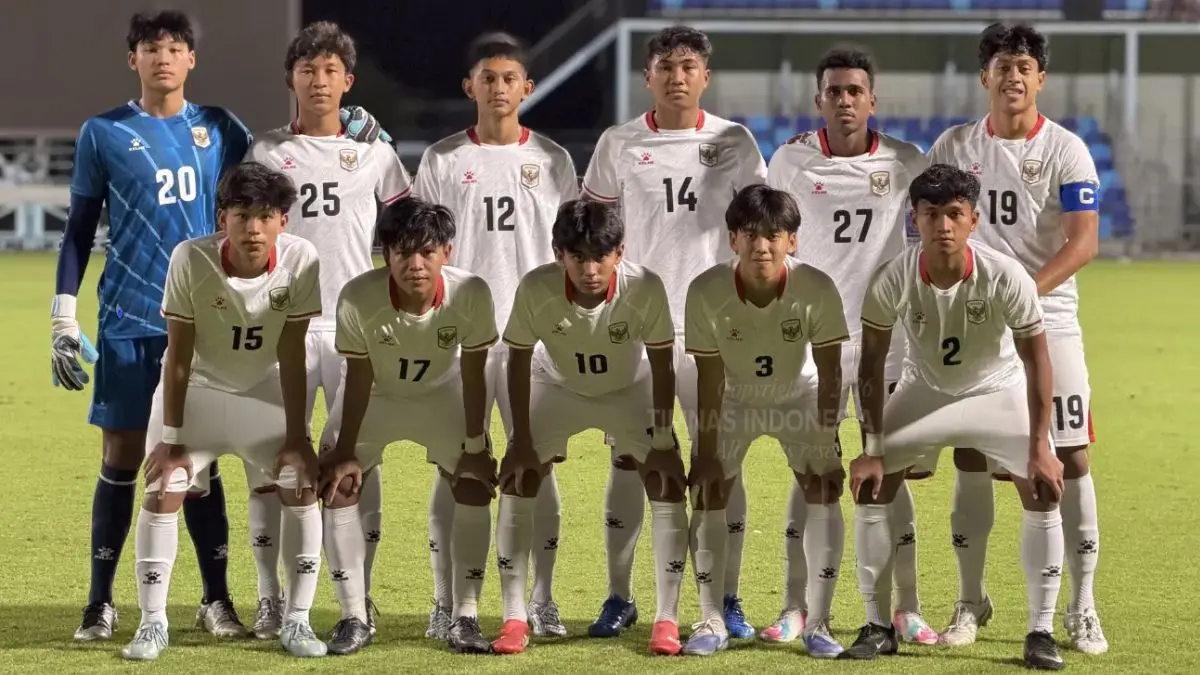

Teknowarta The Indonesia U-17 national team faced a disappointing end to their journey in Group B of the 2026 AFC U-17 Asian Cup. Despite accumulating the same number of points as Qatar and China, the Young Garuda ultimately finished at the bottom of the final group standings.
This outcome was confirmed after Indonesia suffered a 1-3 defeat to Japan U-17 in their final group stage match, held at the King Abdullah Sports City Training Stadium on Tuesday (13/5/2026) night WIB.
In another crucial fixture, China secured a 2-0 victory over Qatar, intensifying the competition within the group standings. The identical point tallies among Indonesia, Qatar, and China—all with three points from three matches—initially puzzled many supporters, who questioned why Indonesia, despite the shared points, was relegated to the last position.
In official AFC tournaments like the U-17 Asian Cup, the final group standings are not solely determined by overall goal difference. Instead, the regulations prioritize a head-to-head calculation, examining the results of matches between teams that finish with an equal number of points.
Indonesia actually started this mini-league competition quite promisingly, securing a 1-0 victory over China. However, a subsequent 0-2 loss to Qatar proved to be a critical turning point. Meanwhile, China’s 2-0 win against Qatar in the group’s final match further complicated the picture.
Based on these three crucial encounters, China emerged with the best goal difference in the head-to-head mini-standings among the tied teams, boasting a +1 difference, having scored two goals and conceded only one. Qatar followed in second place with a goal difference of 0, stemming from their 2-0 win over Indonesia and a 0-2 defeat to China.
Conversely, Indonesia recorded a -1 goal difference in the head-to-head calculation after their 1-0 win against China and 0-2 loss to Qatar. It was this specific regulation that positioned Kurniawan Dwi Yulianto’s squad at the bottom of Group B.
The defeat to Japan in their final match further compounded Indonesia’s woes. Japan displayed dominance from the outset, taking the lead in the 28th minute through Ryoma Tsuyoneshi. The Young Samurai Blue extended their advantage with Takeshi Wada’s goal in the 59th minute. Indonesia momentarily reignited their hopes when Peres Tjoe netted a free-kick in the 70th minute.
However, Japan quickly quashed any comeback aspirations, responding just a minute later with a goal from Arata Okamoto. The 3-1 scoreline held until the final whistle, confirming Japan as group champions.
The failure to advance from the group stage consequently dashed Indonesia’s hopes of competing in the 2027 U-17 World Cup. Nevertheless, the Young Garuda’s performance garnered attention for their resilient challenges in several key group matches.
Many supporters on social media speculated that Indonesia might have had a greater chance of progressing had they managed to score an additional goal against Qatar, as the head-to-head goal difference ultimately became the primary determinant of their final position.
The AFC regulations are indeed stringent when more than two teams are tied on points. After head-to-head points are considered, the tie-breaking process proceeds to goal difference among the tied teams, followed by the number of goals scored. If a tie persists, then overall group goal difference, overall goals scored, and even disciplinary points are taken into account. In the case of Group B, the head-to-head goal difference aspect proved decisive.
The final Group B standings thus saw Japan comfortably in first place, while China ascended to second. Qatar finished third, leaving Indonesia to accept their fate at the bottom of the table.
Despite their early exit, the experience of competing at the Asian level remains a crucial asset for Indonesia’s young talents. The tournament also serves as valuable evaluation material for the coaching staff to enhance game consistency, especially in crucial encounters. While the Indonesia U-17 national team’s journey in the 2026 AFC U-17 Asian Cup concluded sooner than hoped, several young players demonstrated significant potential to become vital contributors to Indonesian football in the years to come.
Summary
Timnas Indonesia U-17 harus mengakhiri perjalanan mereka di Piala Asia U-17 2026 setelah terpuruk di dasar klasemen Grup B. Meski mengumpulkan poin yang sama dengan Qatar dan China (tiga poin), skuad Young Garuda gagal melaju akibat regulasi selisih gol *head-to-head* (H2H) antar tim yang memiliki poin identik. Kekalahan 1-3 dari Jepang di pertandingan terakhir semakin memperkuat posisi sulit Indonesia, sementara China berhasil menang 2-0 atas Qatar.
Berdasarkan perhitungan H2H di antara ketiga tim tersebut, Indonesia memiliki selisih gol -1 (menang 1-0 atas China, kalah 0-2 dari Qatar). Angka ini lebih rendah dibandingkan China yang mencatatkan selisih gol +1 dan Qatar dengan 0. Aturan H2H ini secara spesifik menempatkan Indonesia di posisi terbawah, sekaligus mengubur harapan mereka untuk berkompetisi di Piala Dunia U-17 2027.
