
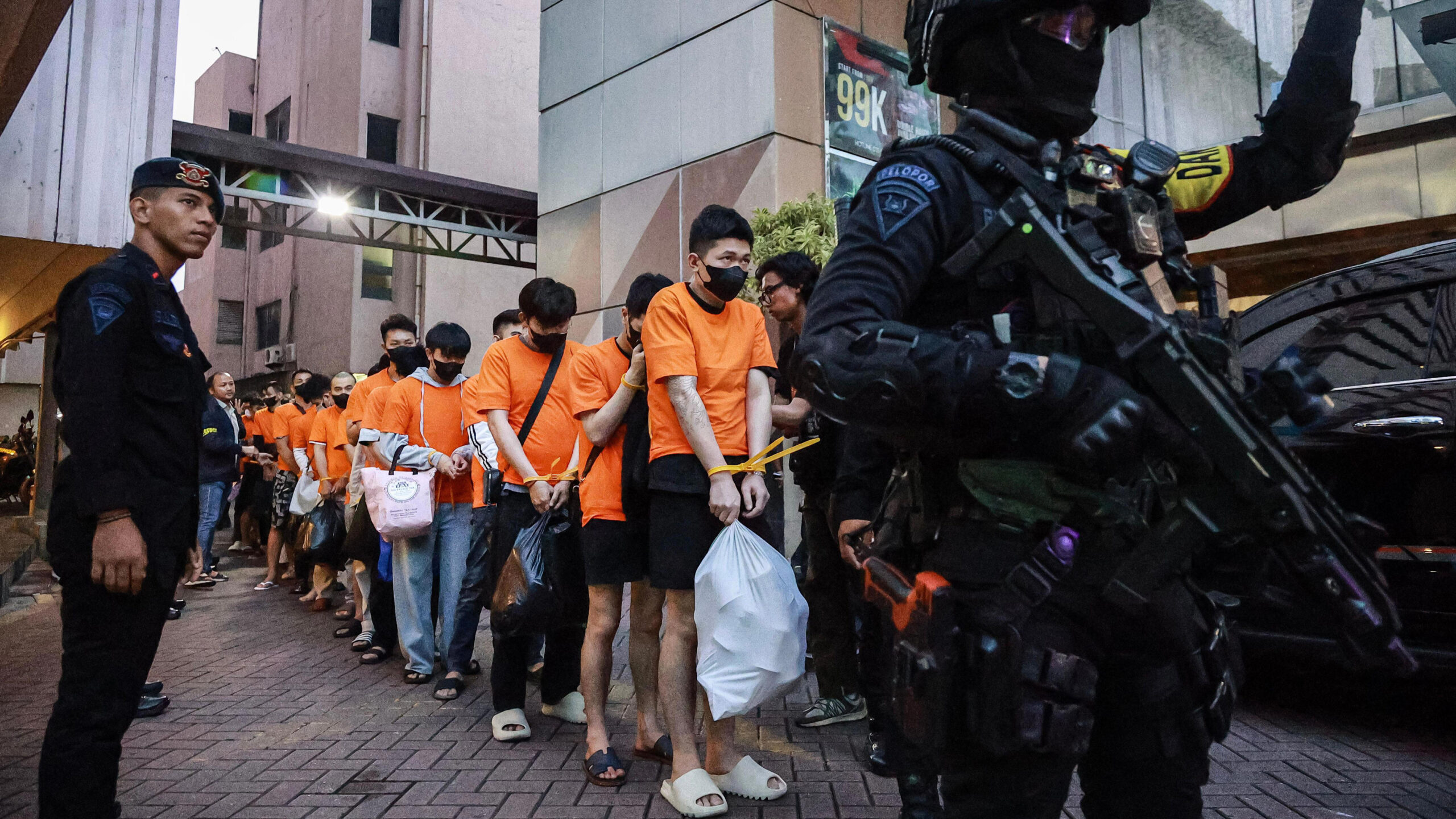

The recent arrest of 320 foreign nationals at an online gambling (judol) office in Hayam Wuruk, Jakarta, highlights a concerning trend: Indonesia is becoming a ‘comfortable haven’ for perpetrators of transnational cybercrime, according to cybersecurity experts. This raises critical questions: Who are the key players enabling these foreign offenders, facilitating financial flows, and funding these sophisticated online gambling operations?
On Saturday, May 9th, police apprehended 321 individuals during a raid on an alleged online gambling syndicate operating out of the Hayam Wuruk Plaza Tower in West Jakarta. The illicit operation was found occupying the top floors, 20 and 21, of the building, with no discernible company name or signage.
Authorities confirmed that 320 of those arrested were foreign nationals, while one individual was an Indonesian citizen from Jakarta who had previously engaged in similar work in Cambodia. “The role of the Indonesian citizen is still under investigation, but for now, they are identified as a customer service representative,” stated Brigadier General Wira Satya Triputra, Director of General Crime at the National Police Criminal Investigation Department (Bareskrim Polri).
The hundreds of foreign nationals detained by the police were reportedly involved in various roles, encompassing marketing, customer service, administration, and even debt collection. Investigators are now intensifying efforts to unravel the online gambling network and identify the principal figures orchestrating this international syndicate.
As of Monday, May 11th, police continue to trace the sponsors, office tenants, and the significant financial flows that sustained this online gambling network throughout its operation. “We will coordinate to track both the financial flows and the sponsors who brought these perpetrators here,” Wira elaborated.
Police further revealed that this particular online gambling network had only been operational for approximately two months, yet it had already managed around 75 online gambling domain sites. However, these specific site names have not yet been released to the public.
What’s the Next Step for the Arrested Foreign Nationals?
In the past three days, at least two government agencies have been actively involved in this complex case. Beyond the police investigation, the Ministry of Immigration and Correctional Affairs has pledged to delve deeper into identifying the sponsors or guarantors responsible for the presence of the 320 foreign nationals involved in the Hayam Wuruk online gambling case.
“We will conduct an investigation to identify the sponsors or guarantors of these foreign nationals’ stay in Indonesia,” confirmed Arief Eka Riyanto, Head of the Immigration Supervision Sub-Directorate at the Ministry of Immigration and Correctional Affairs.
Previously, the police transferred the hundreds of foreign nationals to the Directorate General of Immigration within the Ministry of Immigration and Correctional Affairs, where they are being held at two detention centers: Kuningan and West Jakarta Immigration Detention Houses. Meanwhile, the sole Indonesian citizen arrested has been taken to Bareskrim Polri for further interrogation.
Upon processing, the 320 foreign nationals were identified as comprising 228 Vietnamese, 57 Chinese, 13 Myanmar, 11 Laotian, five Thai, three Malaysian, and three Cambodian citizens. They had all entered Indonesia using tourist visas, valid for a 30-day stay. A significant number of them had already overstayed their visas, indicating immigration violations.
“We are investigating the suspected individuals regarding both immigration violations and criminal immigration offenses,” Arief clarified.

In many transnational cybercrime cases, individuals apprehended on the ground are often merely technical operators or executors, according to Pratama Persadha, Head of the Cyber Security and Communication Research Institute (CISSReC). “They work much like ordinary company employees, with shift systems, work targets, and specific departmental roles such as customer service, transaction operators, digital marketing, and account managers,” Pratama explained.
Pratama further noted that many of these operators are often unaware of the true owners behind the online gambling operations. Modern cybercrime syndicates typically employ a fragmented organizational structure, compartmentalizing information based on operational needs. The objective, he said, is to safeguard the ‘core layer’ should any part of the network be compromised.
In the Hayam Wuruk case, Pratama believes it’s “highly probable that most of the 321 individuals arrested only knew a limited chain of command.” He added, “The intellectual actors or ‘invisible hands’ usually reside abroad, employing fake identities, encrypted communications, offshore servers, and digital intermediaries.”
Despite this, Pratama stresses the importance of mass arrests within these networks. He argues that electronic devices, communication metadata, financial transactions, login patterns, and other digital footprints provide investigators with crucial data to construct a broader map of the criminal network. In the realm of cyber intelligence, key actors are often not identified through direct confessions but rather through meticulous digital forensics and financial tracing.
Is Indonesia Becoming a ‘Safe Haven’ for Southeast Asian Online Gambling?
The discovery of the ‘Hayam Wuruk online gambling hub’ has sparked concerns that Indonesia could be transforming into a ‘comfortable place’ for online gambling networks across Southeast Asia, a sentiment echoed by Pratama Persadha of CISSReC. “From a cybersecurity and transnational crime perspective, cases like this are almost impossible to operate in isolation, without the support of a local ecosystem,” Pratama emphasized.
The local ecosystem support he referred to includes the logistical requirements for operations involving hundreds of operators, large office buildings, high-speed internet connectivity, banking accounts, digital devices, and a certain degree of protection for operational activities over time. All these elements, Pratama contends, necessitate a strong local support network within Indonesia.
Based on these observations, Pratama believes that the notion of “Indonesia becoming a new safe haven for online gambling in Southeast Asia” is far from mere speculation. He views these facts as an urgent alarm, signaling the potential formation of a digital crime protection ecosystem that involves local actors.
In the Hayam Wuruk online gambling headquarters case, Pratama suspects the involvement of such local enablers. In transnational crime operations, he explained, local facilitators don’t always offer direct protection from authorities. Their support can manifest in various forms, such as providing business services, bank accounts, properties, fake identities, operating shell companies, or arranging logistics and permits.
As an illustration, Pratama cited several cases in Southeast Asia where international networks were known to utilize local citizens to open bank accounts, establish formal businesses, rent buildings, and procure a large number of mobile phone numbers. “The focus of the investigation must be broadened to encompass the entire supporting ecosystem,” Pratama asserted.

Meanwhile, several other Southeast Asian countries have begun to crack down on online gambling operations within their borders. Cambodia, for instance, committed to eradicating cyber fraud syndicates and online gambling in January. This led to over 1,000 Indonesian citizens self-evacuating from various locations in Cambodia suspected of being online gambling hubs.
This shift was partly a consequence of the Cambodian government’s actions, including the arrest and deportation of Chen Zhi to China, his home country. Chen Zhi, a former advisor to the Cambodian leader, was accused of running massive online fraud operations and had been indicted by US authorities in October 2025 (sic, likely 2023 or 2024, given the context of January crackdown). Local media reported that his arrest had a significant deterrent effect on online gambling perpetrators in Cambodia. Subsequently, several online gambling syndicates closed their operations and even released their workers to abandon their premises.
In the context of the Hayam Wuruk case, the nationalities of the hundreds of arrested foreign nationals strongly indicate that Indonesia has now become a prime destination for international online gambling syndicates. “Specifically, Myanmar, Cambodia, Laos, and Vietnam were recruitment bases and hubs for online criminal activities targeting transnational victims, always foreign nationals. After being disrupted, there’s been a shift to Indonesia,” explained Brigadier General Untung Widyatmoko, Secretary of NCB Interpol Polri.
According to money laundering (TPPU) expert Yenti Garnasih, as Cambodia cleaned up its act, Indonesia became an attractive alternative due to certain enabling factors. Yenti suggests that the Hayam Wuruk online gambling den raid reveals Indonesia’s “high moral corruption.” “From a money laundering perspective, this indicates the presence of parties supporting the online gambling operations,” Yenti stated.
Yanti believes there is a significant tolerance for those who benefit from online gambling. These beneficiaries of criminal proceeds, she argues, “control, funnel, and enjoy online gambling money and are almost never legally implicated in Indonesia.”
How Effective is Law Enforcement in Prosecuting Online Gambling Perpetrators?
According to records from the Financial Transaction Reports and Analysis Center (PPATK), the turnover from online gambling reached Rp286.84 trillion in 2025 (reporting period), generated from 422.1 million transactions. PPATK claims this turnover represents a 40% decrease compared to 2024. This downward trend was also reflected in a reduction of online gambling deposits, which fell to Rp36.01 trillion from a previous figure of Rp51.3 trillion.
PPATK also recorded that in 2025, 12.3 million people made online gambling deposits through various channels such as banks, e-wallets, and QRIS. Notably, there was a significant increase in the use of QRIS for deposit payments compared to bank transfers or e-wallets.
PPATK attributes these declining figures to the implementation of effective strategies and strong collaboration between the government and the private sector in preventing and combating online gambling across multiple fronts. Additionally, as of mid-2025 (reporting period), the National Police had concluded 1,297 online gambling cases, involving 1,492 suspects. These thousands of case disclosures led to the seizure of Rp922.53 billion and the blocking of hundreds of thousands of online gambling sites. Among these, 13 cases were identified as money laundering offenses.

Nevertheless, Yenti Garnasih critically assesses that online gambling cases handled by the National Police have been a “total failure” due to suboptimal law enforcement. Yenti strongly urges the police to utilize the Money Laundering Law (TPPU) to identify and prosecute the main perpetrators, asserting that almost all online gambling cases in Indonesia can be definitively linked to money laundering.
“Online gambling is the originating crime for money laundering, so the Money Laundering Law represents the last hope to eradicate online gambling from its roots,” Yenti stated. “Therefore, enforcement should not solely revolve around online gambling issues using the ITE (Information and Electronic Transactions) Law.”
Historically, Yenti points out, online gambling cases are frequently resolved using the ITE Law, which consequently makes it challenging for the police to reach the principal actors. Online gambling violates Article 27 paragraph 2 of the ITE Law concerning the distribution of gambling content. Perpetrators, including players, agents, and distributors, face a maximum penalty of 10 years imprisonment and/or a fine of up to Rp10 billion.
In contrast, the TPPU Law can effectively prosecute online gambling cases because the proceeds can be categorized as criminal assets. This law targets kingpins, managers, and parties benefiting from illicit financial flows. By applying the TPPU Law, Yenti is confident that the state can maximize the confiscation of assets and money derived from online gambling crimes, while also providing a strong deterrent with criminal sanctions that can extend up to 20 years in prison.
How Difficult is it to Uncover the Main Online Gambling Perpetrators?
According to cybersecurity experts, tracing the money trail – or ‘follow the money’ – in money laundering cases is an area where Indonesia actually possesses quite advanced technical capabilities. Institutions like PPATK, the Financial Services Authority (OJK), Bank Indonesia, and the national banking sector have relatively adequate anti-money laundering infrastructure and suspicious transaction reporting systems in place.
However, the most significant challenge lies not in the availability of tools, but in the inherent complexity of the modus operandi used by these criminal networks. For Yenti, the main perpetrators are almost certainly individuals with significant power, influence within the political system, and substantial capital.
What Makes Uncovering the Main Perpetrators So Difficult?
Pratama highlights that tracing financial flows within online gambling networks is considerably more challenging today compared to a decade ago. “The perpetrators employ multi-layered financial laundering techniques, where gambling proceeds do not enter a single main account but are fragmented across thousands of nominee accounts, digital wallets, virtual accounts, payment gateways, and even cryptocurrency,” Pratama explained. “This technique aims to sever the connection between the illicit money and its true owner.”
Furthermore, these criminals exploit a vast number of micro-transactions to avoid triggering automated detection thresholds within banking systems. “In many cases, money is circulated repeatedly through ordinary individuals’ accounts, where the account holders are often unaware their accounts are being used as mule accounts. There’s also a pattern of using dormant or passive accounts purchased from the public,” Pratama added.
Baca juga:
- Pengusaha dan politikus Indonesia diduga berada di balik bisnis judi online di Kamboja, bisakah polisi menjerat mereka?
- Anak-anak SD di Indonesia kecanduan judi online sampai ‘ngamuk’, streamer game mengaku sengaja mempromosikan situs judi
- Ribuan WNI di Kamboja ingin pulang ke Indonesia, usai razia bisnis penipuan daring – Apakah kepulangan mereka akan memicu masalah baru?
Technically, therefore, tracing is highly feasible, Pratama noted. However, he emphasized that such efforts demand massive data integration, big data analytics, forensic accounting, and extensive cross-border coordination. An additional layer of difficulty emerges when money is converted into cryptocurrency.
“Once funds are converted into digital assets via specific exchangers, perpetrators can transfer them across international borders within minutes using anonymous wallets, mixer services, decentralized finance (DeFi), and even privacy coins,” Pratama explained. At this point, investigations require a level of cyber financial intelligence far more sophisticated than conventional banking investigations.
What Facilitates Finding the Main Perpetrators?
Despite the challenges, the main perpetrators can still be identified if investigators adopt a modern cyber intelligence approach, according to Pratama. He points to an undeniable truth: the digital world always leaves traces. Servers have logs, domains have registration histories, blockchain transactions have trails, devices possess metadata, and digital communications exhibit connectivity patterns.
Therefore, in these investigations, law enforcement doesn’t solely rely on suspect confessions but meticulously constructs an intelligence graph from all discovered digital data. “From just one phone number, one crypto wallet, one IP address, or one email, investigators can map the relationships between actors using digital link analysis. Even login patterns, activity times, access locations, and device fingerprints can help identify key operators,” Pratama highlighted.
Consequently, Pratama concludes, the success in uncovering the intellectual actors hinges critically on the ability to integrate cyber forensics, financial intelligence, and international cooperation. If the approach remains limited to physical raids and domain blocking, online gambling networks will simply regenerate. “However, if authorities can sever the financial chains, identify the owners of the digital infrastructure, and dismantle the local ecosystem supporters, then the chances of exposing the invisible hand behind the online gambling industry will be significantly greater,” Pratama affirmed.
- Disekap, disetrum, dan dipukul hingga babak belur: Pengakuan WNI yang menyelamatkan diri dari perusahaan scam di Kamboja
- Kantor polisi palsu Australia, China, dan Brasil: BBC masuk ke dalam kompleks penipuan di Kamboja
- Ribuan WNI di Kamboja ingin pulang ke Indonesia, usai razia bisnis penipuan daring – Apakah kepulangan mereka akan memicu masalah baru?
- Kesaksian perempuan Indonesia jadi korban kekerasan seksual di pusat judi online Kamboja
- Kontroversi rekening judi online, apakah satgas pemberantasan bentukan pemerintah efektif?
- Polda DIY tangkap ‘orang yang rugikan’ situs judi online, tapi mengapa tak menjerat bandarnya?
Summary
The Indonesian police recently arrested 321 individuals, including 320 foreign nationals, during a raid on an online gambling operation spanning two floors of the Hayam Wuruk Plaza Tower in Jakarta. This illicit syndicate, operational for only two months, managed around 75 online gambling domain sites and employed foreign workers on tourist visas who often overstayed. Cybersecurity experts warn that this incident highlights Indonesia’s alarming emergence as a “comfortable haven” for transnational cybercrime, partly due to crackdowns in neighboring countries like Cambodia forcing syndicates to relocate.
Investigators face significant challenges in identifying the true masterminds, or “invisible hands,” behind such sophisticated operations, as arrested individuals are typically low-level operators and financial trails are complex, involving multi-layered laundering and cryptocurrencies. Experts emphasize that law enforcement efforts often fail to reach these principal actors when solely relying on the ITE Law. Therefore, it is crucial to apply the Money Laundering Law (TPPU) to target kingpins, confiscate criminal assets, and employ advanced cyber forensics, financial intelligence, and international cooperation to dismantle these networks effectively.
