
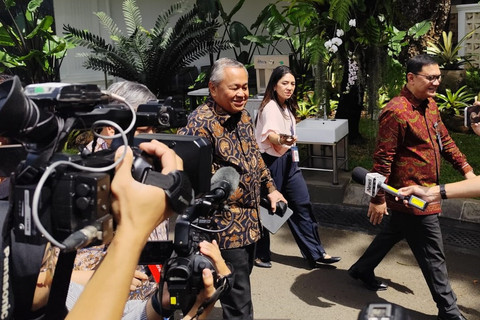

Bank Indonesia (BI) Governor Perry Warjiyo has brought pressing concerns regarding the Rupiah’s increasingly undervalued state directly to President Prabowo Subianto, outlining a comprehensive seven-point strategy to bolster the currency. Among the most impactful measures revealed is a significant restriction on US Dollar purchases, limiting individuals to a maximum of USD 25,000 per month.
The Rupiah recently hit a fresh low, depreciating by 30 points (0.17 percent) to Rp 17,423 per US Dollar by Tuesday afternoon. This decline is largely attributed to short-term pressures stemming from global economic dynamics and seasonal demand. Governor Warjiyo conveyed this assessment following a crucial meeting with President Prabowo and members of the Financial System Stability Committee (KSSK) at the Jakarta Palace.
“Firstly, the current exchange rate is indeed undervalued. However, we are confident that it will stabilize and strengthen in the future,” Perry asserted, conveying a strong sense of optimism despite the immediate challenges.
He passionately underscored the robust fundamentals of the Indonesian economy, which form the bedrock of this positive outlook for the Rupiah’s trajectory. Key indicators highlighted include a remarkable economic growth rate of 5.61 percent, consistently low inflation, vigorous credit growth, and formidable foreign exchange reserves. These strong domestic foundations, he emphasized, intrinsically support a more stable and appreciating Rupiah.
Nevertheless, Governor Warjiyo candidly acknowledged the immediate, short-term pressures emanating from external factors. He specifically cited soaring global oil prices, the elevated interest rates in the United States – with the benchmark 10-year US Treasury yield hovering at 4.47 percent – and the pervasive strength of the US Dollar as primary drivers impacting the Rupiah’s performance.
Further compounding these external forces are seasonal demands for the US Dollar, typically observed between April and June. This period witnesses increased dollar requirements for crucial dividend payments, servicing foreign debt obligations, and funding the needs of Hajj pilgrims. “Indeed, seasonally during April, May, and June, the demand for dollars is significantly high,” Perry elaborated.
Seven Strategies to Safeguard the Rupiah
During the same high-level discussion, Perry Warjiyo detailed the Bank Indonesia’s seven strategic initiatives, all of which have received explicit guidance and approval from the President, aimed at restoring and maintaining the Rupiah’s stability. These measures represent a concerted effort to counteract current pressures and fortify the national currency.
First, BI will intensify its intervention in the foreign exchange market, both domestically and internationally. This proactive approach will utilize various instruments, including spot transactions, Domestic Non-Deliverable Forwards (DNDF), and offshore NDFs conducted in major global financial hubs such as Hong Kong, Singapore, London, and New York. “We will continue our interventions to stabilize the Rupiah both at home and abroad. Our foreign exchange reserves are more than sufficient for this purpose,” Perry reassured.
Second, Bank Indonesia aims to strengthen foreign capital inflows through its Rupiah Securities Bank Indonesia (SRBI) instrument. This strategy is designed to effectively offset any capital outflows observed from the Government Securities (SBN) market and the stock market, thereby shoring up the Rupiah’s position.
Third, BI will continue its strategic purchases in the secondary market, which have already reached a substantial Rp 123.1 trillion on a year-to-date basis. Fourth, the central bank is committed to ensuring ample liquidity within the banking sector, a commitment reflected in the robust 14.1 percent growth in primary money supply.

Fifth, BI is set to significantly tighten regulations on foreign currency purchases lacking an underlying transaction. The previous limit of USD 100,000 per person per month has already been reduced to USD 50,000 and is slated for further reduction to USD 25,000. This means that “any purchase of dollars exceeding USD 25,000 must be supported by an underlying transaction,” Perry clarified. Concurrently, BI is actively promoting the use of local currencies, including the development of a yuan-rupiah market, to diminish the nation’s reliance on the US Dollar.
Sixth, Bank Indonesia plans to bolster its intervention in the offshore NDF market by actively involving domestic banks. This concerted effort is expected to substantially increase liquidity in the market, making it more robust against external shocks.
Seventh, in a collaborative effort with the Financial Services Authority (OJK), BI will enhance its surveillance of banks and corporations exhibiting high levels of dollar purchase activity. This increased oversight aims to prevent speculative movements and ensure adherence to regulations.
Adding to the comprehensive strategy, Finance Minister Purbaya Yudhi Sadewa, also present at the Jakarta Palace, underscored the critical importance of diversifying financing sources to further reduce Indonesia’s dependence on the US Dollar. This move is crucial for long-term currency resilience.
“We are also poised to issue bonds denominated in currencies other than the US Dollar and Rupiah. In the near future, we will enter the Panda Bond market in China, which offers more favorable, lower interest rates,” the Minister announced, signaling a strategic shift in financing. According to Sadewa, these proactive steps will not only fortify Indonesia’s financing structure but also decisively contribute to the Rupiah’s stability. “So, our prospects are excellent; there is no need for anyone to fear,” he confidently stated.
He also conveyed a powerful message from President Prabowo regarding the government’s fiscal health, aiming to reassure the public. “President Prabowo specifically asked me to convey that ‘my money is sufficient. There is plenty of money, so you do not have to be afraid’,” Purbaya concluded, reinforcing the administration’s financial strength and commitment to economic stability.
Summary
Bank Indonesia (BI) Governor Perry Warjiyo has proposed
