
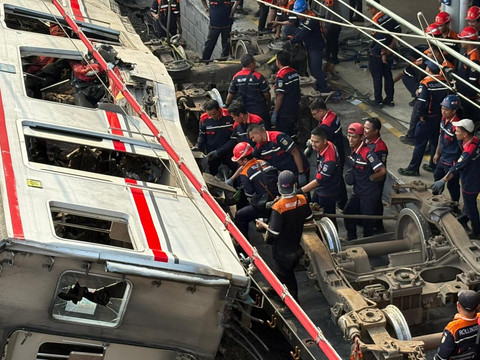
The National Transportation Safety Committee (KNKT) is intensively investigating the cause of the collision between the Argo Bromo Anggrek train and a KRL Commuter Line in East Bekasi. A critical aspect currently under scrutiny in this railway safety probe is the signaling system.
Arif, KNKT’s Public Relations representative, stated that an investigative team was deployed immediately on the night of the incident to gather crucial data from the scene. “Since the night of the incident, KNKT has deployed five railway investigators. The Chairman of KNKT has also been actively monitoring developments on the ground. As for the investigative progress, we currently do not have any significant information to share with the public,” Arif conveyed when contacted on Thursday (April 30). This establishes the ongoing nature of the probe into the Bekasi Timur train accident.
Addressing the widely discussed issue of signal interference, KNKT confirmed that this is indeed one of the key aspects being thoroughly examined in their investigation. “The signaling system is certainly one of the aspects we are deeply looking into,” he added, reinforcing the focus on this critical area in preventing future railway incidents.
The tragic accident, which occurred on Monday night (April 27), resulted in 16 fatalities and left dozens of passengers injured. The chain of events began when a taxi stalled on a level crossing in the Ampera area of East Bekasi due to an electrical malfunction, subsequently being struck by a KRL train heading towards Jakarta. Consequently, a KRL train bound for Cikarang was halted at East Bekasi Station, awaiting the evacuation of the disabled taxi. It was under these precarious circumstances that the stationary KRL Commuter Line train was then struck from behind by the high-speed Argo Bromo Anggrek service.
Argo Bromo Driver Raises Concerns Over Signal Malfunction
Nofiandi, the driver of the Argo Bromo Anggrek train, previously expressed his profound shock regarding the incident. He even suspected a malfunction in the signaling system occurred shortly before the collision. “Yes, I was just as shocked,” Nofiandi stated in a YouTube video by Trainspotter ID, captured moments after the devastating event.
“Alhamdulillah (Thank God), passengers on the Argo Bromo Anggrek were relatively safe. It was the KRL passengers in the very rear carriages who bore the brunt of the impact,” he added, detailing the distribution of casualties. Nofiandi recounted that indications of a signal disturbance were apparent just before the accident. “It seems there was an error with the signal,” Nofiandi stated, pointing directly to a potential technical fault in the railway network.
According to his account, the signal condition he observed did not align with the normal operational sequence. “There had been information from the control center (PK) earlier, but I hadn’t fully ‘copied’ [received or processed] it before the signal suddenly turned red,” he explained, suggesting a rapid and unexpected change in signal status. “It wasn’t exactly sudden, but the signal shouldn’t have turned red directly, as the signal from Bekasi was green. The normal sequence is green, yellow, then red. In terms of connectivity, if it’s green further back, it should be yellow at most here, not immediately red,” he elaborated, highlighting the anomaly in the signaling sequence. At that moment, he recalled, the train he was operating was traveling at a considerable speed. “The speed was quite high, approximately 110 km/h,” he clarified, indicating the significant momentum of the train leading up to the impact.
Summary
The National Transportation Safety Committee (KNKT) is intensively investigating the collision between the Argo Bromo Anggrek train and a KRL Commuter Line in East Bekasi. A critical aspect of this railway safety probe is the signaling system, which KNKT confirmed is under thorough examination. An investigative team was deployed immediately after the incident, although no significant information on the progress has been shared with the public yet.
The tragic accident on April 27 resulted in 16 fatalities and dozens of injuries when the Argo Bromo Anggrek struck a stationary KRL. The KRL had halted at East Bekasi Station after another KRL hit a stalled taxi on a level crossing. The Argo Bromo Anggrek driver reported a suspected signal malfunction, noting an unusual sequence where a green signal quickly turned red before the impact, while the train was traveling at approximately 110 km/h.