
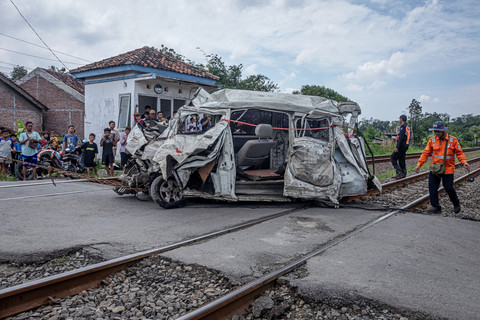

A recent collision involving a train and a taxi at an unmanned railway crossing near Bekasi East Station has once again highlighted the perilous, often overlooked dangers lurking at the intersections of different transportation modes. This incident serves as a stark reminder of the hidden risks that continue to pose a threat to public safety.
Jusri Pulubuhu, Founder and Instructor at Jakarta Defensive Driving Consulting (JDDC), pointedly underscored the alarmingly low safety awareness among motorists navigating railway crossings that lack protective barriers or gates.
“Open railway crossings, those without barriers, inherently diminish drivers’ awareness of potential hazards. This risk is further compounded by numerous obstacles in the surrounding areas that create significant blind spots,” Jusri explained to Kumparan on Tuesday, April 28, 2026, emphasizing the dual challenge of human perception and environmental factors.
Unlike official crossings managed by railway operators, these makeshift or unmanned crossings are devoid of crucial safety features such as warning signs. This absence leaves road users unprepared and less vigilant about entering what is inherently a more dangerous zone.

Jusri elaborated on international practices: “Overseas, there are also unmanned crossings, but the ethical regulations are strictly enforced. What does this entail? Before crossing, it is absolutely mandatory to stop, then roll down both the left and right windows to listen for sounds and vibrations from an approaching train that may be out of sight.” This disciplined approach drastically reduces risk.
A critical, often unacknowledged hidden danger at unofficial unmanned crossings is the statistically lower frequency of accidents compared to what might be expected in normal circumstances over the same period. This paradoxically contributes to a false sense of security.
Consequently, many road users become complacent, erroneously assuming that railway crossing areas are always safe. This widespread complacency, Jusri noted, significantly erodes their awareness of potential dangers, making them more vulnerable to accidents.
“Accidents, by definition, don’t occur constantly. That’s precisely why you might observe road users still attempting to cross even when a railway crossing is closed or while waiting for a train to pass. Why? Because our collective level of safety awareness is incredibly low,” he clarified, linking infrequent incidents to risky behavior.

“It’s not perceived as an anomaly; it’s become normalized. People ignore potential safety threats, and ultimately, when an emergency situation finally arises, they are utterly unprepared to implement any mitigation or risk management strategies,” Jusri stated, highlighting a severe deficiency in preparedness.
He further pointed out that the condition of the road surface at these unmanned crossings is often subpar. Vehicles frequently get stuck while attempting to cross, adding another layer of danger to these already hazardous areas.
Concurrently, Djoko Setijowarno, Advisory Board Member for the Central Indonesian Transportation Society (MTI), strongly urged PT Kereta Api Indonesia (KAI) to promptly address the issue of these unofficial level crossings without barriers.
“The expedited removal of level crossings in densely populated corridors is imperative. With high train frequencies, the closing times for these crossings will only lengthen, potentially causing substantial vehicle queues and increasing traffic congestion,” Djoko informed Kumparan on Tuesday, April 28, 2026.

Djoko added that given the persistently low discipline among road users, the risk of violations and accidents will continue to escalate. Therefore, the construction of grade-separated crossings, such as underpasses and overpasses, must become a top risk-based priority for infrastructure development.
He further stressed that spatial planning along railway lines needs significant reinforcement. Uncontrolled community activities, unauthorized access, and weak enforcement of spatial regulations can all become serious sources of disruption to train operations, compromising both safety and efficiency.
Finally, Djoko emphasized the critical need for KAI and regulators to conduct a comprehensive evaluation of the existing safety system. A modern safety approach, he concluded, dictates that the system must proactively prevent errors from escalating into fatal accidents, rather than merely reacting to incidents after they have occurred.
Summary
A recent train-taxi collision at an unmanned railway crossing near Bekasi East Station underscored the severe dangers of such intersections. Jusri Pulubuhu highlighted motorists’ low safety awareness and complacency, often stemming from blind spots, lack of warning signs, and a false sense of security due to infrequent accidents. This leads to risky behavior and unpreparedness for emergencies, further compounded by subpar road conditions.
Djoko Setijowarno of MTI urged PT KAI to promptly remove unofficial crossings, particularly in densely populated areas, to mitigate congestion and accident risks. He emphasized that constructing grade-separated crossings, like underpasses and overpasses, is a top priority, given persistent low road user discipline. Reinforcing spatial planning and a comprehensive safety system evaluation are also crucial for proactive accident prevention.
