
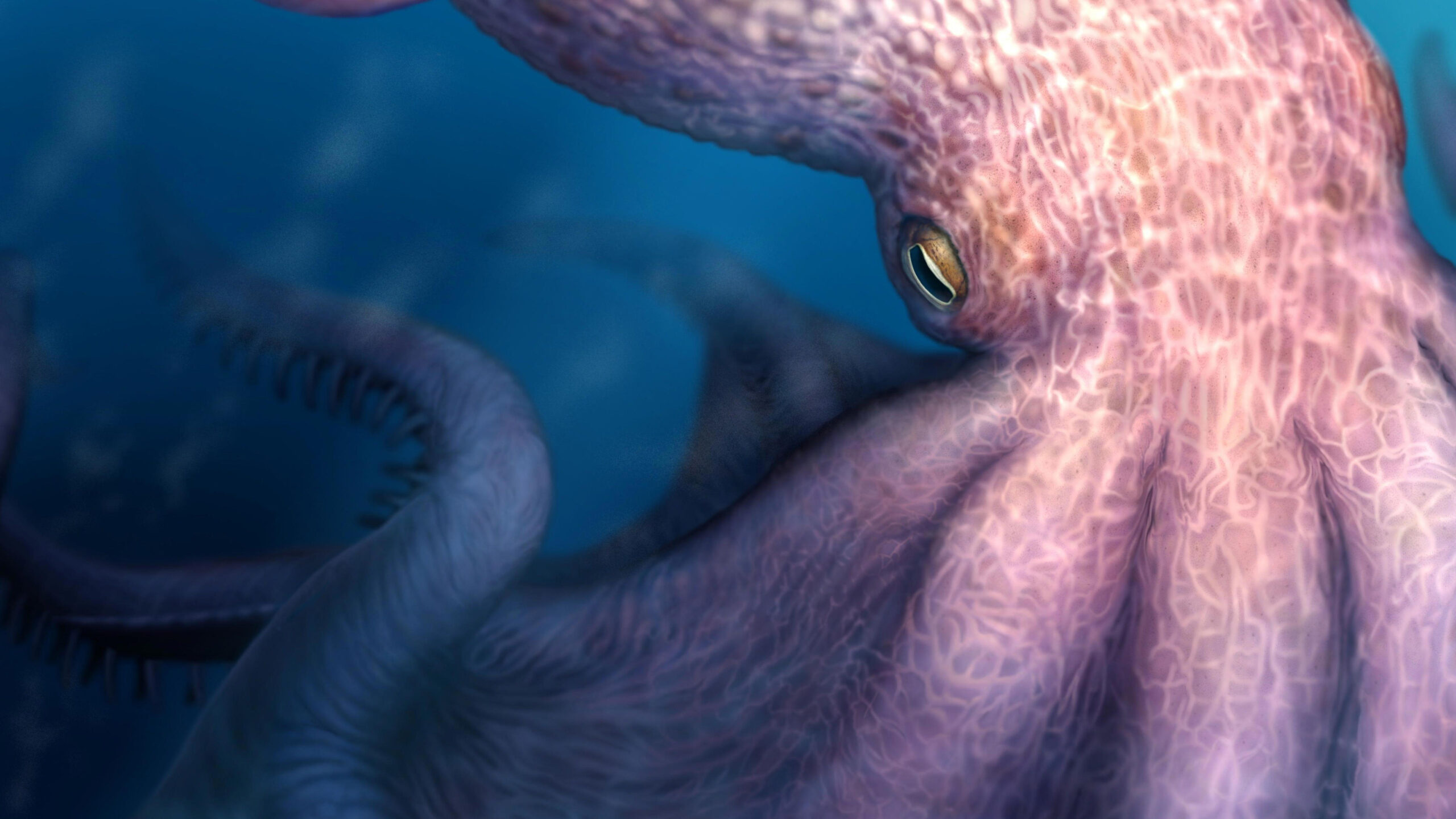

Vast prehistoric oceans, dating back approximately 100 million years, were not exclusively dominated by dinosaurs roaming the land. Startling new research suggests that colossal giant octopuses may have reigned supreme in the ancient seas during this era.
This groundbreaking study is founded on the meticulous examination of several preserved fossilized jaws. Projections from one particular specimen estimate the size of these ancient octopuses to have reached an astonishing 19 meters. Such a monumental discovery positions this creature as potentially the largest invertebrate, and indeed one of the most formidable predators, ever known to scientists.
The current understanding paints a picture of a powerful marine hunter, equipped with robust arms and a distinctive beak-like jaw. These anatomical features would have been instrumental in capturing prey and efficiently crushing the shells and bones of other species. This reinforces the belief that several other octopus species from that ancient period were also exceptionally strong predators.
This finding fundamentally reshapes our understanding of prehistoric marine ecosystems. For decades, paleontologists largely believed that the largest ocean predators were exclusively vertebrates with backbones, such as fish and reptiles. Invertebrates like octopuses and squids were often not given significant consideration in this top-tier predator category, a perspective now being dramatically challenged.

This cutting-edge research, which offers profound new insights into these ancient octopuses, was conducted by a team of dedicated scientists from Hokkaido University in Japan. Their in-depth analysis of the fossil jaws strongly indicates that these giant octopuses possessed the capability to chew through tough shells and the skeletal structures of large fish and marine reptiles.
While their body length alone is estimated to range from 1.5 to 4.5 meters, the inclusion of their immensely long arms extends their total length to an incredible 7 to 19 meters. Another remarkable feature revealed by the fossilized jaws is an uneven structure between the right and left sides. This asymmetry suggests that the octopus might have preferentially used one side of its mouth more often during feeding.
In living animals, such a tendency to favor one side of the body over the other is often associated with more advanced brain function, hinting at a higher level of cognitive ability in these prehistoric cephalopods.
What are the differences compared to modern octopuses?
Modern octopuses are renowned for their exceptional intelligence, sophisticated problem-solving skills, and complex hunting strategies. Today, the largest living octopus species is the Giant Pacific Octopus, boasting an arm span of over 5.5 meters. There are even documented video recordings showing this formidable creature confronting sharks more than a meter in length.
“With their tentacles and suckers, they can bind such animals so there is no escape,” explains Christian Klug, a paleontologist from the University of Zurich who reviewed the research, underscoring their predatory prowess.

Returning to the ancient octopuses, scientists currently face limitations in definitively determining their precise body shape, the exact size of their fins, or their swimming speed. Many aspects of these mysterious creatures remain speculative. Furthermore, beyond these crucial jaw fossils, no other fossils have yet been discovered with stomach contents, which could provide direct evidence of their exact diet.
Dr. Nick Longrich, a paleontologist from the University of Bath, theorizes that these ancient octopuses likely preyed on ammonites, an extinct group of shelled mollusks. However, much like their modern counterparts, they were probably opportunistic and voracious predators, never one to pass up other available prey when the opportunity arose. “It will take time before we fully understand this. It is still a bit of a mystery,” he admits, highlighting the ongoing scientific journey.
For now, these remarkable fossils offer a compelling glimpse into the deep-sea giants that once roamed the ancient oceans, armed with crushing jaws, powerful arms, and potentially an advanced brain that allowed them to contend with other formidable predators of their time. The intriguing research concerning these ancient octopuses was proudly published in the esteemed journal, Science.
Summary
New research, based on fossilized jaws, indicates that colossal giant octopuses, estimated up to 19 meters long, may have dominated prehistoric oceans around 100 million years ago. These creatures were formidable predators, potentially the largest invertebrates, equipped with powerful arms and beak-like jaws capable of crushing shells and bones. This discovery challenges the long-held belief that only vertebrates were top ocean predators in ancient times.
Conducted by scientists from Hokkaido University, the study highlights their immense size and an asymmetrical jaw structure, which could hint at advanced cognitive abilities. While details about their exact diet and characteristics remain somewhat speculative, these remarkable fossils offer a compelling glimpse into the deep-sea giants that once roamed the ancient oceans. The intriguing research concerning these ancient octopuses was published in the journal Science.
