
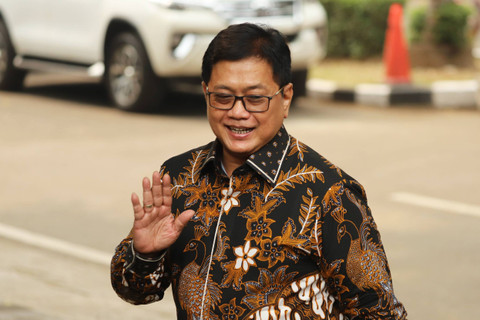

The National Mandate Party (PAN) has voiced strong opposition to a proposal from the Corruption Eradication Commission (KPK) advocating for a two-term limit on the tenure of political party chairpersons. According to PAN Deputy Chairman Viva Yoga Mauladi, such a restriction could be construed as a direct infringement on the fundamental freedom of association, a right enshrined in the Indonesian Constitution.
Speaking to reporters on Friday (April 24), Viva Yoga articulated PAN’s perspective, stating, “Should a discourse emerge to limit the term of party chairpersons, it will invariably be seen as a violation of the freedom of association, as guaranteed by Article 28 of the 1945 Constitution.” He further emphasized that political parties, as private-political organizations, inherently possess the prerogative to independently determine their own leadership structures and processes.
Viva highlighted that Law Number 2 of 2011 concerning Political Parties does not stipulate detailed regulations regarding the term limits for party chairpersons. This deliberate omission, he elaborated, is rooted in the constitutional guarantee of citizens’ rights to associate and assemble, aligning precisely with the provisions of Article 28 of the 1945 Constitution.
“Political parties are distinct community organizations endowed with a public role, differentiating them from state institutions that hold the authority to govern the nation,” Viva asserted. He elaborated that political parties are formed by groups of citizens who share common worldviews, interests, experiences, and collective aspirations, uniting them under a shared purpose.
The Political Parties Act, Viva affirmed, grants comprehensive authority to parties to independently manage their internal affairs. Despite this autonomy, Viva expressed confidence that the public remains vigilant and would not overlook any political party that descends into oligarchy, fails in its cadre regeneration, or exhibits authoritarian tendencies.
Such parties, he contended, would inevitably face consequences at the ballot box. “It is certain that they would not be chosen in subsequent elections, as the party would lose its fundamental basis of legitimacy from the people,” he stated, underlining the vital role of electoral accountability in the democratic process.
Furthermore, PAN believes that the internal life of a political party, meticulously regulated by its Articles of Association and Bylaws (AD/ART), accurately reflects the collective will and shared consensus of its executives and members. This internal governance, according to PAN, is crucial for fostering robust democratic practices within the party structure.
In its commitment to enhancing the quality of democracy in Indonesia, PAN advocates for political parties to maximize their core functions. These include robust political recruitment and education, effectively articulating and aggregating the interests of the populace, and ensuring the cultivation of capable national and regional leadership.
Concluding his remarks, Viva unequivocally reiterated that the selection of a party chairman remains an exclusively internal affair for political parties, an area where external intervention is strictly unwarranted. “The decision regarding who becomes the chairman of a political party is a collective will determined internally. There must be no intervention from any external party or individual,” Viva firmly stated, underscoring the principle of party autonomy.
Summary
The National Mandate Party (PAN) strongly opposes the Corruption Eradication Commission’s (KPK) proposal to limit political party chairpersons to two terms. PAN’s Deputy Chairman, Viva Yoga Mauladi, asserts this restriction infringes upon the fundamental freedom of association, as guaranteed by Article 28 of the 1945 Constitution. He highlighted that Law Number 2 of 2011 concerning Political Parties does not detail such term limits, supporting parties’ prerogative to independently determine their leadership structures.
PAN views political parties as distinct private organizations whose internal governance, defined by their Articles of Association and Bylaws, reflects the collective will of their members. The party believes public vigilance and electoral accountability will naturally address parties exhibiting oligarchy or authoritarianism by not re-electing them. Therefore, the selection of a party chairman remains an exclusively internal affair, strictly unwarranted for external intervention.
