
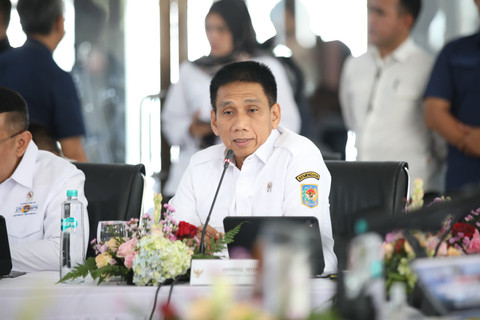
Deputy Minister of Home Affairs, Akhmad Wiyagus, recently underscored the critical importance of strengthening regulations, particularly in spatial planning policies, as a fundamental pillar for advancing national railway development across the vital Indonesian islands of Sumatra, Kalimantan, and Sulawesi. This strategic emphasis highlights the government’s commitment to integrated infrastructure growth.
Wiyagus further affirmed that the expansion of the national railway network is underpinned by a robust legal framework. This solid foundation is clearly demonstrated by several Presidential Regulations (Perpres) that govern island spatial planning. Specifically, these include Presidential Regulation Number 3 of 2012 concerning the Spatial Planning for Kalimantan Island, Presidential Regulation Number 88 of 2011 for Sulawesi Island, and Presidential Regulation Number 13 of 2012 for Sumatra Island.
These crucial legal instruments serve as the bedrock for local governments (Pemda) to formulate and adapt their Regional Spatial Planning Regulations (RTRW) and Detailed Spatial Plans (RDTR). This systematic approach ensures that the development of the railway network can be seamlessly integrated into broader regional development planning, fostering cohesive growth and connectivity.
Within this intricate framework, the Ministry of Home Affairs (Kemendagri) plays a pivotal strategic role, acting as both a facilitator and supervisor. Its primary function is to synchronize policies between the central and regional governments. This vital role is executed through a multi-tiered approach, cascading from governors, who serve as central government representatives in the regions, down to the district and city levels, ensuring consistent policy implementation.
“The Ministry of Home Affairs strongly supports the development of this national railway network. In line with its functions as a government body and supervisor, it facilitates and synchronizes policies with regional governments, a process that is naturally carried out in a tiered manner,” explained Wiyagus during the Coordination Meeting for the Development of the National Railway Network at Tanah Abang Baru Station, Central Jakarta, on Wednesday, April 22, 2026.
Expanding on the current progress, Wiyagus presented an overview indicating that as of April 2026, among the 21 provinces across Sumatra, Kalimantan, and Sulawesi, some regions have already established their local regulations (Perda) concerning spatial planning. Meanwhile, others are still actively engaged in the revision or evaluation process. This varying state of readiness underscores the ongoing efforts to align local frameworks with national objectives.
This situation directly reflects the preparedness of regions to support national railway development. It is imperative that all railway projects are meticulously aligned with the prevailing spatial planning documents to ensure smooth execution and maximize their developmental impact. The synchronization between project plans and spatial regulations is non-negotiable for successful infrastructure rollout.
Beyond regulatory harmonization, Wiyagus also highlighted pressing regional fiscal challenges. He elaborated that the railway sector is not yet fully categorized as a mandatory basic service. Consequently, it often does not receive prioritization in budgetary allocations, particularly for regions with limited fiscal capacity. This presents a significant hurdle for accelerating railway projects where local financial contributions are expected.
“Therefore, this needs to be formulated very carefully,” he emphasized, pointing to the delicate balance required to integrate railway funding into regional budgets without overburdening local finances.
Furthermore, Wiyagus outlined several critical aspects that demand careful attention for the successful expansion of the national railway network. These include aligning priorities between central and regional authorities, strengthening connectivity in areas surrounding key transportation hubs, integrating the rail network with broader regional systems, and fostering robust multi-sector and multi-level government coordination.
“The success of this agenda is not merely about constructing tracks, but also about ensuring that the regional ecosystem and institutional coordination remain robust and functional,” he asserted, emphasizing a holistic approach to infrastructure development.
The high-level event saw the attendance of several prominent figures, including Coordinator Minister for Infrastructure and Regional Development Agus Harimurti Yudhoyono, Minister of National Development Planning/Head of the National Development Planning Agency Rachmat Pambudy, Head of the National Research and Innovation Agency Arif Satria, Deputy Head of the State-Owned Enterprises Regulatory Agency Aminuddin Ma’ruf, alongside representatives from various other relevant ministries and institutions, underscoring the collaborative effort behind this crucial national initiative.
