
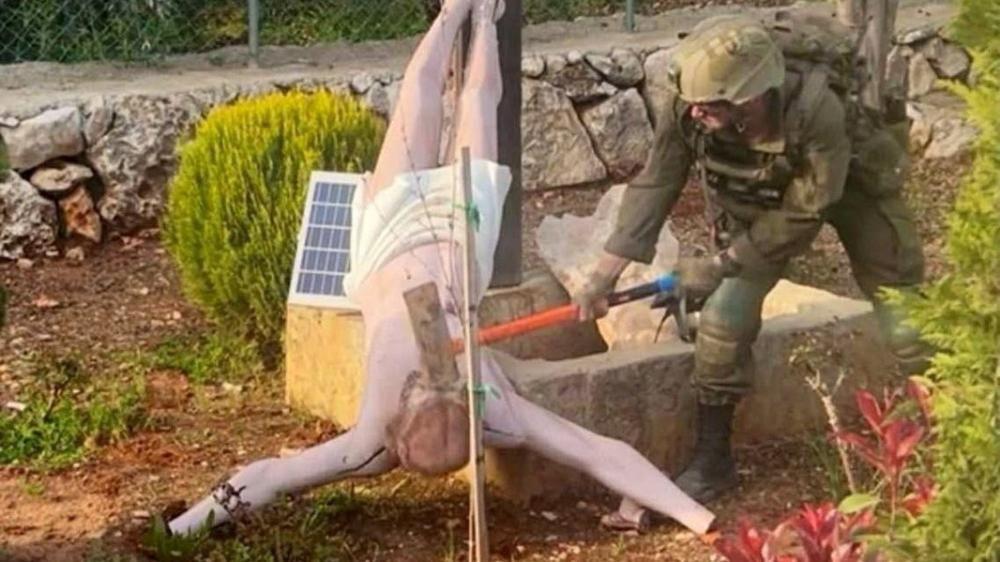

A viral image depicting an Israeli soldier striking a statue of Jesus with a sledgehammer in southern Lebanon has ignited widespread condemnation across social media platforms. The incident has drawn swift and strong reactions from international figures and religious communities.
Israeli Prime Minister Benjamin Netanyahu expressed his deep concern, stating he was “shocked and saddened” by the events. Echoing this sentiment, Israeli Foreign Minister Gideon Saar issued an apology: “We apologize for this incident and to every Christian whose feelings have been hurt,” he stated, acknowledging the profound impact on Christian communities.
Local residents identified the damaged statue as being affixed to a cross outside a family home on the outskirts of Debel. This village is notably one of the few communities where residents have remained steadfast amidst the ongoing conflict between Israel and Hezbollah, highlighting the sensitive nature of the area.
Not an Isolated Incident
Father Fadi Flaifel, head of the Debel congregation, conveyed his unequivocal disapproval to the BBC. “We completely reject the desecration of the cross, our sacred symbol, and all religious symbols,” he affirmed. Father Flaifel further asserted that such actions “contradict the declaration of human rights and do not reflect civilization,” claiming that similar acts of religious desecration have occurred in the past.
The Israeli military has since confirmed the authenticity of the widely circulated social media image, indicating it views the incident “with great seriousness.” The Israel Defense Forces (IDF) emphasized that the soldier’s behavior is “completely inconsistent with the values expected of its forces.” The IDF further stated that “appropriate measures” would be taken against those involved and affirmed its cooperation with the Christian community to “restore the statue to its place.”
This incident unfolds against a backdrop of ongoing military presence, with thousands of Israeli soldiers remaining in southern Lebanon following a ceasefire agreement that took effect on Friday, April 17. The truce brought a temporary halt to six weeks of intense fighting between Israel and the Hezbollah group, a period marked by mutual accusations of ceasefire violations.
US Christian Leaders Condemn Desecration
News of the attack on the Jesus statue in Lebanon prompted strong reactions from the United States. Mike Huckabee, the US Ambassador to Israel and a prominent Protestant pastor, took to X to demand “swift, severe, and public consequences.” Conservative commentators in the US quickly echoed this condemnation of the Israeli soldier’s actions.
“Horrible,” wrote Matt Gaetz, a former advisor to President Donald Trump and a former Congressman, as he reposted the controversial image. Similarly, former US Congresswoman Marjorie Taylor Greene shared the photo, commenting critically on “Our greatest ally’ who annually receives billions of our tax dollars and weapons.” These comments align with recent polling data reflecting a discernible decline in US support for Israel. A recent survey by the US-based Pew Research Center revealed that 60% of US adults now hold a negative view of Israel, an increase from 53% last year.

The growing negative sentiment towards Israel in the US is also fueled by a series of recent incidents. Last month, Israeli police notably prevented Jerusalem’s highest-ranking Roman Catholic leader from entering the Church of the Holy Sepulchre to conduct Palm Sunday mass. Israeli authorities cited safety concerns during the ongoing conflict with Iran as the reason for this restriction. Huckabee characterized this incident as “an unfortunate overreach with huge worldwide implications,” finding Israel’s actions to restrict and ban Christian clergy from entering churches “difficult to comprehend or justify.”
‘Open Hostility’ Concerns
A 2025 report by the Rossing Center, a Jerusalem-based organization dedicated to fostering interfaith relations in the Holy Land, points to a “surge in open hostility towards Christianity.” The report links this trend to “deepening polarization and ongoing ultra-nationalist political trends” within the region. However, Israeli officials have largely dismissed this assessment.
Prime Minister Benjamin Netanyahu countered these claims by asserting that “the Christian population in Israel is growing unlike anywhere else in the Middle East.” He further emphasized Israel’s commitment to religious freedom, stating: “Israel is the only country in the region where the Christian population and its standard of living are increasing. Israel is the only place in the Middle East that upholds freedom of worship for all.”

Israel initiated its military operations on March 2, alleging that Hezbollah commenced confrontations by firing rockets into Israel. This was seen as an act of support for Iran after Israel and the US reportedly launched a war against Tehran in late February. The extensive Israeli military campaign in Lebanon has had devastating consequences, leading to the displacement of over one million Lebanese citizens and resulting in more than 2,290 fatalities, including 177 children and 100 health workers, according to Lebanese authorities. Conversely, Israeli officials reported that 13 Israeli soldiers and two civilians were killed by Hezbollah attacks during the same period.
- Satellite imagery reveals Israel flattening cities in southern Lebanon
- More than 100 international legal experts assess serious violations in US-Israel war with Iran
- History of Israeli attacks on Lebanon
Summary
An image showing an Israeli soldier striking a statue of Jesus in southern Lebanon has sparked widespread condemnation. Israeli Prime Minister Benjamin Netanyahu expressed shock, and Foreign Minister Gideon Saar apologized for the incident, acknowledging the deep impact on Christian communities. The Israeli military confirmed the authenticity of the image, stated the soldier’s actions were inconsistent with its values, and promised appropriate measures, including restoring the statue in Debel.
This incident prompted strong reactions from US Christian leaders and conservative commentators, who criticized Israel despite it being a major recipient of US aid. Such condemnation aligns with a discernible decline in US support for Israel, further fueled by past incidents like restricting Christian clergy from churches in Jerusalem. Reports also highlight growing concerns about “open hostility” towards Christianity in the region, linked to ultra-nationalist political trends.
