
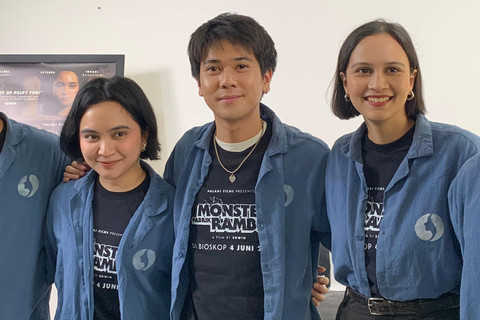

Palari Films’ latest production, Monster Pabrik Rambut (Hair Factory Monster), is poised to deliver more than just visual terror; it offers a biting critique of contemporary workplace realities. Lead actor Iqbaal Ramadhan, who portrays Bona in the film, revealed that the collaboration between acclaimed director Edwin and celebrated writer Eka Kurniawan was specifically crafted to expose the dark underbelly of industry, particularly for blue-collar workers.
“Bung Edwin and Bung Eka are attempting to critique what actually happens in Indonesian workplaces, especially for the blue-collar workers depicted in this film,” Iqbaal stated during a press conference in Kemang, South Jakarta, on Monday, April 20.
Iqbaal highlighted a pervasive issue where safety standards often take a backseat to urgent economic demands. He employed the phrase “Takes Two to Tango” to illustrate the complex and often imbalanced relationship between companies and employees within an imperfect system.
“What I mean is, even if a factory has established safety standards, I sometimes feel it’s the workers themselves who might say, ‘Ah, never mind, just make it easy’,” Iqbaal explained, pointing to a potentially problematic dynamic.

This situation, according to Iqbaal, is frequently triggered by pressing financial necessities. Workers may inadvertently disregard safety protocols in pursuit of time efficiency, hoping to accelerate their earnings. Such compromises, driven by the desire for quick completion and immediate payment, inherently elevate the risk of workplace accidents.
“It’s because of their need to be time-efficient, so the work finishes quickly, and the money comes in fast. These kinds of things ultimately increase the chances of accidents occurring more frequently,” Iqbaal added, emphasizing the perilous cycle.
Furthermore, a crucial point the film aims to convey is the normalization of excessive workloads or overwork, a phenomenon deeply ingrained in many professional environments.
The “Maklum” Phenomenon
Iqbaal describes the “Maklum” phenomenon—where people passively accept inhumane pressures—as the true horror. This resignation to difficult circumstances transforms ordinary workplace stress into a terrifying, normalized reality.
“The horror lies in how much we have normalized this overwork. It’s like everyone thinks, ‘Oh well, bro, if he’s like that, he’s complicated, his standards are too high’,” Iqbaal revealed, reflecting the dismissive attitudes that perpetuate the issue.
Director Edwin underscored that this exploitative system isn’t confined to hair factories but is a pervasive issue across various sectors. He emphasized that the film’s critique resonates far beyond its specific setting.
“The two-party work system, between those who provide work and those who work, doesn’t just happen in factories. It can also occur in office work situations or in many stories within the creative industry, where many are exploited or even self-exploit,” Edwin asserted, broadening the scope of the film’s social commentary.
Monster Pabrik Rambut delves into the story of Putri (Rachel Amanda), who is compelled to work at the factory to settle her mother’s debts, following her mother’s rumored suicide. Her younger sister, Ida (Lutesha), however, believes their mother’s death was caused by mystical occurrences within the factory itself.
As Putri and Ida begin working day and night shifts at the factory, they not only hear unsettling tales but also start to witness a series of strange and supernatural incidents befalling their fellow workers, blurring the lines between industrial exploitation and genuine horror.
Following its successful screening at the Berlinale Film Festival, Monster Pabrik Rambut is set to terrify and provoke thought in Indonesian cinemas starting June 4.
