
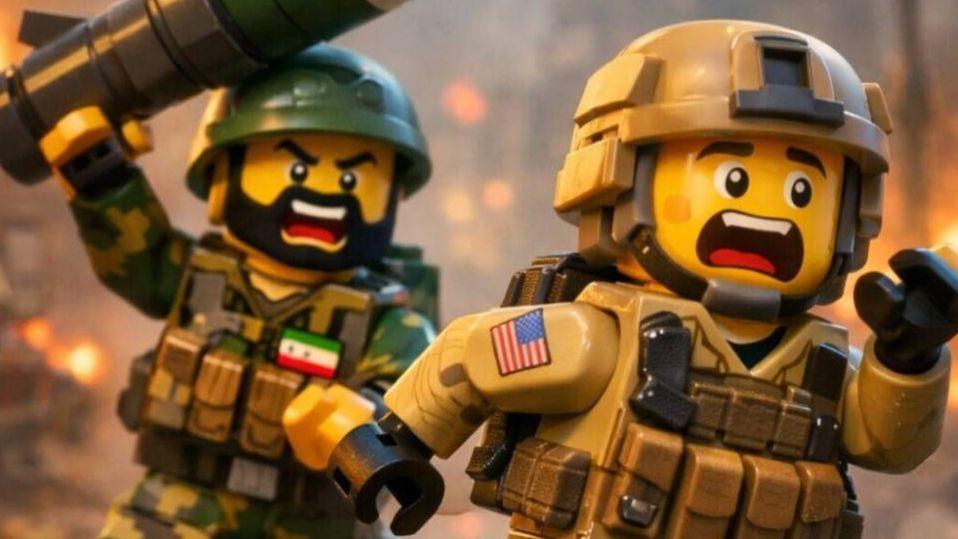

At first glance, these viral AI-generated videos might appear like sophisticated scenes from a Lego movie, boasting vivid visuals and a rapid pace. However, these captivating clips—featuring imagery of dying children, fighter jets, and even former US President Donald Trump—are, in fact, sophisticated pro-Iran propaganda.
The BBC engaged in an interview with a representative from Explosive Media, a key entity behind the production of these provocative clips. The individual, who requested to be identified only as Mr. Explosive, is known as a shrewd social media operator. Initially, Mr. Explosive denied any affiliation with the Iranian government, asserting in previous interviews that his account was “completely independent.” Yet, under persistent questioning, he made a groundbreaking admission: the Iranian regime is indeed one of their “clients”—a revelation he had never publicly disclosed before.
The overarching message conveyed through these videos is a portrayal of Iran’s struggle against what it perceives as an omnipotent global oppressor: the United States. These clips are undeniably striking and far from subtle, yet their directness has not diminished public enthusiasm for sharing and commenting on them extensively across social platforms.
One particular video controversially depicts Donald Trump tumbling amidst a swirl of documents labeled “Epstein archives,” all set to rap lyrics declaring, “secrets are starting to leak, pressure is building up.” Another equally potent video features George Floyd beneath a police officer’s boot, accompanied by a narrative stating that Iran “stands here for everyone who has been harmed by your system.”
Leading propaganda expert Dr. Emma Briant suggests that the term “slopaganda”—a neologism introduced in an academic paper last year as a play on “AI slop”—is inadequate to describe the powerful and “highly sophisticated” nature of this content. The reach of these AI-powered propaganda clips is staggering, estimated to have garnered hundreds of millions of views throughout the ongoing conflict.
During his interview, Mr. Explosive appeared in silhouette, framed by red and green lights—the colors of the Iranian flag. On his desk was a helmet adorned with green feathers, an emblem associated with the revered warrior Husayn ibn Ali, a figure frequently featured in their videos. He clarified that his team at Explosive Media consists of fewer than 10 individuals, strategically employing Lego-style graphics because, as he put it, “it is a universal language.” Significantly, Iranian and Russian state media accounts on X routinely disseminate these videos to their millions of followers, amplifying their reach.
When questioned about the prominent display of Epstein documents in his videos, Mr. Explosive explained it was intended to demonstrate to his audience the “type of confrontation they are witnessing” between Iran—which he claims “seeks truth and freedom”—and those who “associate themselves with cannibals.” This statement refers to unsubstantiated theories alleging that the Epstein documents link the Trump administration to cannibalistic practices—accusations entirely devoid of credible evidence.
The videos are also rife with significant factual inaccuracies, a point we pressed Mr. Explosive on. For instance, one clip depicts the Iranian military successfully capturing a downed US fighter jet pilot. However, US officials have confirmed that the airman, who was stranded in a remote mountainous region of Iran after his plane was shot down, was successfully rescued by US special forces on April 4. Mr. Explosive vehemently rejected this claim. “Maybe no pilot went missing, no rescue operation,” he asserted, adding, “Their main goal was to steal uranium from Iran.” When challenged on this assertion—by citing US officials who stated the airman was receiving treatment in Kuwait—he simply retorted, “Only 13% of what Trump says is based on fact.”
The video produced by Explosive Media regarding the airman has been remarkably effective in solidifying this alternative narrative among English-speaking audiences. A partisan TikTok influencer based in the US, @newswithsteph, informed her followers that the Lego videos are “shockingly accurate; they’re uncovering stories about a recent US pilot mission that was not a rescue operation at all, but a special operations mission to obtain uranium.”
Dr. Emma Briant emphasizes that artificial intelligence has empowered Iran and similar actors to communicate directly and far more effectively with Western audiences than ever before. She notes they leverage tools largely trained on Western data, making them ideal for creating “culturally resonant” content for target demographics. “This is what authoritarian states targeting the West have lacked,” she stated.
Concurrently, Dr. Tine Munk, a cybersecurity expert from Nottingham Trent University, characterizes Iran’s tactics as a form of “defensive memetic warfare,” perceived by its creators as essential to counteract American rhetoric.

Explosive Media’s videos first emerged in early 2025, but their popularity surged dramatically with the outbreak of the US-Iran war. The Lego-style clips have also grown increasingly detailed, now illustrating specific locations in the Gulf region—including power plants, airports, and industrial areas—depicted as utterly destroyed by Iranian missile strikes. In reality, most of these locations sustained only limited damage.
These videos are frequently produced almost in “real time,” appearing shortly after major developments in the war. Notably, one video concerning a ceasefire agreement was even published before any official announcement. Local officials have reported thousands of casualties in Iran, Lebanon, and other Middle Eastern nations. The current conflict escalated in February following US and Israeli attacks on Iran.
In the interview, Mr. Explosive ultimately acknowledged that the Iranian government is indeed one of his company’s “clients,” a point he had previously communicated through Instagram messages, indicating his operations had received direct assignments for various projects from Iranian officials. Prior to the war this year, thousands of protesters were killed in brutal crackdowns by the regime. The US-based Human Rights Activists News Agency (Hrana) reported at least 7,000 civilian fatalities.
Nevertheless, Mr. Explosive staunchly defended his team’s association with the Iranian government, asserting that working for the state is an honor. He also dismissed the recent wave of mass protests as a “coup” funded by former President Donald Trump. Furthermore, Mr. Explosive rejected allegations that his videos utilize antisemitic tropes. “Our videos are not antisemitic; our videos are anti-Zionist,” he declared. He defended the portrayal of Israeli Prime Minister Benjamin Netanyahu drinking blood, stating that the imagery was intended to highlight “the atrocities he commits.”
Currently, the majority of Iranian citizens are unable to access the internet due to a nationwide blackout. Mr. Explosive claimed he could communicate with the BBC using “journalist internet” provided by the Iranian government, a notable detail given Iran’s consistent ranking as one of the world’s most repressive nations concerning press freedom.

While various social media platforms have taken action to shut down accounts featuring these compelling Lego-style propaganda videos, new accounts appear to emerge with equal rapidity. According to Dr. Tine Munk, this represents an agile and aggressive form of internet diplomacy that is likely here to stay. Crucially, she adds, this approach “removes the intermediaries, removes the press and mass media, and constantly spreads memes.” “Traditional diplomacy is not present here. This blurs our understanding of what is actually happening. But at the same time, the risk is increased misinterpretation and escalation,” she warned. “In other words, we are in a kind of limbo.”
- What is artificial intelligence, how dangerous is it, and what jobs are threatened by it?
- Stories of people asking AI for advice on love and relationships
- These are the clearest signs we are watching an AI video
Summary
Stunning AI-generated Lego-style viral videos are sophisticated pro
