
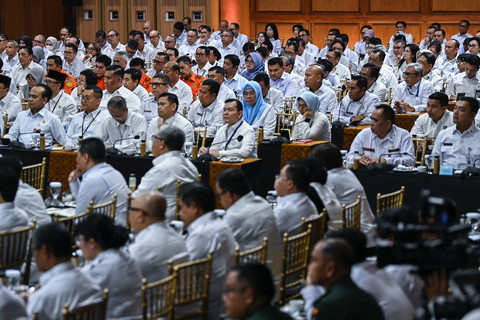

Cyrus Network, a prominent survey institution, recently conducted a national public opinion survey from April 1 to 5, 2026. The comprehensive study, titled ‘Evaluation and Public Opinion Related to Eid Homecoming and Other Current Issues,’ aimed to gauge the sentiment of the Indonesian populace on various critical matters.
A significant focus of the survey was to assess the level of public satisfaction with the performance of ministries operating under the leadership of the Prabowo-Gibran administration. Specifically, it scrutinized the public’s perception of how effectively the ministers of the Red and White Cabinet are executing the President’s vision and priority programs.
The overall findings regarding public satisfaction with ministerial performance reveal a largely positive outlook:
-
Very dissatisfied: 1.8 percent
-
Dissatisfied: 22.2 percent
-
Satisfied: 67.3 percent
-
Very satisfied: 2.7 percent
-
Don’t know/No answer: 6 percent
These results clearly indicate that the majority of respondents expressed satisfaction with the ministers’ performance, positioning the overall public satisfaction at a ‘good’ level. It’s worth noting that a ‘very good’ rating is defined by scores ranging from 77.6 to 100 percent in this survey’s metric.
Beyond general satisfaction, the survey further delved into identifying the most popular ministries and providing a detailed assessment of individual ministerial performance. The granular insights offer a clearer picture of public perception.

Coordinating Ministries Evaluation
Among the coordinating ministries, the Coordinating Ministry for Economic Affairs distinguished itself by securing the top position as the best-performing coordinating ministry and emerging as the most popular among the public. The popularity rankings for coordinating ministries were as follows:
-
Coordinating Ministry for Economic Affairs: 82.8 percent
-
Coordinating Ministry for Infrastructure and Regional Development: 82.7 percent
-
Coordinating Ministry for Food: 81.6 percent
-
Coordinating Ministry for Political and Security Affairs: 81.4 percent
-
Coordinating Ministry for Legal, Human Rights, Immigration, and Correctional Affairs: 81.3 percent
-
Coordinating Ministry for Community Empowerment: 80.6 percent
-
Coordinating Ministry for Human Development and Culture: 79.9 percent
When it came to performance, the coordinating ministries also received varied ratings, categorized into ‘very good’ and ‘good’ levels:
-
Coordinating Ministry for Economic Affairs: 80.3 percent (very good)
-
Coordinating Ministry for Infrastructure and Regional Development: 80.1 percent (very good)
-
Coordinating Ministry for Food: 79.5 percent (very good)
-
Coordinating Ministry for Political and Security Affairs: 78.9 percent (very good)
-
Coordinating Ministry for Legal, Human Rights, Immigration, and Correctional Affairs: 78.6 percent (very good)
-
Coordinating Ministry for Community Empowerment: 75.1 percent (good)
-
Coordinating Ministry for Human Development and Culture: 74.1 percent (good)
Ministerial Performance and Popularity
Shifting focus to individual ministries, the Ministry of Finance demonstrated stellar performance, earning a ‘very good’ rating. It was closely followed by the Ministry of Health and then the Cabinet Secretariat. The Ministry of Finance achieved an impressive 89.2 percent, deemed ‘very good,’ while the Ministry of Health scored 86.8 percent, also in the ‘very good’ category. The Cabinet Secretariat rounded out the top three with 86.3 percent, signifying ‘very good’ performance as well. The complete performance breakdown is depicted in the accompanying graphic.

In terms of popularity, the Ministry of Finance once again emerged as the most favored ministry among the public. Trailing behind were the Ministry of Religious Affairs and the National Police. A detailed ranking of ministerial popularity is presented in the following visuals.


Survey Methodology: A Rigorous Approach
This comprehensive survey was designed to meticulously explore public perception regarding prevailing public issues, particularly those pertaining to national social, economic, and political conditions, alongside the government’s efficacy in governance. Cyrus Network stated that an additional objective was to ascertain the public’s level of knowledge, personal experiences, trust, satisfaction, and overall assessment of current government policies and programs.
The sampling process for this study employed a multistage random sampling method, specifically utilizing a two-stage sampling technique. Respondents were carefully selected to represent the Indonesian population, encompassing individuals aged at least 17 years old or those already married, with an equal proportion of male and female participants. A total of 1,260 respondents were surveyed, spread across 126 villages/sub-districts in all 38 provinces. Each selected respondent was interviewed face-to-face to ensure data quality and depth of responses.
The survey maintains a high degree of reliability, with a confidence level of 95 percent and a margin of error estimated at approximately 2.82 percent, reinforcing the robustness of its findings.
