
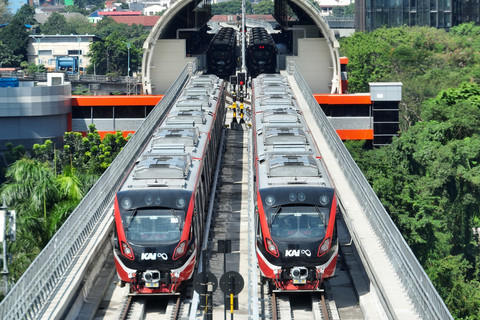

The LRT Jabodebek commuter service experienced a notable 10 percent decline in passenger numbers on Friday, April 10th, marking the inaugural day of the government’s work-from-home (WFH) policy. This immediate shift in commuter patterns significantly impacted daily ridership across the Greater Jakarta light rail network, underscoring the direct effect of new working arrangements on urban transportation.
Radhitya Mardika, Manager of Public Relations for LRT Jabodebek, attributed this reduction directly to the implementation of the WFH policy for civil servants (ASN), particularly affecting travel during peak hours. As reported by Antara on Saturday, April 11th, the impact was evident in the daily operational figures, showcasing a clear correlation between the policy and commuter behavior across the busy public transport system.
On Thursday, April 9th, KAI (Kereta Api Indonesia), the operator of LRT Jabodebek, successfully served 118,505 passengers. However, by Friday, April 10th, this number dropped significantly to 106,301 users. This represents a total decrease of 12,204 passengers, precisely a 10 percent reduction in a single day, highlighting the substantial influence of the WFH directive on public transport usage within the Jabodebek region.
Data further revealed that the most significant drops in passenger volume were observed at stations located near major office complexes and integrated transport hubs. Kuningan Station, for instance, saw a decrease of 2,246 users, falling from 12,530 passengers on Thursday, April 9th, to 10,284 on Friday, April 10th. Similarly, Dukuh Atas Station recorded a reduction of 1,095 users, moving from 16,954 to 15,859 passengers during the same period. Rasuna Said Station also experienced a substantial decline, with 1,052 fewer passengers, dropping from 7,621 to 6,659, reflecting a concentrated impact in business districts.
Radhitya elaborated that other LRT Jabodebek stations in close proximity to government offices and business districts, such as Setiabudi, Cikoko, and Pancoran, also observed similar decreases in ridership. Despite this dip in demand, KAI maintained its unwavering commitment to optimal service delivery. On Friday, April 10th, the LRT Jabodebek continued to operate on a full weekday schedule, deploying 430 trips to ensure seamless service for all commuters and uphold its service standards.
Furthermore, all station facilities and dedicated LRT Jabodebek personnel remained fully staffed and alert, ensuring the safety and comfort of every passenger. KAI reaffirms its dedication to serving as an efficient, punctual, and integrated public transportation solution for the community. “KAI will continue to support the mobility of the public, ensuring that every LRT Jabodebek journey prioritizes aspects of safety and comfort for all users,” Radhitya concluded, emphasizing the operator’s steadfast commitment to its passengers and the broader urban transit landscape.
Summary
LRT Jabodebek experienced a 10
