
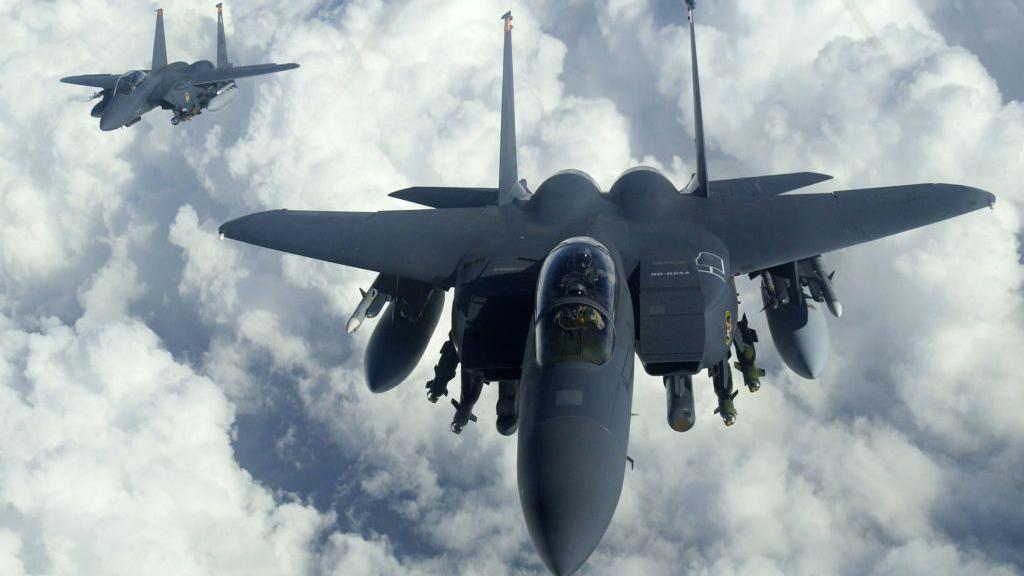
The United States military has successfully rescued a fighter jet crew member who was shot down in Iran, concluding an operation described as highly intricate and complex.
The high-stakes rescue operation reportedly involved a significant deployment of resources, including dozens of American special forces personnel, US fighter jets, helicopters, and members of the CIA, according to US media reports.
On Sunday, April 5, US President Donald Trump confirmed the successful mission via social media, stating: “We have rescued a seriously injured and very brave F-15 crew member, deep within the mountains of Iran.”
The dramatic incident originated on Friday, April 3, when an F-15 jet, carrying both a weapon systems officer and a pilot, was shot down in southern Iran. This marked a significant event, being the first time a US fighter jet had been downed by enemy forces in over two decades.
Both American military personnel aboard the F-15E Strike Eagle managed to eject from the stricken aircraft. While the pilot was swiftly rescued on the same day, the second crew member remained missing, triggering an urgent search.
A tense race against time ensued as both the United States and Iran launched efforts to locate the missing aviator.
Iranian authorities, asserting their intention to capture the crew member alive, offered a substantial reward of £50,000 (approximately 1.1 billion Indonesian Rupiah). Unverified videos circulating on social media showed armed civilians actively participating in the search.
Upon reaching the ground, the downed crew member was reportedly armed only with a pistol for self-defense, as confirmed by US officials. This lone defense underscored the peril of his situation.
According to the US military, the crew member had undergone specialized survival training for such scenarios. This comprehensive preparation included instructions on activating locator beacons, seeking higher ground, maintaining concealment, and establishing communication channels.
However, US media reports indicated that the aviator opted to hide in a mountain crevice, judiciously limiting the use of his beacon. This decision was driven by the critical concern that the signal could be detected by Iranian forces, and he reportedly waited patiently for his rescue team to arrive.
The CIA played a crucial role in the intricate rescue operation, a senior Trump administration official told US media. The US intelligence agency was instrumental in precisely tracking the crew member’s exact location to the mountain crevice and relaying this vital intelligence to the Pentagon.
President Trump elaborated that US officials diligently monitored the crew member’s location “24 hours a day” while meticulously planning the complex rescue operation. He highlighted the urgency of the situation, adding that the aviator was “hunted by our enemies, who were getting closer by the hour.”
Adding another layer of complexity, the CIA reportedly employed diversionary tactics. US reports indicate that the agency deliberately spread false information within Iran, suggesting that US forces had already located the second crew member, likely to mislead Iranian search efforts.
In a post on Truth Social, President Trump revealed the scale of the military response, stating that the US military “sent dozens of aircraft, armed with the world’s deadliest weapons, to pick him up.”
As US special forces advanced towards the stranded crew member, a strategic use of bombs and gunfire was employed to suppress and deter Iranian forces from approaching his position, according to US reports. This aggressive tactic created a window for the rescue team.
Further compounding the mission’s challenges, US media also reported that two transport planes designated to ferry the rescue team were unable to take off from a remote base situated within Iranian territory. These two aircraft were subsequently destroyed to prevent them from falling into enemy hands. The special forces then proceeded to utilize three additional aircraft to successfully extract the crew member, the reports added.
Footage and photographs, verified by BBC Verify, provided visual evidence of the intense conflict, showing the still-smoking wreckage of aircraft in Iran’s central mountainous region, approximately 50 km southeast of the city of Isfahan.
Conversely, the Iranian military presented a different narrative, claiming that two US C-130 military transport planes and two Black Hawk helicopters were destroyed during the operation. They also asserted that “a diversionary and escape mission at an abandoned airport south of Isfahan… was completely foiled.”
Iranian state media further reported on Sunday, April 5, that forces from the Islamic Revolutionary Guard Corps (IRGC) had shot down a US drone in Isfahan while it was actively searching for the missing crew member. The BBC has stated it could not independently confirm either version of events near Isfahan.
Before midnight US time, the complex rescue operation reached its successful conclusion. The crew member was then promptly flown to Kuwait for urgent medical attention, US officials confirmed.
President Trump, while expressing relief, noted that the officer had “suffered serious injuries” but reassured the public that “he will be fine.”
The US government has maintained discretion regarding the specifics, withholding any information about the crew member’s exact rescue location or identity.
William Fallon, a retired US Navy admiral and former US military official, suggested to the BBC that the “time of day” likely played a crucial role in the mission’s success. He emphasized that “Darkness is better for our people because they are accustomed to operating at night,” leveraging their expertise in nocturnal operations.
Fallon also offered a stark reminder about the inherent risks of aerial missions over hostile territories: “You have to be ready to be the one hit.”
Shortly before 00:00 EDT (04:00 GMT) or 11:00 WIB on Sunday, April 5, US media widely reported that the second crew member had been successfully located.
President Trump emphatically underscored the US military ethos in a social media post: “WE WILL NEVER ABANDON AN AMERICAN WARFIGHTER!”
Despite the successful rescue from the American perspective, Iran staunchly maintained that the operation was a definitive failure.
Ebrahim Zolfaghari, spokesman for Iran’s main military command, claimed in a video statement that several US military aircraft were forced to execute emergency landings during the incident.
“That foolish president, trapped in a quagmire of war and aggression he started himself… is fully aware that any aggression, ground operation, or infiltration… will face decisive and humiliating defeat,” Zolfaghari asserted, reflecting Iran’s combative stance.
This rhetoric of a “failed” mission was consistently reiterated by Iranian officials and state television, particularly after Donald Trump announced the pilot’s rescue, aiming to counter the American narrative of success.
Some US analysts viewed the loss of an F-15E within Iranian territory, compounded by the reported destruction of several rescue aircraft, as a revealing indicator of the inherent limitations of US air power when operating deep within adversary territory.
General Frank McKenzie, former commander of US Central Command, acknowledged to CBS, a BBC partner in the US, that “we did lose some aircraft on that mission.” However, he philosophically added that such losses are acceptable “anytime” in situations where the paramount goal is retrieving a downed service member. “It takes a year to build a plane—it takes 200 years to build a military tradition of leaving no one behind,” he powerfully stated on CBS’s Face The Nation program, emphasizing the military’s unwavering commitment to its personnel.
Additional reporting by Ghoncheh Habibiazad, BBC Persian.
- Trump threatens Iran: Open Hormuz Strait by Tuesday or power plants will be destroyed
- ‘I haven’t slept for days’ – The story of an Iranian citizen one month after the US-Israel attacks began
- Iran vs Israel-US war: Are we heading for World War Three or is the concern exaggerated?
- CIA operations in Indonesia: Porn films, communist hunt lists, and the Jakarta Method
- ‘You are no longer my brother’ – When war divides families in Iran
- ‘I am more worried when my son serves in Papua’ – The story of an Indonesian soldier killed in Lebanon
- Iran’s missile strike on US military base causes $900 million in damage, according to latest analysis
- ‘Cut off one head, a new head will grow’ – Officials killed, Iranian government not toppled
- Iranian missiles breach Israeli air defenses, strike two cities near nuclear facilities
- How Israeli media reported the Iran-US War?
Summary
The United States military successfully rescued an F-15 fighter jet crew member who was shot down in the mountains of Iran, concluding a highly intricate operation. President Donald Trump confirmed the mission on April 5, stating that the seriously injured crew member had been located deep within enemy territory. The complex rescue, which began after the F-15 jet was downed on April 3, involved dozens of US special forces, fighter jets, helicopters, and critical intelligence from the CIA.
The downed crew member reportedly hid in a mountain crevice, carefully limiting beacon use to evade Iranian forces, who were also actively searching. During the rescue, US special forces employed bombs and gunfire to deter approaching Iranian forces, and some transport aircraft were destroyed to prevent them from falling into enemy hands. Conversely, Iranian authorities asserted that the US mission was a definitive failure, claiming several US military aircraft were destroyed and a US drone was shot down. Despite some aircraft losses, US officials reiterated their unwavering commitment to retrieve all service members, emphasizing the tradition of leaving no one behind.
