
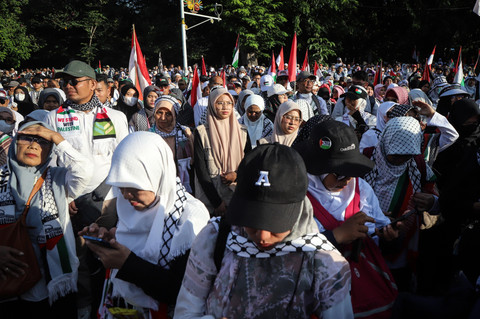

A coalition of Islamic organizations, known as the Majelis Ormas Islam, staged a significant demonstration in front of the United States Embassy in Central Jakarta on Sunday, April 5th. Titled “Millions of Prayers and Defense for Martyrs and Al-Aqsa Mosque,” the event underscored deep religious and national sentiments.
The peaceful protest commenced with a long march, starting from the iconic National Monument (Monas) and proceeding towards the US Embassy. Participants then collectively sang the Indonesian national anthem, “Indonesia Raya,” followed by a series of moving Islamic songs (nasyid).

A central part of the rally was a mass prayer session, including an absentee funeral prayer (salat gaib), held in solemn remembrance of Indonesian National Armed Forces (TNI) soldiers who tragically lost their lives in Lebanon following attacks attributed to Israel. Esteemed religious leader KH Nasir Zein led these profound prayers, fervently calling, “O Allah, destroy the Zionists, O Allah. O Allah, scatter them, O Allah.”
Following the emotional prayers, the demonstration continued with participants singing songs specifically chosen to express robust support for Palestinian independence, further cementing the rally’s dual focus on Al-Aqsa and global justice.

KH Nazar Haris, a prominent figure from the Union of Islamic Ummah (Persatuan Ummat Islam), articulated the core message of the gathering. He explained, “We are offering prayers not only for Al-Aqsa Mosque but also for the three Muslim Indonesian soldiers from the TNI who fell in Lebanon while on a mission for world peace.” Haris emphasized that pursuing peace is a fundamental mission for Muslims globally, stating, “And they fell; we pray that they become martyrs in the sight of Allah Subhanahu wa Ta’ala. Therefore, we are deeply empathetic.”
Concurring with this sentiment, Muhammad Faisol, Deputy Secretary of the Islamic Union (Persis), highlighted the gravity of the soldiers’ sacrifice. “This is not just about numbers; it’s about lives. And it’s about our nation’s dignity, which we must undoubtedly be aware of and care about,” Faisol asserted. He drew a poignant comparison, noting, “While our brothers and sisters in Gaza have often been the victims, now it is our own brothers and sisters who have become heroes.” This statement brought a stark focus on the direct impact on Indonesian military personnel.
The three heroic soldiers mourned at the rally were posthumously recognized as Major Zulmi Aditya Iskandar, Sergeant First Class Muhammad Nur Ichwan, and Corporal Farizal Rhomadhon. Their tragic deaths occurred in two separate incidents in Southern Lebanon. Corporal Farizal was killed on Sunday, March 29th, when an Israeli projectile exploded near his unit’s position in the vicinity of Adchit al-Qusayr village. The following day, Monday, March 30th, the United Nations confirmed the deaths of Sergeant First Class Ichwan and Major Zulmi. They were casualties of an explosion that struck a UNIFIL logistics convoy near Bani Hayyan. The bodies of all three brave servicemen arrived back in Indonesia on Saturday, April 4th, with military funerals honorably conducted the very next day.
Summary
A coalition of Islamic organizations, Majelis Ormas Islam, held a significant demonstration titled “Millions of Prayers and Defense for Martyrs and Al-Aqsa Mosque” in Central Jakarta on Sunday, April 5th. The event began with a march from Monas to the US Embassy and included patriotic songs. A central part was a mass absentee funeral prayer (salat gaib) for Indonesian National Armed Forces (TNI) soldiers who tragically died in Lebanon following attacks attributed to Israel.
Prominent figures like KH Nazar Haris emphasized that prayers were offered for both Al-Aqsa Mosque and the three fallen Indonesian soldiers, Major Zulmi Aditya Iskandar, Sergeant First Class Muhammad Nur Ichwan, and Corporal Farizal Rhomadhon, who were on a world peace mission. Their deaths occurred in two separate incidents in Southern Lebanon on March 29th and 30th. Muhammad Faisol highlighted the gravity of their sacrifice, underscoring its impact on national dignity and acknowledging them as heroes.
