
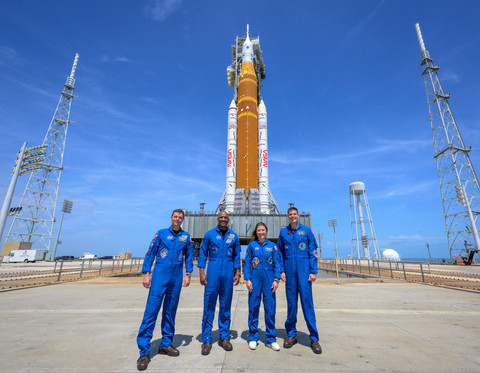

In a monumental stride for human space exploration, the United States’ space agency, NASA, successfully launched its powerful Space Launch System (SLS) rocket as part of the Artemis II mission. The historic liftoff occurred on Wednesday, April 1, 2026, at 6:20 PM Florida time, carrying four human crew members from Earth on a planned 10-day journey around the Moon.
The distinguished Artemis II crew comprises four highly skilled astronauts: Reid Wiseman, Victor Glover, Christina Koch, and Jeremy Hansen. These intrepid explorers are poised to make history as they embark on a mission that revives humanity’s quest to venture beyond Earth’s immediate orbit.
This mission marks the first time since 1972 that astronauts will journey near the Moon, signifying NASA’s most ambitious human spaceflight endeavor in over half a century. It is set to become the furthest human journey ever undertaken in space, propelling the crew approximately 406,000 kilometers from Earth.
Will the astronauts land on the Moon during Artemis II?
While the excitement around lunar exploration is palpable, it is important to clarify that the astronauts will not be landing on the Moon during the Artemis II mission. The primary objective of this crucial flight is to rigorously test whether the integrated components of the Artemis program are capable of safely sending astronauts to the Moon and successfully returning them to Earth. This mission focuses on validating critical systems and procedures in a deep-space environment.
During their 10-day odyssey, the astronauts will orbit the far side of the Moon, conducting a series of vital research agendas before heading back home to Earth. This extensive flight around the lunar orbit represents a significant leap forward, laying robust groundwork for the eventual return of a U.S. crew to the lunar surface. This milestone is strategically placed before China’s first planned crewed lunar landing, which is currently slated for 2030.
The SLS Rocket and Orion Capsule
The backbone of this pioneering program is the formidable, single-use Space Launch System (SLS) rocket, towering an impressive 98 meters tall. Integrated within this colossal launch vehicle is the Orion spacecraft capsule, engineered as the astronauts’ resilient living and working quarters for their journey toward lunar orbit.
The combined height of the rocket and its launch platform surpasses that of London’s iconic Big Ben clock tower, with a staggering total weight reaching approximately 5,000 tons. This ‘giant’ assembly was meticulously transported using the Crawler-Transporter-2, a tracked vehicle reminiscent of a tank, originally built by NASA in 1965 to move the mighty Saturn V rockets of the Apollo era.
Before its historic launch, this powerful rocket system completed its measured 6.4-kilometer journey from the immense Vehicle Assembly Building (VAB) to Pad 39B at the Kennedy Space Center in Florida, United States, a testament to the intricate logistics involved in human spaceflight.

The successful execution of the Artemis II mission is profoundly crucial for the future trajectory of space exploration. If all goes according to plan, this mission will decisively pave the way for subsequent crewed test flights, including Artemis III, which is scheduled for Earth orbit in 2027. Ultimately, it culminates in the ambitious Artemis IV mission in 2028, which targets the monumental goal of landing astronauts on the lunar surface once again.
Humanity’s last direct landing on the Moon took place during the Apollo 18 Mission in December 1972. That mission, led by Eugene Cernan, Harrison Schmitt, and Ronald Evans, brought the Apollo era to a close, notably collecting the largest quantity of lunar rock samples. Following 1972, lunar exploration by NASA was paused due to significant budget cuts and evolving political priorities within the U.S., setting the stage for the renewed efforts of the Artemis program to return humans to the Moon.
Summary
NASA successfully launched the powerful Space Launch System (SLS)
