
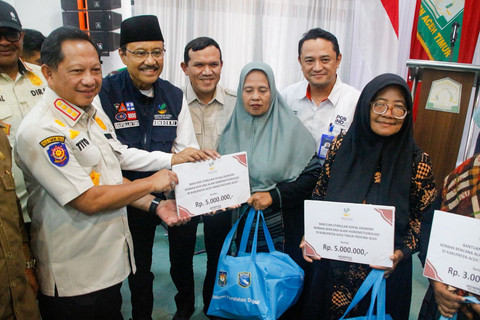

In a crucial move to bolster recovery efforts, the Sumatra Post-Disaster Rehabilitation and Reconstruction Acceleration Task Force (PRR Task Force) has been instrumental in deploying vital livelihood assistance (Jadup) to survivors grappling with the aftermath of devastating floods and landslides across Aceh, North Sumatra, and West Sumatra. This comprehensive support aims to ensure the sustained well-being of those affected by recent natural disasters.
As of March 29, daily reports from the PRR Task Force confirm that the distribution of Jadup has reached all three impacted provinces. Out of an initially planned allocation for 62,990 individuals, a significant 54,585 survivors have already received their rightful support, with the total disbursed funds amounting to an impressive Rp 272.726 billion. This widespread distribution underscores the government’s commitment to immediate and effective post-disaster aid.
A detailed breakdown of the distribution reveals varying levels of need and reach across the regions. Aceh recorded the highest realization, with financial aid extended to 42,540 individuals, totaling Rp 203.696 billion. North Sumatra saw assistance reaching 10,235 individuals, with funds totaling Rp 53.759 billion. Meanwhile, West Sumatra provided support to 1,794 individuals, disbursing a total of Rp 15.044 billion to assist their recovery.
The Jadup distribution scheme provides essential relief at a rate of Rp 15,000 per person per day, extended over a crucial three-month period. This critical livelihood assistance is meticulously managed, beginning with data validation by local governments to ensure accuracy and targeted support. Following validation, the aid is efficiently disbursed through PT Pos Indonesia, guaranteeing its timely delivery to those in need.
More than just monetary support, Jadup serves as a fundamental lifeline, explicitly designed to secure the ongoing existence and dignity of disaster survivors. This strategic initiative goes beyond repairing physical infrastructure; it is specifically engineered to restore the purchasing power of communities, which is often severely crippled by natural calamities. By doing so, the Task Force aims for a holistic recovery that addresses both immediate needs and long-term economic stability.
This massive distribution of Jadup is not an isolated effort; it runs parallel with the extensive rollout of Socio-Economic Stimulant Assistance (BSSE) and Housing Contents Assistance (BIH). Together, these combined initiatives have already reached 35,780 disaster survivors, with total funds amounting to Rp 107.340 billion. Such integrated government support highlights a multi-faceted approach to comprehensive community recovery in Sumatra.
Furthermore, the PRR Task Force has also extended crucial Housing Waiting Fund (DTH) support for disaster survivors who opt not to reside in temporary shelters. This DTH provides Rp 600,000 per month over a three-month period, ensuring each eligible household receives a total of Rp 1.8 million. This offers flexibility and empowers survivors to choose suitable living arrangements as they rebuild their lives.
Remarkably, the disbursement of DTH has achieved a 100 percent success rate, with funds transferred to all 14,021 registered recipients across the three provinces. This includes 8,099 recipients in Aceh, 4,162 in North Sumatra, and 1,760 in West Sumatra, demonstrating efficient and equitable aid delivery to every eligible household.
During a recent visit to disaster survivors in South Tapanuli, Muhammad Tito Karnavian, Head of the Sumatra Post-Disaster Rehabilitation and Reconstruction Acceleration Task Force, underscored a critical factor: the swiftness of disbursing various forms of financial aid, including Jadup, household furniture assistance, economic stimulants, and DTH, hinges entirely on the speed and thoroughness of data collection by local governments.
Consequently, Tito urged regional heads in the affected areas to prioritize and expedite the collection and completion of disaster survivor data. This crucial step is vital to ensure that targeted and effective assistance can be distributed without unnecessary delays, reaching those who need it most promptly.
“The faster we receive the data, the faster BPS (Central Statistics Agency) can conduct field verification, and consequently, the faster BNPB (National Disaster Management Agency) can act,” Tito emphasized during the Stage One Key Handover ceremony for 120 Permanent Housing Units for Disaster Victims in South Tapanuli, North Sumatra, on Friday, March 27, 2026. This statement powerfully encapsulates the urgent need for seamless collaboration to accelerate disaster relief efforts.
Summary
The Sumatra Post-Disaster Rehabilitation and Reconstruction Acceleration Task Force (PRR Task Force) has significantly increased the distribution of vital livelihood assistance (Jadup) to survivors of floods and landslides across Aceh, North Sumatra, and West Sumatra. As of March 29, 54,585 individuals have received a total of Rp 272.726 billion, aimed at securing their existence, dignity, and restoring purchasing power. This crucial aid, provided at Rp 15,000 per person per day for three months, is efficiently disbursed through PT Pos Indonesia following local government data validation.
In addition to Jadup, comprehensive government support includes Socio-Economic Stimulant Assistance and Housing Contents Assistance, reaching 35,780 survivors with Rp 107.340 billion. The Task Force also achieved 100% disbursement of the Housing Waiting Fund (DTH) to 14,021 eligible households, offering Rp 1.8 million for those not in temporary shelters. Muhammad Tito Karnavian, Head of the PRR Task Force, stressed that the swift delivery of all financial aid critically depends on rapid and accurate data collection by local governments, urging regional heads to prioritize this step.
