
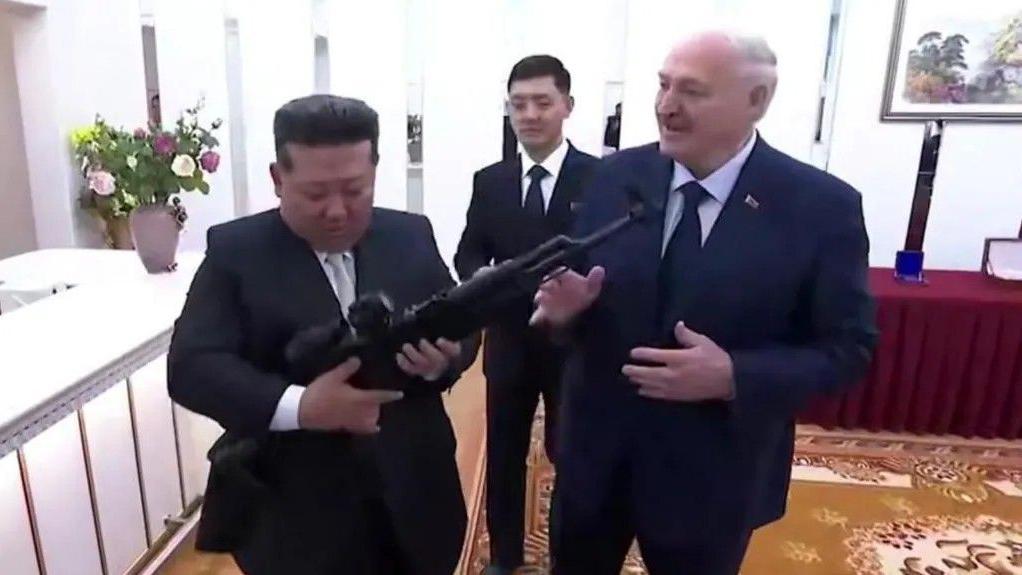

In a significant diplomatic gesture, Belarusian President Alexander Lukashenko presented a rifle to North Korean leader Kim Jong Un during a signing ceremony for a friendship agreement in Pyongyang, according to state media reports. The leaders, both staunch supporters of Russia’s war in Ukraine, solidified their commitment to closer cooperation and a unified rejection of pressure from Western nations.
A video released by Belarusian state media captured Lukashenko lightheartedly telling Kim that he was bringing an automatic rifle, quipping, “this is just in case the enemy comes.” This exchange underscores the strong anti-Western sentiment shared by both regimes, setting a notable tone for their burgeoning alliance.
In a reciprocal gesture, Kim Jong Un presented Lukashenko with a sword and a vase adorned with a portrait of the Belarusian leader. The exchange of gifts further highlighted the deepening personal and political ties between the two nations, which are increasingly isolated on the international stage.
As reported by the Belarusian news agency Belta, Lukashenko conveyed a message of optimism to Kim, stating, “I can tell you as a friend, as someone who has seen much in this world: a bright future awaits your country, with its hardworking and disciplined people.” This affirmation reinforces the perceived strength and resilience of North Korea under Kim’s leadership.
Lukashenko further articulated the rationale behind their alliance, emphasizing that when “the norms of international law are openly ignored and violated by powerful forces,” countries must unite to “protect their sovereignty and improve the welfare of their citizens.” This statement frames their cooperation as a necessary defense against perceived global injustices.
Both leaders expressed strong support for the newly inked pact. Lukashenko described the friendship agreement as “fundamental,” while Kim affirmed that it would “further guarantee the stability of bilateral relations,” as noted by Belta. This agreement is expected to lay the groundwork for expanded collaboration between the two nations.

Beyond diplomatic declarations, the leaders also pledged cooperation across a wide array of sectors, ranging from agriculture and information sharing to public health, according to North Korea’s state news agency KCNA. This broad scope indicates an intent to foster comprehensive bilateral engagement, bypassing the global sanctions framework.
Both North Korea and Belarus are currently subjected to extensive Western sanctions due to alleged human rights violations and their pivotal support for Russia’s war in Ukraine. Pyongyang faces additional, separate sanctions specifically targeting its illicit nuclear weapons program, which has long been a source of international concern.
Reports suggest that Pyongyang has also sent troops to bolster Russia’s military campaign. Western officials informed the BBC last year that an estimated 1,000 North Korean soldiers were killed within the initial months of the Russia-Ukraine conflict, underscoring the tangible support provided to Moscow.
This week, Kim Jong Un further solidified his allegiance to Moscow in a message to Vladimir Putin, stating that “Pyongyang will always be with Moscow,” according to North Korea’s KCNA. This reiteration of support highlights the strategic alignment of these nations against a backdrop of increasing geopolitical tensions.
Previously, Ukraine has accused Russia of utilizing Belarusian territory as a military base to launch attacks, implicating Belarus directly in the ongoing conflict. This history adds another layer to the strategic partnership being forged between Pyongyang and Minsk.
- Is Kim Jong Un worried about North Korea’s future due to the Iran vs. US-Israel war?
- Who is Kim Jong Un’s daughter, the powerful successor to North Korea’s rule?
- Trump and Kim Jong Un still seem to want to get along – What’s the reason?
- North Korean regime increasingly executes citizens who watch foreign films
Summary
Belarusian President Alexander Lukashenko presented a rifle to North Korean
