
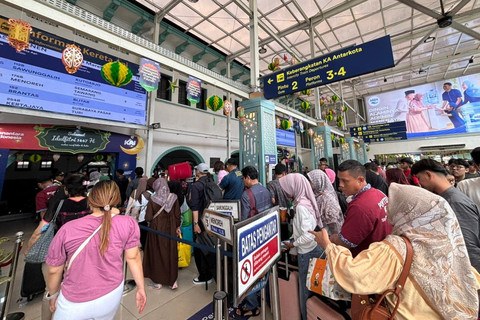

PT Kereta Api Indonesia (Persero), widely known as KAI, has reported a significant surge in Lebaran 2026 train ticket sales, especially as the crucial return journey period commences. This robust increase highlights growing public confidence in rail transportation, particularly for long-distance services.
As of March 24, 2026, at 10:00 AM Western Indonesia Time (WIB), KAI had successfully sold 4,195,627 tickets. This impressive figure accounts for 93.3 percent of the total 4,498,696 seats made available for the entire Lebaran travel period, spanning from March 11 to April 1, 2026.
Anne Purba, Vice President of Corporate Communication at KAI, underscored that this escalating sales trend is a clear indicator of strengthening public trust in KAI’s services. “The trend of rail travel has been continuously rising since mid-March and is now entering the peak return flow phase. Passengers are choosing trains for their enhanced comfort and reliable scheduling,” Anne stated in a written release on Tuesday, March 24.
Breaking down the sales figures, long-distance train tickets have already reached 3,616,273, remarkably exceeding 100 percent occupancy at 101.2 percent of the 3,571,760 provided seats. Meanwhile, local train ticket sales stood at 579,354, representing 62.5 percent of their total 926,936 available seats. Anne also noted that seat availability remains fluid, largely due to dynamic customer travel patterns where passengers do not always occupy a seat for the entire route from the initial to the final station.
Throughout the Lebaran transport period from March 11 to March 23, 2026, KAI efficiently served a total of 2,820,174 passengers across Java and Sumatra. This comprises 2,378,680 long-distance train customers and an additional 441,494 local train users, demonstrating the vast scale of operations during this peak travel season.
This heightened demand is clearly reflected in the daily volume and occupancy rates for long-distance trains, which have seen a steady climb. On March 22, KAI registered 242,773 passengers with an occupancy rate of 150.7 percent. This figure further escalated on March 23, reaching 246,987 passengers with an impressive 154.1 percent occupancy.
Occupancy Exceeds 100 Percent
Entering March 24, 2026, KAI recorded exceptionally high passenger movements. By morning, at least 225,193 long-distance train passengers were scheduled for departure, with a provisional occupancy rate of 137.8 percent, a number expected to rise further. Anne explained that this sustained high volume is also influenced by travel patterns where many individuals commence their return journey after observing Eid al-Fitr prayers in their temporary residences, ensuring elevated travel volumes during the return period. The phenomenon of occupancy rates exceeding 100 percent stems from the dynamic nature of passenger journeys within a single train set.
“In a single long-distance train journey, one seat can be utilized by more than one passenger for different route segments. This operational scheme allows for a greater number of passengers to be served compared to the total number of physical seats available,” Anne clarified, highlighting KAI’s efficient utilization of its capacity.
Amidst this soaring demand, several trains have experienced particularly high booking levels during the Lebaran 2026 period. These include popular services such as KA Airlangga, KA Joglosemarkerto, KA Sri Tanjung, KA Bengawan, KA Kahuripan, KA Rajabasa, and KA Jayakarta.
Despite the high demand, prospective travelers still have opportunities to secure return tickets. KAI advises passengers to explore alternative routes, consider different departure schedules, or utilize connecting train services. Furthermore, customers are encouraged to leverage KAI’s connecting train facilities and opt for more flexible travel dates to increase their chances of securing a seat.
Below is the daily trend of long-distance train passengers during the period of March 11–23, 2026:
• 11 March: 101,617 passengers (63.7 percent)
• 12 March: 126,208 passengers (79.2 percent)
• 13 March: 165,675 passengers (101.4 percent)
• 14 March: 185,873 passengers (113.7 percent)
• 15 March: 180,836 passengers (110.6 percent)
• 16 March: 173,753 passengers (106.3 percent)
• 17 March: 191,413 passengers (117.1 percent)
• 18 March: 205,842 passengers (125.9 percent)
• 19 March: 196,324 passengers (120.1 percent)
• 20 March: 167,659 passengers (104.6 percent)
• 21 March: 193,583 passengers (120.2 percent)
• 22 March: 242,773 passengers (150.7 percent)
• 23 March: 246,987 passengers (154.1 percent)
Summary
PT Kereta Api Indonesia (KAI) reported a significant surge in Lebaran 2026 train ticket sales, with 93.3 percent of the total 4,498,696 seats sold as of March 24, 2026. Long-distance train tickets notably surpassed 100 percent occupancy, reaching 101.2 percent, attributed to a dynamic operational scheme where a single seat can be utilized by multiple passengers across different route segments. This robust demand highlights increasing public confidence in KAI’s services during the Lebaran travel period from March 11 to April 1.
During March 11-23, KAI efficiently served over 2.8 million passengers, with long-distance train daily occupancy peaking at 154.1 percent with 246,987 passengers on March 23. Popular services like KA Airlangga and KA Jayakarta experienced particularly high booking levels. KAI encourages travelers still seeking tickets to explore alternative routes, different departure schedules, or connecting train services for available seats.
