
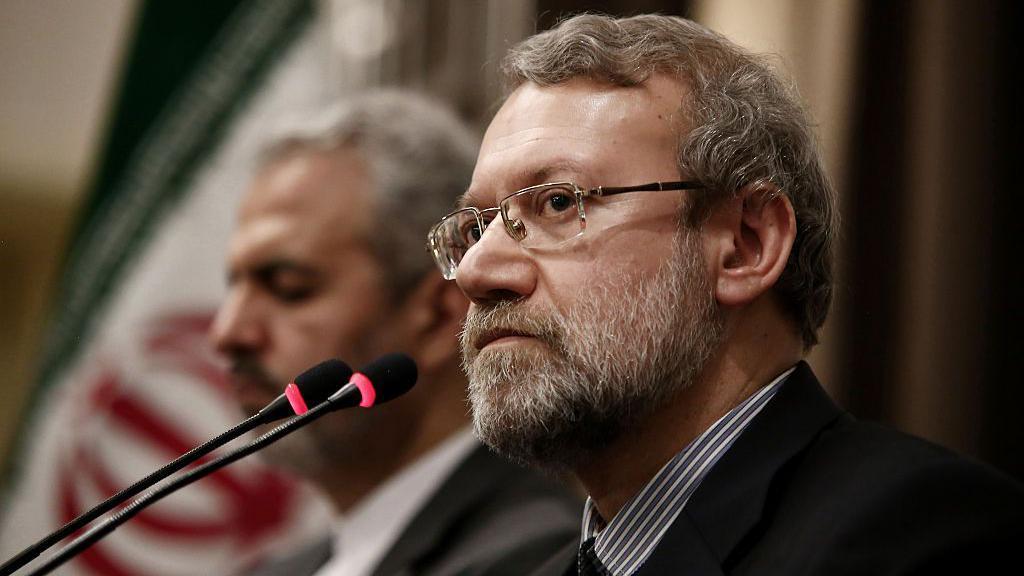

The recent Israeli airstrike, which tragically claimed the life of Iran’s security chief, Ali Larijani, has removed one of the Islamic Republic’s most influential and seasoned strategic policymakers.
Though not a military commander, Larijani was nonetheless a pivotal figure, instrumental in shaping Iran’s strategic decisions and national direction.
Serving as the Secretary of the Supreme National Security Council (SNSC), he stood at the very nexus of critical decision-making concerning war, diplomacy, and overarching national security policies.
His counsel carried significant weight across Iran’s intricate power structure, particularly when navigating the complex and often contentious confrontations with the United States and Israel.
In the aftermath of the Supreme Leader Ali Khamenei’s assassination on February 28, 2026, Larijani adopted a defiantly resolute stance, signaling Iran’s readiness for a protracted and challenging conflict.
Larijani’s demise, officially confirmed by Iranian state media, tragically occurred amid a series of escalating attacks that have claimed the lives of numerous senior Iranian officials and commanders within a mere span of weeks.
This disturbing pattern strongly suggests a concerted and ongoing effort to systematically dismantle and weaken Iran’s leadership infrastructure during this volatile period of war.
While widely perceived as a hardliner in his dealings with the West, Larijani was frequently described as a pragmatist within domestic political circles.
His political philosophy deftly blended unwavering ideological loyalty with a pragmatic, technocratic approach, consistently prioritizing measured and actionable strategies over mere rhetorical flourish.
Despite his profound skepticism regarding Iran’s engagement with Western nations, he played an integral role in several pivotal diplomatic endeavors, notably serving as an envoy for Iran’s significant long-term cooperation agreement with China.
Who Was Ali Larijani?
Ali Larijani held the critical position of Secretary of Iran’s Supreme National Security Council (SNSC).
President Masoud Pezeshkian had appointed him to this influential SNSC secretary role in August 2025.
Furthermore, Larijani was sworn in as the esteemed representative of the late Supreme Leader of Iran, Ayatollah Ali Khamenei, within the very same council.
Iranian media outlets also frequently portrayed Larijani as a trusted advisor to the revered late supreme leader.
His extensive political career included a notable 12-year tenure as the Speaker of Iran’s parliament, from May 2008 until May 2020.
While he initially led the principlist faction in parliament between 2008 and 2012, in more recent years, he had increasingly been characterized as a ‘moderate conservative,’ reflecting his evolving political approach.
Prior to his role as parliamentary speaker, Larijani distinguished himself as Iran’s chief nuclear negotiator, a critical position he held from 2005 to 2007.
His brother, Sadegh Larijani, also remains a highly influential figure within the Islamic Republic.
He currently chairs the Expediency Discernment Council, Iran’s supreme arbitration body, which serves as the final arbiter in disputes arising between the parliament and the constitutional oversight body, the Guardian Council.
What Three Major Crises Confront Larijani’s Successor?
At the moment of his untimely death, Ali Larijani was deeply engrossed in navigating three profound and escalating crises.
The foremost crisis was the ongoing war itself. Larijani firmly advocated for Iran to prepare for a protracted struggle, potentially escalating the conflict across the entire region and even beyond, controversially suggesting the closure of the Strait of Hormuz.
The second major challenge involved a burgeoning wave of domestic unrest. These disturbances, initially sparked by economic grievances, rapidly mutated into widespread protests explicitly demanding the overthrow of the Islamic Republic.
In response, the government unleashed a brutal crackdown, tragically resulting in the deaths of thousands of protesters nationwide.
The third critical crisis revolved around Iran’s ambitious nuclear program and the stalled indirect negotiations with Washington. Both these sensitive issues were further complicated and disrupted by a series of US-Israeli military attacks.
Larijani’s sudden death leaves these multifaceted issues dangerously unresolved, bequeathing them to an as-yet-unknown successor who will inherit an extraordinarily precarious and volatile situation.
While Iran has demonstrated a degree of resilience, partly by significantly unsettling global energy markets, its sovereign airspace remains alarmingly vulnerable to ongoing and successive attacks.
Consequently, any newly appointed senior official will confront the immediate and ominous risk of becoming a direct target for further US-Israeli military strikes.
Will Iran’s Military Play a Larger Role After Larijani’s Death?

Larijani’s assassination could significantly accelerate a shift of power, further consolidating influence within Iran’s military apparatus.
Recent statements from President Masoud Pezeshkian suggest that units of the armed forces have essentially been granted broad, decisive authority to act should the senior leadership be rendered incapable of fulfilling its critical duties.
In practical terms, this delegation of authority could translate into swifter decision-making, albeit potentially at the expense of robust central coordination and strategic coherence.
Adding to the mounting concerns, there are discernible signs that Iran’s leadership is grappling with significant challenges in managing the delicate succession process.
The delay in public announcements and the deliberate shielding of several key figures from the spotlight—including the newly appointed Supreme Leader, Mojtaba Khamenei—underscore this internal struggle.
The reasons for this opacity remain unclear, possibly stemming from heightened security concerns or profound internal uncertainty within the ruling elite.
In the immediate short term, the unfolding situation is likely to be characterized by heightened instability: a more aggressive military posture on the battlefield, coupled with even stricter repressive measures enacted domestically.
Over a more extended period, however, a governing system that persistently loses its senior officials could face increasing difficulty in functioning effectively, particularly in a nation of over 90 million people grappling with complex challenges.
The profound impact of Larijani’s death, therefore, extends far beyond the mere loss of a single official.
This tragic event deepens an already brewing leadership crisis, threatening to critically influence not only the trajectory of the ongoing war but also the fundamental stability of the Iranian state itself.
- ‘This is not our war’ – Germany, Spain, and other nations refuse to send warships to the Strait of Hormuz
- Why did the US attack Iran’s Kharg Island?
- US Marine forces and additional warships moved to the Middle East
- What is the US-Israel objective in attacking Iran?
- Will Gulf states retaliate against Iranian attacks and be drawn into the war?
- Iran’s specific strategy against US-Israel
More on the Iran war
- First speech: New Iranian Leader Mojtaba Khamenei vows to close the Strait of Hormuz
- Who is Mojtaba Khamenei, Iran’s new Supreme Leader?
- Ayatollah Ali Khamenei passes away: Who is his successor and what might happen next?
Summary
Ali Larijani, kepala keamanan dan pembuat kebijakan strategis Iran yang sangat berpengaruh, meninggal dunia dalam serangan udara Israel baru-baru ini. Sebagai Sekretaris Dewan Keamanan Nasional Tertinggi (SNSC), ia merupakan tokoh sentral dalam keputusan krusial terkait perang, diplomasi, dan keamanan nasional, terutama dalam konfrontasi dengan Amerika Serikat dan Israel. Larijani, yang dipandang sebagai garis keras terhadap Barat tetapi pragmatis di dalam negeri, baru-baru ini mengisyaratkan kesiapan Iran untuk konflik berkepanjangan. Kematiannya terjadi di tengah serangkaian serangan terhadap pejabat Iran, menunjukkan upaya untuk melemahkan infrastruktur kepemimpinan negara tersebut.
Pengganti Larijani akan mewarisi tiga krisis besar: perang yang sedang berlangsung yang ia advokasi untuk eskalasi, gejolak domestik yang luas menuntut penggulingan pemerintah, dan negosiasi nuklir yang terhenti akibat serangan militer. Pembunuhannya dapat mempercepat pergeseran kekuasaan menuju militer Iran, yang berpotensi mengarah pada pengambilan keputusan yang lebih cepat tetapi kurang terkoordinasi. Peristiwa tragis ini memperdalam krisis kepemimpinan yang sudah ada, mengancam untuk sangat memengaruhi lintasan perang dan stabilitas fundamental negara Iran.
