
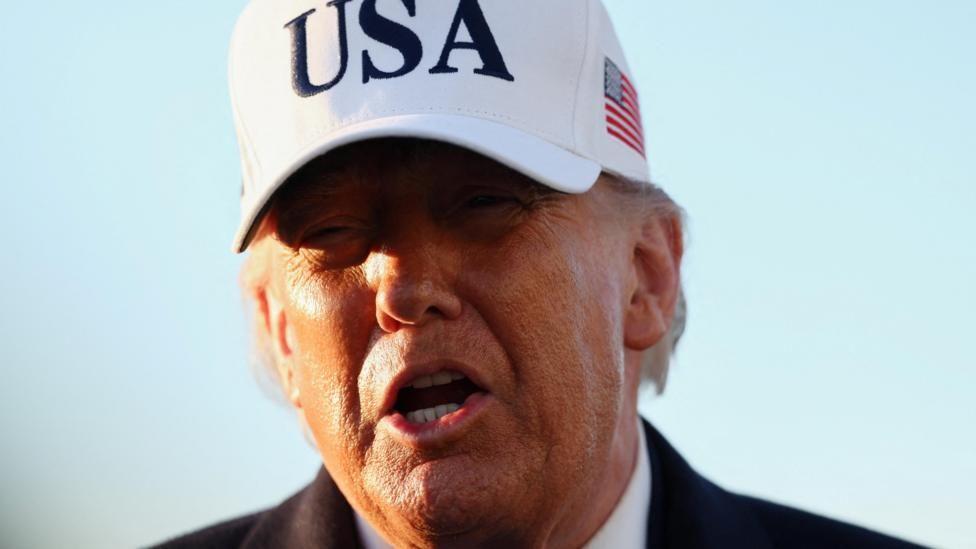

Former U.S. President Donald Trump has issued a fervent appeal to allied nations, urging them to deploy warships to the Strait of Hormuz. His call aims to safeguard commercial vessels and re-establish the critical global oil supply, yet it has been met with significant resistance and outright rejections from key international partners.
On Saturday, March 14, Trump took to his Truth Social platform to press his demand. In a series of posts, he implored the United Kingdom, China, France, Japan, South Korea, and other nations to unite in a “joint effort” to reopen the vital sea lane, emphasizing the urgency of the situation for global trade.
Trump reiterated his plea later that Saturday evening, specifically addressing “countries worldwide that receive oil supplies through the Strait of Hormuz.” He assured these nations that the United States would provide “much” support to any willing participants in this crucial maritime security initiative.
Further intensifying his stance, Trump underscored his warning in an interview with the Financial Times, published on Sunday, March 15. He declared that a failure to guarantee maritime transport security would “severely damage the future of NATO,” directly linking the regional crisis to the core integrity of the transatlantic alliance.
The Strait of Hormuz, a strategic choke point, has been closed by Tehran in direct retaliation for recent US and Israeli air strikes. This closure has delivered a substantial blow to the global energy sector and international commerce, triggering widespread concern among economic and political leaders.
Regarded as the world’s busiest oil shipping route, approximately 20% of global oil supplies typically traverse the Strait of Hormuz. Its unprecedented closure has precipitated one of the largest supply disruptions in history, leading to a dramatic surge in crude oil prices worldwide and threatening economic stability.

The pressing question now remains: will these allied nations commit their naval assets to escort merchant fleets through this critical waterway, or will they continue to resist direct involvement in the ongoing US-Iran tensions?
The responses have been largely unequivocal. The United Kingdom, Germany, Australia, Spain, and Japan are prominent among the nations that have explicitly stated their unwillingness to deploy vessels in what they perceive as a burgeoning conflict against Iran.
During a press conference at Downing Street on Monday, March 16, UK Prime Minister Keir Starmer firmly asserted that his country would not “get involved in a wider war” in Iran. This statement clearly signaled London’s intent to avoid deepening military engagement in the volatile region.
Starmer elaborated that the UK was indeed “working with allies” to formulate a viable strategy for reopening the Strait of Hormuz. However, he emphatically stressed that this critical mission was not, and would not be, part of a formal NATO operation, distancing the alliance from direct military intervention.
‘This Is Not Our War’
Germany’s Defense Minister, Boris Pistorius, delivered an unreserved rejection of Trump’s plea for naval assistance. His remarks underlined a profound skepticism regarding the proposed European involvement.
“What does Trump expect from a handful of European frigates that the mighty US Navy cannot do?” Pistorius retorted, highlighting the perceived disparity in military capabilities. He then added, with sharp clarity, “This is not our war. We did not start it,” firmly dissociating Germany from the escalating conflict.
Echoing this sentiment, Friedrich Merz, spokesperson for the German Chancellor, declared that any war against Iran “has nothing to do with NATO” and unequivocally labeled it “not a NATO war.” This position solidified Germany’s stance against alliance involvement.
Merz swiftly closed the door on any potential German military engagement, making the nation’s position abundantly clear.
At a press conference in Berlin, Merz elaborated on Germany’s constitutional requirements for military action: “We have no mandate from the UN, the EU, or NATO, as required by the Constitution. Therefore, it was clear from the outset that this war is not NATO‘s business.” This emphasized a legal and procedural barrier to participation.
He further revealed that neither the United States nor Israel had consulted Germany prior to launching their military operations, underscoring a lack of pre-emptive diplomatic engagement with a key ally.
Merz concluded with finality: “Therefore, the question of how Germany could be militarily involved in this conflict was never even considered,” firmly shutting down any speculation of German deployment.
In Madrid, the Spanish government made its non-participation in military operations in the Strait of Hormuz unequivocally clear. Defence Minister Margarita Robles and Foreign Minister José Manuel Albares jointly announced on Monday, March 16, that Spain considered the US-Israel war against Iran to be an illegal act.
Robles directly rebuffed former President Trump’s request for Spanish military support to secure the vital waterway, which Tehran had de facto closed to oil tankers. She also dismissed Trump’s ominous threat of a “very bad future” for NATO allies who refused to join the effort, signaling Spain’s disregard for such pressure tactics.
“Spain will never accept a patchwork solution, because the main goal must be to end the war, and to end it now,” Robles asserted, emphasizing a commitment to de-escalation rather than military intervention.
Foreign Minister José Manuel Albares augmented this perspective, acknowledging the serious concern the situation in the Strait of Hormuz posed for Europe. However, he maintained that the European Union’s stance must be resolute: the conflict must be halted immediately, irrespective of economic considerations.
Albares concluded, “We must not do anything that would add to tensions or worsen the escalation,” advocating for diplomatic solutions over military confrontation in the volatile region.

In Japan, Defence Minister Shinjiro Koizumi informed parliament on Monday, March 16, that “seeing the current situation with Iran, we are currently not considering launching maritime security operations.” This statement aligned Japan with other nations opting out of direct military involvement.
Similarly, Australia’s Minister for Infrastructure and Transport, Catherine King, confirmed in an interview with ABC on Monday, March 16, that her country would not be dispatching warships to the Strait of Hormuz, reinforcing the widespread reluctance among allies.
Meanwhile, China’s Embassy spokesperson in Washington refrained from confirming whether Beijing would accept Trump’s request. Instead, the spokesperson underscored the collective responsibility of all parties to ensure a stable and unhindered global energy supply, subtly deflecting from direct military commitment.
In South Korea, the presidential office indicated a more cautious approach, stating that the nation would “maintain close communication with the United States regarding this matter and make a decision after careful study.” This suggests an openness to discussion but no immediate commitment to military action.
Conversely, Iranian Foreign Minister Abbas Araghchi firmly asserted that Tehran was neither seeking a ceasefire nor engaging in message exchanges with Washington. He reiterated that the Strait of Hormuz would remain closed “for our enemies,” signaling Iran’s defiant stance amidst the international pressure.
Araghchi further clarified Iran’s position: “They (Americans) are asking other countries to come help keep the Strait of Hormuz open… from our point of view, the channel is open.” This statement highlighted a stark divergence in perceptions regarding the accessibility of the vital waterway.
He concluded with a clear warning: “The Strait is only closed to our enemies, those who commit unjust aggression against our country and its allies,” underscoring Iran’s readiness to defend its strategic interests against perceived adversaries.
An Ironic Stance on NATO’s Future
According to BBC diplomatic correspondent Paul Adams, “during his two terms, Donald Trump did not hesitate to criticize—even attack—NATO member states.” This established a historical context for the current tensions surrounding his recent demands.
Adams suggested that Trump’s latest declaration—that a failure to secure the Strait of Hormuz would “severely damage the future of NATO“—carries a particular interpretation of the alliance’s fundamental purpose, one that potentially conflicts with its founding principles.
General Nick Carter, former UK Chief of Defence Staff, articulated this point to the BBC on Monday, March 16. “NATO was formed as a defensive alliance,” he stated. “It is not an alliance designed for one of its members to wage war on its own initiative and force everyone to participate,” adding, “I don’t think that’s the kind of NATO we want to be part of.” This critique from a senior military figure further undermined Trump’s rationale.
Adams also drew attention to the inherent irony of Trump’s statement, given his insistence just two months prior on claiming Greenland, a sovereign territory belonging to a NATO member. This perceived hypocrisy, Adams noted, “might explain why some responses sounded so blunt,” implying a direct correlation between Trump’s past actions and the allies’ unyielding rejections.
From the White House on Monday, Trump offered another perspective on his request for assistance in the Strait of Hormuz. He asserted, “not because we need it, but because I want to see how they react,” suggesting a test of loyalty or resolve rather than an actual operational requirement.
He reiterated his long-standing grievance: that the United States has consistently protected other nations, yet they have failed to reciprocate that protection when America most needed it, fueling a narrative of unequal burden-sharing within the alliances.

- Why Did the US Attack Iran’s Kharg Island?
- US Marines and Additional Warships Deployed to the Middle East
- ‘Nowhere to Hide on the Ship’ – The Ordeal of Crew Members Trapped in the Waters of the Strait of Hormuz
- US-Israel Conflict with Iran Threatens Global Food, Pharma, and Mining Sectors – Indonesian Nickel Production Disrupted
- Which Countries Stand to Benefit from the Middle East Conflict – and Which Face the Heaviest Impact?
- Dozens of Nations Release Largest Oil Reserves in History Amid Cargo Ship Attacks in the Strait of Hormuz
Summary
Former US President Donald Trump called on allied nations to
